The Monarch of Venom – King Cobra

As I’m sure all of you know, the king cobra (Ophiophagus hannah) is a very dangerous and venomous snake. It is a member of Elapidae so its fangs are fixed instead of hinged like a viper’s. This means they do not fold down when the snake’s mouth is closed. Also unlike viper fangs, an elapid’s fangs are relatively short. This does not mean that any less venom can be injected, however, and has no impact on the snake’s ability to do serious damage. The venom of a king cobra is some of the most powerful in the snake world. One bite can deliver as much as two tenths of an ounce of venom and is enough to kill twenty adult humans or one adult elephant. The venom contains a mixture of neurotoxins and cardiotoxins. Once bitten, a person may feel extreme pain, become dizzy with blurred vision, experience paralysis, cardiovascular collapse, coma, and then respiratory failure. Death can come within half an hour for an untreated bite victim. Fortunately, there are two kinds of antivenom that have been created solely for king cobra bites.

King Cobra

But venom isn’t everything about the king. This snake also happens to hold the record for being the longest venomous snake in the world at up to eighteen feet. Another interesting thing is the fact that, despite being the most famous cobra and often the first snake that comes to mind when that word is said, it is not actually a “true cobra”. True cobras belong to the genus, Naja, while the king cobra is in its own separate genus, Ophiophagus, which is Greek for “snake eater”. That part of the name doesn’t lie. King cobras do in fact eat other snakes almost exclusively, the favorite being ratsnakes. It will also eat pythons, and other venomous snakes such as true cobras and kraits. When snake prey is scarce, it will hunt birds, lizards, rodents, and other mammals instead. The king cobra is found throughout South and South-East Asia in higher elevation forests. It has no problems pursuing prey into the trees or water, as it is an excellent swimmer and climber. It even prefers to live in areas that have access to several bodies of water.

48297923106_45dbd5b057_c
As fearsome as they appear, king cobras are actually quite shy and reclusive, much preferring to flee if they have a choice. If this is not possible, however, they will first try to ward off a threat by raising up and displaying their hood. They may even feign striking while keeping their mouth closed. A king cobra’s hiss is also another effective defense tactic. Unlike the higher frequency hisses of most snakes, the king’s hiss is low and almost like a growl. If all this fails then the snake will strike to harm. It can do this even while raised high off the ground and moving forward. King cobras have a very large striking range and it is easy to misjudge the distance they can reach and accidentally get caught in the danger zone. While adult cobras would rather not waste their venom on defense, it’s a different story for the babies. Their bites are every bit as toxic as adult bites and they are much more nervous and aggressive since they are so small and vulnerable.

6411226005_6ee68374b1_c

Eating another snake

King cobras are very good parents, which is fairly unusual for most snakes. The female will make a nest for her eggs on the ground and vigilantly guard them and incubate them until they are ready to hatch. She usually lays between twenty and forty eggs and stays with them for up to ninety days. When the babies finally hatch, the mother leaves by instinct to go hunt so she doesn’t eat the hatchlings. Baby king cobras are a little less than two feet long and are more vibrantly patterned and colored than adult cobras.

Babies!

Hopefully you now know a little bit more about the king cobra than the average person, and hopefully you enjoyed learning about it. It’s definitely an animal to be understood and respected deeper than just its widely feared surface.

References:
“King Cobras.” National Geographic. National Geographic Society, n.d. Web. 23 June 2015. http://animals.nationalgeographic.com/animals/reptiles/king-cobra/

2. Reid, H. Alistair. “Snakebite in the tropics.” BMJ 3.5614 (1968): 359-362.

3. “King Cobra (Ophiophagus Hannah).” Toxicology. University of California, San Diego, n.d. Web. 23 June 2015. <http://toxicology.ucsd.edu/Snakebite%20Protocols/Ophiopha.htm&gt;.

4. Young, Diana. “Ophiophagus Hannah (Hamadryad, King Cobra).” Animal Diversity Web. University of Michigan Museum of Zoology, 7 June 1999. Web. 23 June 2015. <http://animaldiversity.org/accounts/Ophiophagus_hannah/&gt;.

5. O’Shea, Mark. Venomous Snakes of the World. Princeton: Princeton UP, 2011. 97. Print.

6. Smith, Grant. “The Ultimate Cobra Snake Facts Guide.” Cape Snake Conservation. Cape Snake Conservation, 08 Apr. 2013. Web. 23 June 2015. <http://www.capesnakeconservation.com/the-ultimate-cobra-snake-facts-guide/&gt;.

Photo Links:
1. https://flic.kr/p/aWPEic

2. https://flic.kr/p/2gzVtSb

3. https://flic.kr/p/aLxd8p

4. https://i.pinimg.com/originals/20/a7/6d/20a76dc85f0b018ecb1f993cd8e42d3f.jpg

Saving A Serpent – Mangshan Pit Viper

The only places in the world you can find the Mangshan pit viper (Protobothrops mangshanensis) are Mt. Mang and the Hunan and Guangdong Provinces of China. It is currently listed as an endangered species by the International Union for Conservation of Nature and Natural Resources (IUCN) because of its restricted range in combination with deforestation and human encroachment into its habitat. There is also a demand for it in the illegal pet trade business because of the stunningly gorgeous colors and patterns on its scales and its lovely green eyes. Fortunately, there are populations present in the Mangshan Natural Nature Reserve and captive breeding has been going on in several countries with fair success since 1994. 100 snakes have been bred as of 2010.

Closeup of the beautiful scales

The Mangshan pit viper lives in mountainous, mixed pine and broad leaf forests in leaf litter, rotting wood, and caves. It typically reaches lengths of 5-7 feet and is a particularly heavy snake, getting up to about 11 pounds or so. This pit viper preys on frogs, rodents, birds, and insects. The tip of its tale is a pale, greenish white and is used to lure in the animals it hunts by mimicking a caterpillar or worm. The snake hides the rest of its body from sight and sticks up its tail, which is wriggled back and forth. When prey comes close enough, it strikes and injects a mix of hemotoxic and myotoxic venom with its 0.8 inch long fangs. Hemotoxin prevents blood coagulation and leads to hemorrhaging while myotoxin causes muscle paralysis and necrosis. Most vipers deliver large amounts of venom in a bite and this snake is no exception. Up to 960 milligrams can be injected by a single fang. As with all pit vipers, the Mangshan pit viper possesses small, temperature sensitive pits beneath its eyes that help it locate prey.
800px-Chřestýšovec_mangšanský_zoo_praha_2

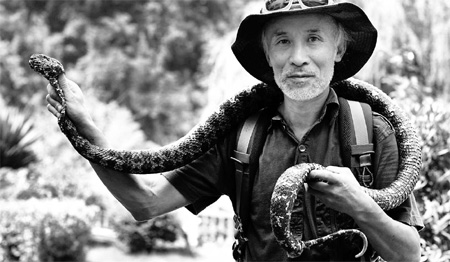
One man, Dr. Chen Yuanhui, has dedicated his life to protecting these snakes since 1990 when the species was officially recorded. Nicknamed “Dr. Snake”, Yuanhui first heard about the pit viper in 1984 when he was given a description of it by a snakebite victim in the hospital where he worked. Several years later, in 1989, he was notified about a nest of 23 snakes that had been captured nearby. He went to investigate and the snakes that were caught fit the exact description his patient had given him years ago – green and yellow markings with a white tail tip. Ever since then, Dr. Yuanhui has kept several Mangshan pit vipers in his home and has conducted research and raised awareness about the need to conserve this species. He is also curator for the Mangshan Museum of Natural History.

Dr. Chen Yuanhui with a wild Mangshan pit viper, 2010.

It takes a lot of love and dedication to continue to care for and research these gorgeous pit vipers after having survived 9 bites over the past 30 years. It’s a great thing there are people like Dr. Yuanhui in the world to set an example for the rest of us about what can be done for endangered animals like the Mangshan pit viper.

References:
1. Gong, Shi-ping, et al. “Population status, distribution and conservation needs of the Endangered Mangshan pit viper Protobothrops mangshanensis of China.” Oryx 47.01 (2013): 122-127.

2. O’Shea, Mark. Venomous Snakes of the World. Princeton: Princeton UP, 2011. 160. Print.

3. “Mangshan Pit Viper Fact Sheet.” San Diego Zoo. San Diego Zoo Global, 4 Apr. 2011. Web. 21 May 2015. <http://library.sandiegozoo.org/factsheets/mangshan_pit_viper/pit_viper.html&gt;.

4. “Mangshan Pit Viper.” Arkive.org. Wildscreen, n.d. Web. 20 May 2015. <http%3A%2F%2Fwww.arkive.org%2Fmangshan-pit-viper%2Fprotobothrops-mangshanensis%2F>.

5. China Daily. “‘Dr. Snake’ Bears Fangs for Conservation.” China.org.cn. China Daily, 17 Feb. 2011. Web. 21 May 2015. <http://www.china.org.cn/environment/2011-02/17/content_21940781.htm&gt;.

Photo Links:
1.https://www.wallpaperflare.com/snake-reptile-animal-memphis-zoo-memphis-tn-usa-camouflage-wallpaper-efpip

2.https://commons.wikimedia.org/wiki/File:Ch%C5%99est%C3%BD%C5%A1ovec_mang%C5%A1ansk%C3%BD_zoo_praha_2.jpg

3.http://www.chinadaily.com.cn/china/images/attachement/jpg/site1/20110217/0023ae6962090ec6a81847.jpg

The Tiniest Snake On Earth – Barbados Threadsnake

If you were walking along and happened to come across one of these little snakes, you would probably mistake it for an earthworm. The Barbados threadsnake (Leptotyphlops carlae) was officially identified relatively recently, in 2008, by S. Blair Hedges from Pennsylvania State University and is currently the smallest known snake species in the world. It is endemic to the island of Barbados and lives on the oldest part of the island where there is still secondary forest. Unfortunately, Barbados has been mostly deforested and populated by humans, so this snake may only have a little over a square mile of suitable habitat left to sustain it and could be considered critically endangered. Very little is known about it yet, but it has been discovered that the species can come in different sizes. Threadsnakes only lay one egg at a time and the smaller snakes will have hatchlings that are proportionally larger than the hatchlings of larger snakes.

Barbados threadsnakes generally only reach a length of 4 inches and feed on termite and ant larvae that they seek out underground. They are completely blind and hunt using scent trails. This snake is so small possibly because of island dwarfism. It may have evolved to fill the predatory niche of a centipede, which would normally prey on termites and ants. It is thought that the Barbados threadsnake may be the minimum size that is possible for a snake to still be able to produce offspring.
OHoTdKwFVoXjhbBpDTdI_UksXLoTzR_5AI2LAxwvLDk
Let’s hope that in the coming years, more will be learned about this fascinating little animal and conservation measures will be taken to protect it and restore its habitat. It would be a shame to lose something so special when we have only just begun to get to know it.

References:
1.Hedges, S. Blair. “At the lower size limit in snakes: two new species of threadsnakes (Squamata: Leptotyphlopidae: Leptotyphlops) from the Lesser Antilles.” Zootaxa 1.30 (1841): 2008.

2.Kennedy, Barbara. “World’s Smallest Snake Found in Barbados.” Penn State News. Pennsylvania State University, 3 Aug. 2008. Web. 02 May 2015. <http://news.psu.edu/story/184803/2008/08/03/worlds-smallest-snake-found-barbados&gt;.

Photo Links:
1.http://upload.wikimedia.org/wikipedia/commons/thumb/7/7e/Relative-offspring-size-hi-res.jpg/1280px-Relative-offspring-size-hi-res.jpg

2.https://www.reddit.com/r/Awwducational/comments/2y1lae/the_barbados_threadsnake_is_the_smallest/