Now it’s time for one of my favorite animals out there. This article has been long overdue. I’m talking about nudibranchs! The colorful, badass, and diverse group of marine slugs. But first, I have some honorable mentions. These may not be part of the Nudibranchia order, but they’re still amazing and deserve a shoutout.
One group is Cephalaspidea (headshield slugs), which includes such animals as the cannibalistic Navanax and sand dwelling Aglaja. Next are the Saccoglossa (“sap-sucking” sea slugs), that steal the chloroplasts of the algae they eat and use them to become solar powered. New research on this group of slugs has even revealed a species, Elysia marginata, that can self-decapitate and live as an autonomous head without a heart or digestive system as it regenerates its entire body in under a month. It’s hypothesized that the slugs do this primarily to rid themselves of heavy internal parasite loads. Only younger slugs are capable of regeneration like this. Older slugs will usually die after undergoing this extreme form of autotomy (the process of voluntarily shedding a body part, usually in response to a threat). Last but definitely not least, we have the orgy loving, purple ink spewing Aplysiidae (sea hares). This family contains the largest gastropod in the world – the black sea hare (Aplysia vaccaria) – with the most massive specimen weighing just under 31 pounds and stretching over 3 feet long! What an amazing gang of critters we have here!

Internet personality and wildlife educator, Coyote Peterson, holding a black sea hare (from his YouTube thumbnail).
Now that we’ve met some of their relatives, let’s meet the actual nudibranchs themselves. Nudis, as they are affectionately referred to by many who study and adore them, come in a couple of flavors. We have the aeolids and the dorids. We’ll start with aeolids since they are probably the most recognizable and are famous for their gorgeous, often stunningly colorful, cerata. Cerata (singular, ceras) are extensions of the animal’s back that increase surface area and aid in respiration through gas exchange. Not only this, but these structures also contain branches of the sea slug’s digestive tract. If these two things weren’t enough, the cerata also house another secret.

Cerata on the thick-horned nudibranch (Hermissenda crassicornis).
Aeolid nudibranchs love to feed on cnidarians, a large group of animals including anemones, hydroids, corals, and jellies, and this is where their super power comes in. Famously, cnidarians sting anything they come into contact with. How do nudis get past this defensive strategy? Among other, more poorly understood modes of protection, they may use armor to keep themselves safe. Chiton, the invertebrate analogue of keratin, is notably quite tough. Some aeolids have intracellular granules of chiton both on the outside and the inside that prevent nematocysts, the packets containing coiled stinging cells, from penetrating their tissues when fired. With this ability the nudis are able to ingest the prey animal’s tentacles safely. The most impressive part about these slugs’ feeding habits is that the tip of each ceras has a structure called a cnidosac. Each cnidosac contains a few, inactivated, nematocysts that have been stolen from their prey. To summarize, aeolid nudibranchs eat their prey, stingers and all, then pass many of those stingers up to the tips of their cerata to use as their own defense. It’s very much insult to injury for the poor cnidarians they feed on. These weaponized meals are called kleptocnidae, which very fittingly means ‘stolen sting’. Some nudibranchs even possess stings strong enough to harm humans. One of these is arguably the most popular sea slug, Glaucus atlanticus (also called the blue sea dragon), probably due to its very Pokémon-like appearance. G. atlanticus is pelagic and feeds on the Portuguese man o’ war and related siphonophores, resulting in an equally potent sting.
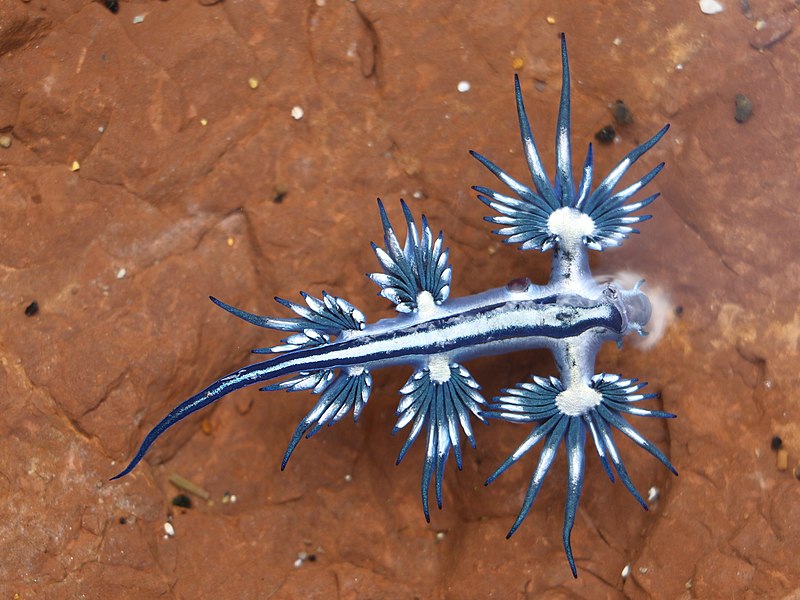
Glaucus atlanticus photograph by Peter Woodard.
The bright colors of many aeolid nudis are usually enough to deter predators, but if that fails, they get a nasty sting, courtesy of their own prey. Even with the warning colorations and kleptocnidae, there is the inevitability that some predators will persist. When this does occur, there are a few final parlor tricks up the slug’s proverbial sleeve. Not all nudibranchs have the ability, but many can just swim away if they’ve had enough. And remember our friend Elysia who can decapitate itself? As it turns out, plenty of aeolid nudibranchs can autotomize too, though not to the same level of drama. Many studies have demonstrated that a firm pinch to a slug’s ceras will result in its detachment, leaving the predator distracted with a squirming, mucus spewing appendage as the owner swims away. As with Elysia and many other animals that can autotomize, nudibranchs can regenerate lost cerata. It usually takes just over 40 days to fully regenerate one – a small price to pay for survival and the chance to reproduce.

An adorably plump “shaggy mouse” nudibranch (Aeolidia loui) on a shell.
Speaking of reproduction, all nudibranchs are hermaphroditic. This means they have both male and female sex organs. Although they possess the equipment and the potential to fertilize themselves, there is little indication that they actually do so. These slugs prefer to have a partner involved. They find each other through chemicals in the trails of mucus left behind while traveling. A pair of structures on the head, the rhinophores, detect these chemicals in the water. This is akin to how a moth follows pheromones in the air with the help of its feathery antennae. The closest human analogue to this is our sense of smell, though it still differs quite radically. Many species, such as the barnacle eating dorid (Onchidoris bilamellata), often have mass spawning orgies that can cover entire rocks, but generally it is more of a quiet affair. When two slugs find each other and are both ready to mate, they participate in a circling, dance-like courtship before aligning their genitals. The reproductive opening is located on the right side of the head and contains both a penis and a vagina. One species of slug, Goniobranchus reticulatus, is famous for its disposable penis that detaches in the recipient and then regrows within a day. Plenty of others do this too, but G. reticulatus was the first to make headlines. Once mating is complete, both partners tend to go their separate ways. Sperm is stored inside a special sac until the eggs are ready to be fertilized internally. Eggs are laid in a ribbon on or near the nudibranch’s preferred prey and typically hatch within a week or 2 as tiny larvae called veligers.

Barnacle eating dorids during an orgy.

Aeolidia sp. pair with eggs.

A Heath’s dorid (Geitodoris heathi) sitting under its yellow ribbon of eggs.
The mating behaviors discussed above are shared by both kinds of nudibranchs, but there are plenty of other things unique to the dorids. One of the most obvious of these is that they completely lack the billowing cerata that make aeolids so recognizable. Instead, they blatantly demonstrate where they get their name. Nudibranch is a mashup of Latin and Greek derived words meaning “naked” and “gills”, respectively. Cerata are multifaceted and have no single obvious function that can be visually ascertained at a quick glance and aeolids are clearly shell-less and therefore still naked as far as mollusks go. Dorids, however, display their gills right out in the open and it is very easy to recognize them as such. This tuft of gills, often referred to as “butt fluff”, is situated on top of the animal’s rear and can be drawn into the body when necessary. The gills also happen to surround the slug’s anus which… works for them. You may be wondering how these naked squishies avoid being eaten if they don’t have the fancy cerata defenses of their aeolid brethren. As it turns out, dorids have some nasty tricks of their own. Rather than stealing stingers, these not so garden variety slugs steal poisons and sequester them in their tissues. This makes them toxic. *Cue Britney Spears* A few are able to synthesize their own toxins, but most get them from prey. Dorids usually feed on sponges and can be very specialized, often only feeding on a single species. Many are very well camouflaged to their prey due to the necessity of living on or near it. Predators may have a difficult time spotting nudis like this and if they do, they may get a bad tasting surprise. Others choose to loudly advertise their toxicity with bright colors. Plenty of aeolids do this too and it is a fantastic example of aposematic coloration. “Eat me and you’ll regret it!” or “Touch me and you’ll get hurt!” These vibrant warning patterns and colors are exactly what make these animals so visually appealing to us. We see beautiful little dragons while predators see a bad time.
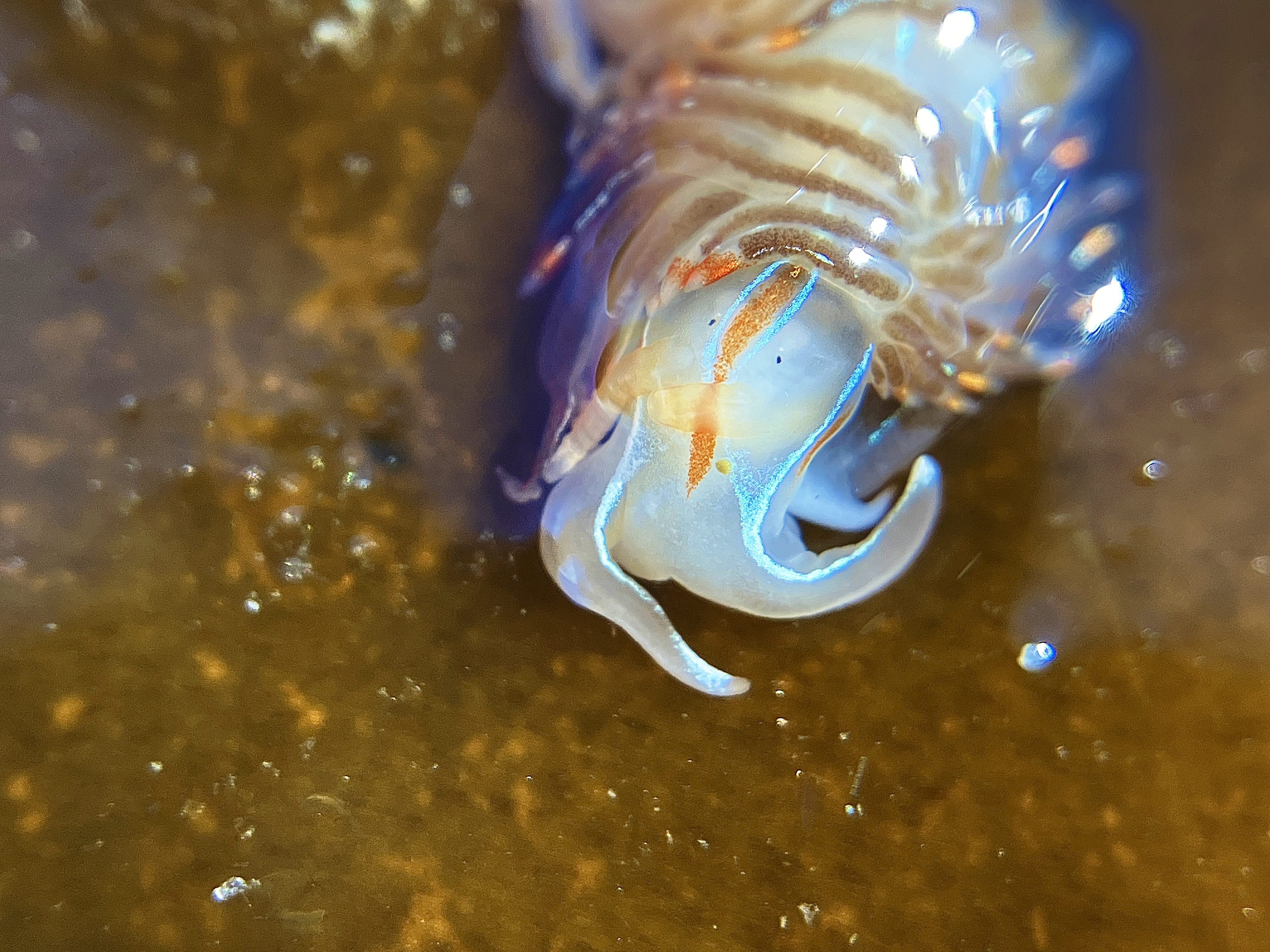
This thick-horned nudibranch looks like it’s glowing! You can even see its tiny eyespots.
Nudibranchs are varied and complex animals that are continually revealing new secrets to us. If you weren’t a fan of sea slugs before, I hope you are now. It is unfortunate that their land dwelling cousins aren’t nearly as beautiful, but remember that they are still cut from the same cloth. Maybe that will change your perspective a little the next time you encounter one. Perhaps when you hear the word “slug”, your reaction will no longer be one of disgust if it was before.
Here is a link to a group of sea slug photos that show off just how diverse they are. Only one of these, the “leaf sheep” (Costasiella sp.) is not a nudibranch, although it is labeled as such: https://www.scubadiving.com/photos/photo-contest-gallery-nudibranch-central
Please also enjoy this video of slugs from the Philippines. Keep in mind, this is just one small spot, but has a mind boggling array of species. This group of animals is so insanely diverse, it’s hard not to drop your jaw in awe.
References:
1. Mitoh, Sayaka, and Yoichi Yusa. “Extreme Autotomy and Whole-Body Regeneration in Photosynthetic Sea Slugs.” Current Biology, vol. 31, no. 5, 8 Mar. 2021, doi:10.1016/j.cub.2021.01.014.
2. Rudman, Bill W. “Aplysia Vaccaria.” The Sea Slug Forum, Australian Museum, 2006, http://www.seaslugforum.net/showall/aplyvacc.
3. Greenwood, Paul G. “Acquisition and Use of Nematocysts by Cnidarian Predators.” Toxicon, vol. 54, no. 8, 6 Mar. 2009, pp. 1065–1070., doi:10.1016/j.toxicon.2009.02.029.
4. Miller, Jennifer A., and Maria Byrne. “Ceratal Autotomy and Regeneration in the Aeolid Nudibranch Phidiana Crassicornis and the Role of Predators.” Invertebrate Biology, vol. 119, no. 2, 11 May 2005, pp. 167–176., doi:10.1111/j.1744-7410.2000.tb00005.x. Accessed 22 Oct. 2022.
5. Sekizawa, Ayami, et al. “Disposable Penis and Its Replenishment in a Simultaneous Hermaphrodite.” Biology Letters, vol. 9, no. 2, 23 Apr. 2013, pp. 1–4., doi:10.1098/rsbl.2012.1150. Accessed 8 Nov. 2022.
6. Sekizawa, Ayami, et al. “Another Usage of Autotomized Penis.” Journal of Ethology, vol. 39, no. 3, 15 May 2021, pp. 319–328. Springer, doi:10.1007/s10164-021-00706-1. Accessed 8 Nov. 2022.
7. Ottuso, Patrick Thomas. “Close Encounters With the Environment.” MDedge, May 2009, cdn.mdedge.com/files/s3fs-public/Document/September-2017/083050237.pdf. Accessed 5 Nov. 2022.
8. Faulkner, D.John, et al. “Geographical Variation in Defensive Chemicals from Pacific Coast Dorid Nudibranchs and Some Related Marine Molluscs.” Comparative Biochemistry and Physiology Part C: Comparative Pharmacology, vol. 97, no. 2, 19 Apr. 1990, pp. 233–240. Science Direct, Elsevier, doi:10.1016/0742-8413(90)90133-t. Accessed 5 Nov. 2022.
Photo Sources:
1. https://www.youtube.com/watch?v=15I8eIqh9iI
2. https://commons.wikimedia.org/wiki/File:Glaucus_atlanticus_Long_reef.jpg
All other photos taken by me.
Video Link: https://www.youtube.com/watch?v=_f3GpKiaQUA