True or False:
All mice only eat seeds and other plant based food.
If you chose true, you’re wrong!
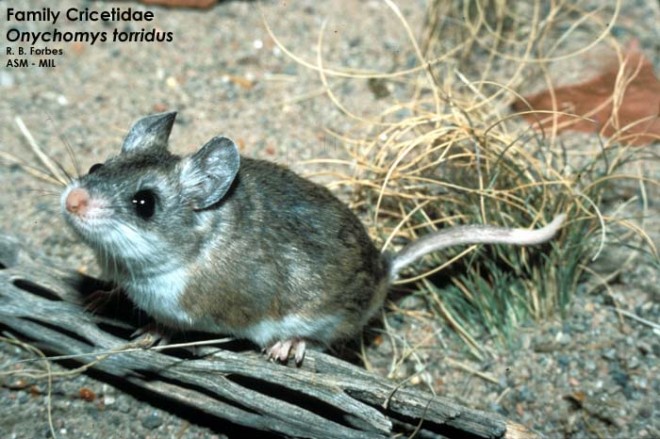
There is actually such thing as a carnivorous mouse! It lives in the Sonoran Desert of the American Southwest and Northern Mexico and is the worst nightmare of many an arthropod. The Southern grasshopper mouse (Onychomys torridus) is a tiny and ridiculously vicious predator of anything from deadly Arizona bark scorpions (Centruroides sculpturatus), tarantulas, giant desert centipedes (Scolopendra heros), and lizards, to even other small mammals – its own species included. Larger prey items like lizards or rodents are killed with a bite through the spinal cord at the base of the skull. Other prey are ripped apart and eaten bit by bit.
Being mice, these animals are small, but they are able to take down prey much larger than themselves. They reach maturity at a young age, as do other mice, and are weaned of their mother’s milk and able to eat whatever is brought to them by 20 days. Litters consist of 1-5 mice and these babies become sexually mature by day 40. Females have their first litters between 4 and 5 months of age and raise them in a burrow stolen from another rodent (which may have been killed and eaten during the eviction process).

One of the most impressive things about Southern grasshopper mice is that they are able to take on venomous scorpions like C. sculpturatus with no ill effects. How do they do this?
When it comes to scorpion stings, these mice just don’t care. They don’t just ignore the pain, they don’t even feel it. This is because they have special pain pathways that are affected very differently by scorpion venom than other mammals. Normally, painful sensations are sent to the central nervous system (CNS) via the tetrodotoxin-sensitive (TTX-S) Nav1.7 and tetrodotoxin-resistant (TTX-R) Nav1.8 voltage-gated sodium channels in the dorsal root ganglia (DRG). The Nav1.7 is activated while Nav1.8 is left alone, and a signal is sent to the CNS.
Ashlee Rowe and colleagues experimented in the lab to find out how the venom affects these sodium channels in the grasshopper mouse. They injected nonlethal doses of Centruroides venom into the paws of both grasshopper mice and house mice (Mus musculus), which served as the control species. In addition to venom, they also injected saline and formalin, another painful chemical. These served as negative and positive controls, respectively. The behavior of the mice and the responses of the DRG neurons were measured.
As expected, house mice spent a lot of time licking the paws injected with venom and with formalin, but showed little response to saline. In contrast, grasshopper mice with venom injections only licked their paw for a few seconds before returning to normal behavior. They actually showed more irritation in response to the saline than the venom. When treated with formalin, the grasshopper mice licked the injured paw significantly more than in response to venom, but still less than house mice did. This indicates that their resistance to pain is specific to scorpion venom, and does not spread to other pain inducing chemicals.

When sodium currents in the Nav1.8 DRG neurons were measured in grasshopper mice, it was found that the venom actually inhibited these currents on a dose dependent scale. House mouse neurons showed no alteration in current, as is typical for most mammals. For Nav1.7 action potentials to be sustained after initial propagation, the sodium currents in Nav1.8 are necessary. Under the influence of scorpion venom, the researchers predicted inhibition of Nav1.8 to decrease excitation of the membranes and firing of action potentials. This is exactly what they discovered. The venom significantly decreased the excitation and blocked firing in grasshopper mouse neurons. The opposite occurred in house mice, supporting the expected, standard mammal response.
In short, the grasshopper mouse feels no pain in response to Centruroides venom thanks to the signals never reaching the CNS. Understanding how this mouse’s nociceptors work differently could have implications in medical treatment for human pain.
Whew! That was a lot of complicated science! Let’s get back into something a little more fun and simple.
Can this little rodent get any more badass than it already is? The answer is yes, it can! Not only do grasshopper mice take down and devour some of the most fearsome creatures in the desert, they also advertise their reign as tiny kings with howling war cries. That’s right! These mice howl at the moon like miniature wolves. As a species, they are very territorial and will let others know who the top mouse is by rearing up on their hind legs, throwing back their heads, and emitting a high, carrying howl after they make a kill.
If you ever go camping in the Sonoran desert and you hear the strange, whistling cry of a grasshopper mouse, you can be pretty sure that there’s one less bark scorpion to come crawling into your tent at night.
References:
1. McCarty, Richard. “Onychomys torridus.” Mammalian Species (1975): 1-5.
2. Reardon, Sara. “Mouse Eats Scorpions and Howls at the Moon.” Zoologger. New Scientist, 11 Jan. 2013. Web. 14 July 2015. <https://www.newscientist.com/article/dn23072-zoologger-mouse-eats-scorpions-and-howls-at-the-moon/>.
3. Wade, Lizzie. “Mouse Impervious to Scorpion’s Sting.” Science Magazine. AAAS, 24 Oct. 2013. Web. 14 July 2015. <http%3A%2F%2Fnews.sciencemag.org%2Fbiology%2F2013%2F10%2Fmouse-impervious-scorpions-sting>.
4. Rowe, Ashlee H., et al. “Voltage-gated sodium channel in grasshopper mice defends against bark scorpion toxin.” Science 342.6157 (2013): 441-446.
Photo and Video Links:
1. https://www.youtube.com/watch?v=AcYW31N96b4
2.http://phenomena.nationalgeographic.com/files/2013/10/Grasshopper_mouse_scorpion.jpg
3.http://www.mammalogy.org/uploads/imagecache/library_image/library/1170.jpg