Arizona Bark Scorpion

The Arizona Bark Scorpion (Centruroides sculpturatus) is a tiny scorpion found in, well, Arizona (though it also occurs in other states of the American Southwest as well as Northern Mexico). It lives in the Sonoran desert and is mostly active at night when it hunts crickets, beetles, and other small insects which it ambushes from a dug out burrow. This little guy only reaches a maximum length of about three inches and is very light brown in color. During the day, it hides in the shade or buries itself in sand to avoid the sunlight. It’s often found under rocks, in crevices, bark, leaf litter, and can sometimes find its way into dark places in houses or shoes. During the winter, many bark scorpions will come together to form packs. This is extremely unusual as almost all other species of scorpion are strictly solitary.

As with all scorpions, the Arizona bark scorpion fluoresces when exposed to ultra violet light. They are easy to locate wandering around at night in the desert because of this.

Bark scorpions live for about six years and are sexually mature after one. Females give birth to live young instead of laying eggs. The baby scorpions are exact miniatures of the adult and stay with the mother scorpion, riding around on her back, until their first molt. Litter sizes can range from twenty five to thirty five babies.

Proud mama!

This scorpion is not generally aggressive, but it will become so if it feels threatened as with any wild animal. Its first instinct is to get away, but if that fails, it can deliver a sting that is very painful and can be quite dangerous. Although not normally fatal, stings can lead to temporary paralysis and possibly convulsions on whatever portion of the body was stung. The Arizona bark is the most venomous scorpion in North America and stings should always be treated as a medical emergency and receive adequate medical attention. Stings have been described by victims as feeling like continuous jolts of electricity after envenomation. Luckily, this is such a common species that antivenom is widely available to people who get stung.
If you ever happen to run across an Arizona bark scorpion, don’t mess with it or kill it, just whip out your black light (which I’m sure all of you have and carry around with you at all times, right?), stand back and enjoy it. Scorpions are very interesting and unique arachnids and should be treated with the respect they deserve.

References:
1.McWest, Kari J. “Centruroides Sculpturatus.” Species Centruroides Sculpturatus. Iowa State University Department of Entomology, 26 Mar. 2006. Web. 02 May 2015. .

2.”Arizona Bark Scorpion.” Scorpion Facts and Information. Bio Expedition, 2013. Web. 02 May 2015. .

3.Curry, Steven C., et al. “Envenomation by the scorpion Centruroides sculpturatus.” Clinical Toxicology 21.4-5 (1983): 417-449.

4.Gaffin, Douglas D., et al. “Scorpion fluorescence and reaction to light.” Animal Behaviour 83.2 (2012): 429-436.

Photo Links:
1.http://upload.wikimedia.org/wikipedia/commons/a/a9/Basgen-scorpion-compared.JPG

2.http://lh3.googleusercontent.com/-QrCuYLESDzo/TqXUCWAJVCI/AAAAAAAAAD8/OCBNhtSuoOk/s0/IMG_0123.JPG

3.http://kjzz.org/sites/default/files/field/image/Centruroides%20sculpturatus%2010.JPG

Antilles Pinktoe Tarantula

A lot of people really hate spiders and I think that’s a shame. Yes, they have eight legs and eight eyes which is a little weird, some of them are deadly, and they like to put their webs up right at face level so you’ll accidentally walk straight into them. But there’s more to spiders than that. Most of them aren’t harmful at all and help keep us safe from creatures that actually are very dangerous. Their ability to weave such perfect, intricate works of art in minutes made out of stuff stronger than steel is an incredible feat. Jumping spiders possess some of the most advanced eyes in the animal kingdom and can target things with pinpoint accuracy. Plus, they’re pretty adorable:

Phidippus regius female

But I’m not talking about jumping spiders or orb weavers today. I’m talking about a gigantic tree spider called the Antilles pinktoe (Avicularia versicolor). This tarantula is a popular pet because it has such beautiful colors and is relatively easy to keep.

7549677318_f874797f9e_z

Adult spider in a tree by Thomas Baillieaux on Flickr

Caribena_versicolor_8_Fh
Antilles pinktoes are native to the islands of Guadeloupe and Martinique in the Caribbean Sea where they live high in the trees in funnel webs that they spin. They seldom come down to the ground, so when kept in captivity, the height of the cage is more important than their floorspace. They also live in a very warm and humid environment and prefer temperatures in the 70s with 80% humidity and good ventilation.
Pinktoes are very quick, agile, and are very good jumpers despite the fact that they are tarantulas and not jumping spiders. They can easily leap up to a foot straight in the air or out from a perch. When hunting, they will use these skills to creep up and pounce on insects such as crickets, beetles, cockroaches, and moths. Pinktoes will sometimes even take small lizards like anoles.
Female spiders are slightly larger than the males and can grow to have a leg span of up to 6 inches across. The males are not as bulky and usually have more vivid coloration. Males only live up to 5 years whereas females can live over 10 with good care. In the wild, these spiders will group together to form colonies, but this is not the case in captivity, especially not with males and females together. That usually leads to the male being eaten.
The babies, or “sling”, are a very different color from adults, but equally as stunning. When they hatch, they are a beautiful, shimmering blue and keep this color until they start nearing adulthood.

4280768248_be8ab4e756_c

Metallic blue baby by Tarantuland on Flickr

Although very docile, these spiders don’t like to be handled much. They rarely bite and the bite is no worse than a bee sting when they do, but they also have urticating hairs as with all tarantulas. Instead of kicking them off with their back legs, however, they prefer to press them against the surface of the thing that they feel is threatening. The hairs can be very irritating and cause lots of itching and redness, so it’s best not to annoy the spider too much.
If you’ve ever felt like getting a pet spider, this is a lovely one to have. Just make sure you take good care of it because it’s definitely worth keeping around!

References:
1.Gurley, Russ. “Antilles Pink Toe Tarantula.” Animal World. Animal-World, n.d. Web. 02 May 2015. <http://animal-world.com/encyclo/reptiles/spiders/AntillesPinktoedTreeSpider.php&gt;.

2.Bertani, Rogerio. “Release of urticating hairs by Avicularia versicolor (Walckenaer, 1837)(Araneae, Theraphosidae).” Bull. Soc. ent. Fr 44 (2003): 29-92.

Photo Links:

1.http://upload.wikimedia.org/wikipedia/commons/f/fc/Female_Jumping_Spider_-_Phidippus_regius_-_Florida.jpg

2.https://flic.kr/p/cv953j

3.https://commons.wikimedia.org/wiki/File:Caribena_versicolor_8_Fh.jpg

4.https://flickr.com/photos/36404122@N03/

Ghost of the Forest – Clouded Leopard

The clouded leopard (Neofelis nebulosa) is a beautiful cat found in Southeast Asia, China, and Himalayan foothills. It is a slightly different species from the Sunda clouded leopard (Neofelis diardi) of Sumatra and Borneo. The Sunda clouded leopard was originally thought to be just a subspecies of the clouded leopard, but genetic analysis has since shown that the Sunda diverged into a separate species about 1.5 million years ago. It might have traveled over a once existent land bridge spanning from mainland Asia to Sumatra and Borneo. Furthermore, the Sunda species is split into two subspecies: N. diardi diardi on the island of Sumatra and N. diardi borneensis in Borneo.

2901090110_a31dfcff72_c
Neofelis diardi
48472605796_60ed3cf413_c
Neofelis nebulosa

The clouded leopard is the smallest of the big cats – only four to six feet including the long tail. It is named for the cloud like markings on its coat and the Sunda’s cloud spots are darker and smaller than the mainland species’. The markings provide camouflage in the dappled sunlight of its rainforest home while hunting or hiding. Clouded leopards are excellent climbers and primarily spend time up in the trees. Their legs are short to give them a lower center of gravity and their three foot long tails provide good balance. Their paws and claws are quite large and their back ankles are flexible enough to rotate backwards, allowing them to climb down a tree head first. The paw pads are special in that they can conform to the tree bark when the cat is climbing.

Clouded leopards have extremely formidable jaws, which can open up to 100 degrees. Their upper canine teeth are the longest in comparison to their skull size of any other living carnivore known. This, and other structural evidence, suggests that there is a connection between the clouded leopard and prehistoric saber-toothed cats such as Smilodon. It is possible that clouded leopards also use a similar hunting technique to saber-toothed cats. All other living big cats take down prey by attacking the throat or muzzle whereas the saber-tooth used its fangs to sever the spine, nerves, and blood vessels in the neck and strangulate the animal. This is a method that kills instantly.

Clouded leopards are cats that need help, but they are difficult to breed in captivity because there is so much aggression between the males and females. One way that was found to combat this is to introduce leopard pairs around one year old so that a successful pair bond is created and aggression is lessened. Leopards become sexually mature around two years of age. Female leopards give birth to one to five cubs in a litter, although it is most often two, and those cubs will be fully independent by ten months.

Clouded leopards are incredibly rare and elusive in the wild, so there is still not much known about them. Their habitat is threatened by rampant deforestation and they are poached for their beautiful fur as well as teeth and claws. This leopard is listed as an endangered species in the United States, which prohibits the trade of any live cats, parts, or products. Over most of its range, it remains protected, but some areas such as India, Malaysia, and Thailand have more lax and poorly enforced regulations. Breeding programs have been set up in many places around the world and the practice of introducing prospective pairs when young has shown relatively good success in recent years. In 2011, a pair of cubs was born at Tacoma’s Point Defiance Zoo and Aquarium in my home state of Washington and three were born at the Nashville Zoo in Tennessee, then four in 2012.

Let’s hope that captive breeding programs continue to be a success and more attention is given to the conservation of the clouded leopard’s habitat and life in all areas of its range.

UPDATE!!! 6/5/15
Four new clouded leopard cubs have been born at Point Defiance Zoo & Aquarium in Tacoma, Washington!
They are now officially on display, so go see them if you’re in the area! 🙂


http://www.king5.com/story/news/2015/05/19/1-week-old-clouded-leopard-cubs-at-point-defiance-healthy-and-adorable/27613921/

References:
1. World Wildlife Fund. “New Species Declared: Clouded Leopard On Borneo And Sumatra.” ScienceDaily. ScienceDaily, 15 March 2007. .

2. McGinley, Mark. “Clouded Leopard.” The Encyclopedia of Earth. Ed. C. Michael Hogan. The Encyclopedia of Earth, 23 Feb. 2010. Web. 02 May 2015. .

3. “About the Clouded Leopard.” Clouded Leopard Project. Clouded Leopard Project, 2003. Web. 02 May 2015. .

4. Christiansen, Per. “Sabertooth characters in the clouded leopard (Neofelis nebulosa Griffiths 1821).” Journal of Morphology 267.10 (2006): 1186-1198.

5. “Clouded Leopard Cubs.” Welcome Our New Clouded Leopard Cubs. Point Defiance Zoo & Aquarium, June 2011. Web. 02 May 2015. .

6. “The Nashville Zoo Celebrates Two Sets of Clouded Leopard Cubs.” The Associated Press. The Associated Press, 29 Mar. 2012. Web. 02 May 2015.

Photo Links:
1.https://flic.kr/p/5qmR21

2.https://flic.kr/p/2gRmLWG

3.http://img2.timeinc.net/people/i/2013/sandbox/leopards/clouded-leopard-1-600×450.jpg

4.http://polimaty.pl/wp-content/uploads/2015/03/leop11.jpg

5.http://cdn2.arkive.org/media/CC/CC232D1C-14CF-4169-AFFD-10C6F2058FFC/Presentation.Large/Clouded-leopard-resting.jpg

6.http://mediad.publicbroadcasting.net/p/kplu/files/styles/medium/public/201106/PDZA_clouded_leopards_Day_9_1_no_watermark.jpg

7.http://www.look.com.ua/large/201209/23461.jpg

8.http://www.gannett-cdn.com/-mm-/fe286d436c8f0a373e03adfa196a1fc6cd281ba1/c=19-0-781-573&r=x513&c=680×510/local/-/media/2015/05/19/NWGroup/KING/635676622701274568-150517-pdza-cubs-54-L.jpg

Nature’s Hoax

Most people only know that platypuses (Ornithorhynchus anatinus) are cute, yet ridiculous looking monotreme, or egg laying, mammals from Australia. In reality, there is much more to them than that. Although it might not seem like it because of the small, slightly obscured eyes, the platypus actually has fairly acute vision over long distances. However, it can’t use this sense when diving under water to search for prey. When it dives, the platypus closes its eyes, ears, and nostrils to keep out water. To navigate and hunt, it relies on its ability to sense the electrical currents given off by its preys’ muscular contractions every time they move. This is called electrolocation or electroreception. Electroreceptors along its bill allow it to gauge the direction it needs to go by determining the strength of the signal. This is why a platypus will constantly sweep its head side to side while on the hunt. It is trying to analyze the signal strength to locate its prey. In addition to the electroreceptors on its bill, the platypus also possesses mechanoreceptors which detect touch. The place in the brain that processes the electrosensory signals is located in the tactile somatosensory area and some of the cells there can receive input from both the mechano and electroreceptors. This suggests that there is a very close relationship between these two forms of sense.

It’s dangerous to go alone! Take this.

Platypuses have very dense, luxuriously soft fur and were formerly hunted for their pelts because of this. They are generally dark, grayish brown on their backs and creamy white on the belly. The top layer of fur, called guard hair, is coarser and helps insulate the platypus by trapping a layer of air and locking out water when swimming.

Trapped air is released from the fur due to pressure as the platypus dives.

In addition to their peculiar egg laying trait, they also have a wicked self defense method. They are one of the very few known venomous mammals. Both sexes of platypus are born with calcaneus spurs near their hind feet, but the male’s contain a potent cocktail of toxins specifically designed to cause pain and incapacitate an opponent. These toxins have been found to directly target pain receptors in the brain and a dose of them can result in agony that can last up to a few weeks or longer. It is not fatal to humans, but it has been known to kill smaller animals such as dogs. They may be irresistibly cute and cuddly, but before you go grabbing up and hugging the next platypus you come across, think carefully about how you do that.

References:
1. Pettigrew, J. D., P. R. Manger, and S. L. B. Fine. “The sensory world of the platypus.” Philosophical Transactions of the Royal Society B: Biological Sciences 353.1372 (1998): 1199-1210.

2. De Plater, G. M., P. J. Milburn, and R. L. Martin. “Venom from the platypus, Ornithorhynchus anatinus, induces a calcium-dependent current in cultured dorsal root ganglion cells.” Journal of neurophysiology 85.3 (2001): 1340-1345.

3. “Wildlife Queensland – Platypus.” Wildlife Queensland – Platypus. Wildlife Queensland, n.d. Web. 20 Apr. 2015. .

Photo Links:
1. http://i.imgur.com/dP1SjOv.jpg

2.http://academic.reed.edu/biology/professors/srenn/pages/teaching/web_2010/EmilyFong/platypusgrassdavewatts.jpg

The Real Life “Blob” – Slime Mold

Ever seen the 1958 horror classic, “The Blob”? Well that movie is actually based somewhat in reality. Our planet is swarming with over 900 species of mini “Blobs” as we speak. They’re not animals, they’re not plants, and they’re not even a type of fungus. These suckers are slime molds and they actually share a taxonomic group, Amoebozoa, with amoebas! All of the so called “true slime molds” fall under this in their own grouping known as Eumycetozoa. The ones that are most recognizable as slime molds to the average observer are the mycetozoans. Still with me? Good.

Basically what they are is giant, unicellular organisms containing thousands of nuclei as a result of a swarm of single cells that fused into one. Slime molds make their homes in any place from forest floors, lawns, moldy gutters, to their own special cages in laboratories. They feed on decaying vegetation, bacteria, and fungi that they “chase” down and engulf by sending out protoplasmic strands that move via cytoplasmic streaming. This essentially means that they shift their cell contents forward and grow toward a target as the trailing end’s growth is restricted and starts to recede. This behavior has become extremely popular to study among scientists because of the ease of observation thanks to the slime mold’s large size. The movement can even be seen with the naked eye. Their growth patterns can be manipulated and studied using a trail of oatmeal flakes, which in its own, really creepy way, is kind of charming. I have actually done this myself with a Physarum polycephalum (the most commonly studied lab slime mold). They will follow the trail to create some of the most intricate patterns imaginable for a slime.

They seem to also possess some sort of seemingly sentient problem solving ability because, when placed in a maze, they will restrict their growth to the shortest, most direct path to food placed at the other end on the very first trial. They can also apparently anticipate periodic events. There was even an experiment done by Klaus-Peter Zauner at the University of Southampton in the UK that involved a P. polycephalum controlled robot. The slime mold was grown in a six pointed star formation on a circuit and connected remotely with a computer to a six-legged robot. Each of the six points controlled a leg of the robot. Slime molds hate bright light, so when exposed to that, it tried to get away. The robot sensed the slime’s movement and it tried to scuttle away from the light too.

dn8718-2_495

The hexapod robot controlled by P. polycephalum. Credit: Klaus-Peter Zauner

There is also now evidence that slime molds may possess a form of memory, though they have no brain. They are able to recognize their own trails and know where they have been and where they have not. This was tested by researchers who placed several of our friends, P. polycephalum, into a U-shaped trap. When the trap was untreated with paths of slime, 96% of P. polycephalum were able to easily navigate through to get to the sugar water at the other end before their 120 hour time limit was up. After the trap was coated with slime, however, only a third of the molds reached the sugar water before time ran out and had great difficulty making it back to the beginning again.

If all of that brainless problem solving and memory weren’t enough, slime mold has recently become a hero to astronomers and computer scientists for helping to create a computational model to visualize the cosmic web connected by dark matter. This new model is based on the growth pattern of the ever useful P. polycephalum and appears to be the most accurate model of the interconnectedness of the universe to date. In addition to helping solve some of our greatest cosmic mysteries, slime mold has been able to replicate the Tokyo railway almost perfectly, following oat flakes representing Japanese cities. It took engineers hours upon hours to create something that a slime mold did effortlessly in just over a day.

A slime mold begins as a single cell and once it encounters food or a compatible zygote, it multiplies to become the giant slime cell that is most commonly seen. At the end of a slime’s life cycle, which happens when conditions become unfavorable, it forms rigid clusters of spores known as sporangia or fruiting bodies. These spores are eventually released and travel to new locations to start the cycle over again.
Now that you know more about slime molds, let’s take a look at a few individuals.
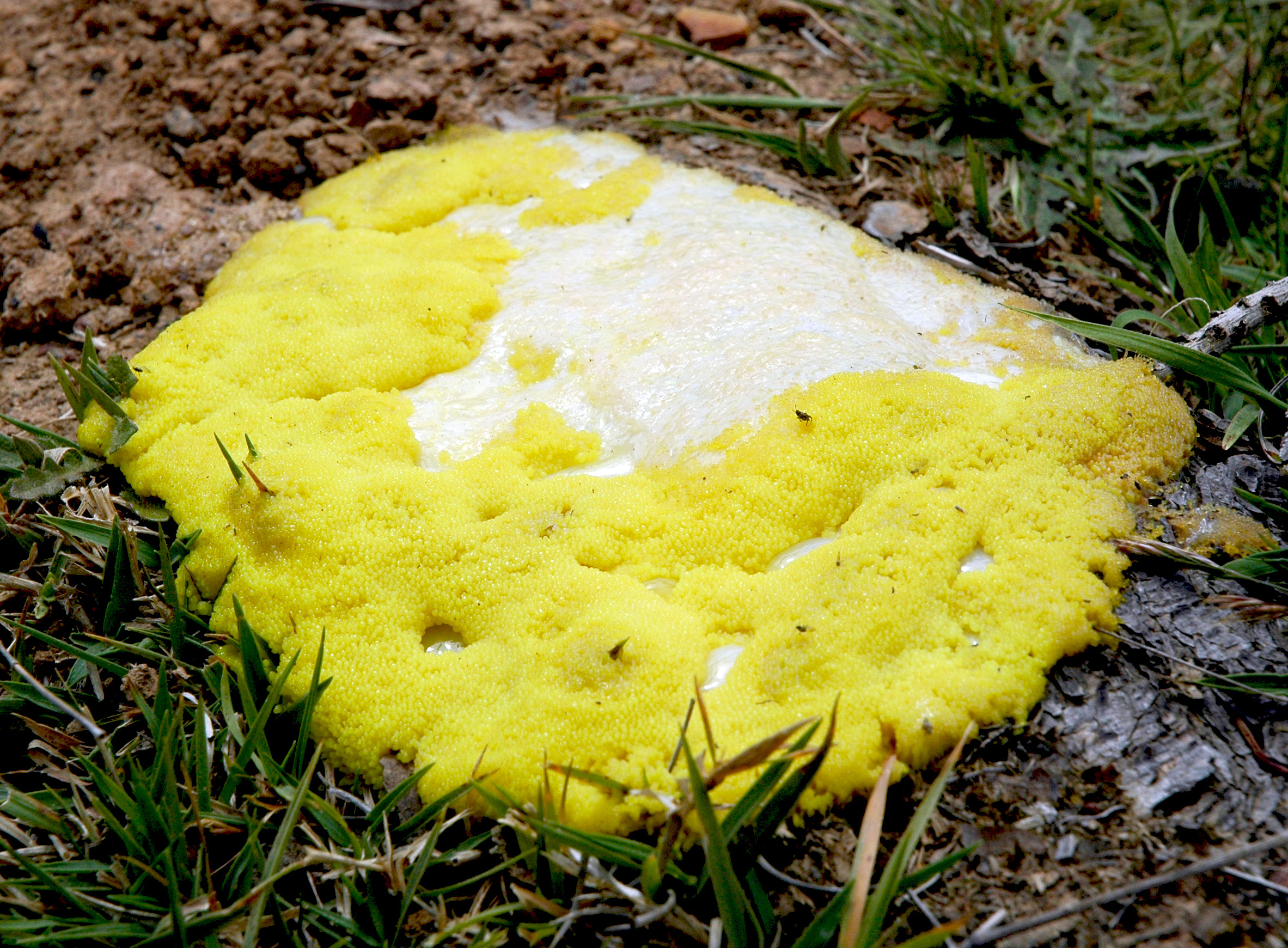
Fuligo septica.

As the scientific name suggests, this one is particularly disgusting. It is more commonly known as the dog vomit slime mold and is one of the largest species.

This is our much less offensive little robot controller up there and the kind I had the, uh, pleasure (?) of growing.

50249550513_cd751d5961_k

Physarum polycephalum. Credit: Dru!

Many of them are actually quite colorful and magical looking.

diachea-leucopodia-78316ma-4x15x-1-1024x768-1

Diachea leucopodia. Credit: Carlos de Mier

22799139487_497cd9fc0c_c

Metatrichia vesparium. Credit: Katja Schulz

21168023043_2f5be8dd65_o

Ceratiomyxa fruticulosa. Credit: Ryszard

tubifera_ferruginosa_52288

Tubifera ferruginosa

I hope you found this interesting and now I’ll just leave you with a rather prophetic quote from biologist Chris Reid, one of the researches who experimented with slime mold memory: “I, for one, welcome our new gelatinous overlords.”

References:
1. Leontyev, Dmitry V., and Martin Schnittler. “The phylogeny and phylogenetically based classification of myxomycetes.” Myxomycetes. Academic Press, 2022. 97-124.

2. Ling, Hubert. “Myxomycetes: Overlooked Native Plants.” The Native Plant Society of New Jersey. The Native Plant Society of New Jersey, 2012. Web. 19 Apr. 2015. .

3. Knight, Will. “Robot Moved by a Slime Mould’s Fears.” New Scientist. New Scientist, 13 Feb. 2006. Web. 19 Apr. 2015. .

4. Tsuda, Soichiro, Klaus-Peter Zauner, and Yukio-Pegio Gunji. “Robot control with biological cells.” Biosystems 87.2 (2007): 215-223.

5. Ingber, Sasha. “Slime Has Memory but No Brain.” National Geographic, National Geographic Society, 12 Oct. 2012. Web. 19 Apr. 2015. .

6. Reid, Chris R., et al. “Slime mold uses an externalized spatial “memory” to navigate in complex environments.” Proceedings of the National Academy of Sciences 109.43 (2012): 17490-17494.

7. Stephens, Tim. “Astronomers Use Slime Mold Model to Reveal Dark Threads of the Cosmic Web.” UC Santa Cruz News, 2020, news.ucsc.edu/2020/03/cosmic-web.html.

8. Wogan, Tim. “Ride the Slime Mold Express!” Science, AAAS, 21 Jan. 2010, http://www.science.org/content/article/ride-slime-mold-express. Accessed 13 Aug. 2023.

Photo Links:
1.Slime mold robot

2.Fuligo septica

3.Physarum polycephalum

4.Diachea leucopodia

5.Metatrichia vesparium

6.Ceratiomyxa fruticulosa

7.Tubifera ferruginosa