Spectral Leaf – Ghost Mantis

Yes, it’s another mantis, but they’re really cool insects, so why not?

The Ghost mantis (Phyllocrania paradoxa) is a tiny mantis found throughout Eastern and Western Africa and occasionally in the South, including the island of Madagascar. It mainly lives in drier areas and clings to the leaves and twigs of different plants in its habitat. It only grows up to about two inches in length and is considered to be miniature for a mantis. Ghost mantis males and females are roughly the same length, but the male is slimmer and has slightly longer wing cases that are partially transparent. Males also have eight abdominal segments, whereas females possess only 6. They can be a variety of different colors ranging from a subtle brownish green to almost black. The most common color is dark brown, however.

Two females next to a  50 euro coin.

Like the orchid mantis, ghost mantises boast some of the most impressive camouflage of the insect world. The thorax is slightly flattened into a leaf-like shape and each of the walking legs and abdomen have projections that mimic dead leaves as well. A ghost mantis’ back is laced with thin veins and mottled with pigmentation that mimics leaf folds. The head is probably the weirdest and most intriguing part of the animal’s body. Its eyes are almost invisible due the fact that they are the exact color as the rest of its exoskeleton. Above them is a long, ghoulish crest that resembles a dried and withered leaf. In addition to the ghost mantis’ physical camouflage, it also displays behavioral camouflage. It will often tuck its forelegs up tight against its body to give it an unusual shape that may confuse potential predators. When disturbed, it will start to rock back and forth to mimic a leaf blowing in a gentle breeze.

Ghost mantises aren’t typically very active. They mainly hang upside down on leaves and branches while waiting for prey. They possess no attributes that help lure other creatures to them, so their only hunting strategy is to hide and stay still. Crawling insects are the most common prey items as they have more trouble taking down flying insects. A ghost mantis can stay motionless in the same spot for hours ready to seize prey that comes too near. It may quickly turn its head to look at something it sees, but the rest of its body remains unmoving. If something comes by that is a threat rather than food, the first line of defense will be to get away or use that quaking motion described earlier. If that fails, it uses thanatosis (plays dead) to try to fool whatever is startling it. It does this by folding all of its legs into its body and dropping to the ground. This may seem like it would make the mantis an easy target, but most of its predators are only interested in live prey so it actually works quite well.

Similar to many other species of mantis, ghost mantis babies are disguised as ants to avoid being eaten. Many mantis predators such as spiders and large insects avoid ants because they can be so dangerous. A baby ghost mantis is just the right size for this gimmick to work before the second molt, but after that it becomes too big to pull it off and begins to take on the appearance of an adult. Although the ghost mantis is slightly longer lived than other mantises, its life is still short. Even so, it’s very special that such a cool animal like this exists.

References:
1. Tomasinelli, Francesco, and Andrea Mangoni. “Biology and Captive Breeding of the African Dead Leaf Mantis Phyllocrania Paradoxa.” Mantis Study Group Newsletter 23 (Feb. 2002): 1-12. http://mantodea.myspecies.info/sites/mantodea.myspecies.info/files/MSG%20NL%2023%20%28February%202002%29.pdf

2. “Ghost Mantis – Phyllocrania paradoxa.” Keeping Insects. Keepinginsects.com, n.d. Web. 23 June2015. http://www.keepinginsects.com/praying-mantis/species/phyllocrania-paradoxa/

Photo Links:
1.https://upload.wikimedia.org/wikipedia/commons/c/c8/Phyllocrania_paradoxa_Morphology.jpg

2.http://www.pxleyes.com/blog/wp-content/uploads/camouflage-photography-in-the-animal-world-50-astonishing-photos/29.jpg

3.https://upload.wikimedia.org/wikipedia/commons/thumb/2/2d/Phyllocrania_Paradoxa_F_Subadult.jpg/640px-Phyllocrania_Paradoxa_F_Subadult.jpg

A Deceptive Flower – Malaysian Orchid Mantis

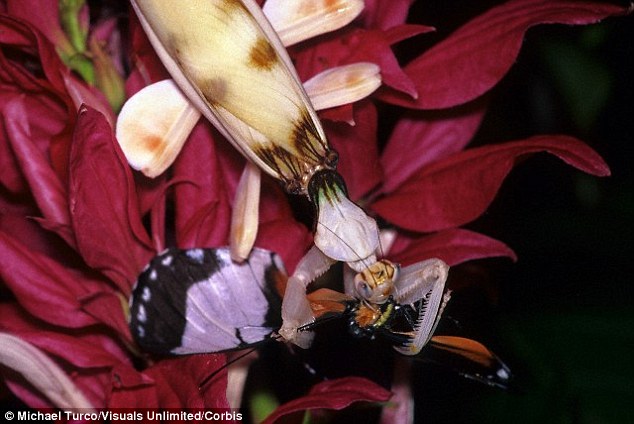
The Malaysian orchid mantis (Hymenopus coronatus) is a unique species of mantis that lives in the South Asian rainforests of Malaysia, Sumatra, and Indonesia. It is quite small, only about two and a half inches long at most for the female, and displays the greatest sexual dimorphism of all the mantids. Males are half the size of the female and there is even a slight difference in the coloring of a band-like marking around the neck. This marking is green in sub-adult females and a brownish purple on sub-adult males. Either color goes nicely with the subtle, creamy pastel shades of the mantis’ body. The species itself can come in a range of colors depending on what environment it matures in. Most often it is white or pink, but there can be purple, yellow, green and a variety of other colors.

Adult male and female.

Although the Malaysian orchid mantis is a beautiful creature, it is also a vicious predator. As the name suggests, this mantis often chooses orchid flowers as its hunting grounds. Its body is camouflaged perfectly to match the botanical backdrop on which it hides. The four walking legs are even equipped with petal mimicking projections so as to camouflage better. All the mantis needs to do is lie in wait, perfectly still, for some poor unsuspecting insect to visit the flower. Once this occurs, the mantis grabs it up in its sharp, spiny forelegs with lightning speed and proceeds to rip it apart with its powerful jaws. It uses this same weaponry to defend itself from harm when threatened and can become quite aggressive if disturbed. First it will rise up into a threat display with its arms outstretched and wings spread wide. If it still feels bothered then it will attack. Those arms can actually inflict a good amount of damage to a human hand and the mantis will not hesitate to bite any place it can reach.

Another very interesting defense is used only by orchid mantises when they are very young nymphs. The little baby mantises walk around disguised as a dangerous species of ant. They hold their abdomens curled over their bodies and move with an ant-like motion. They walk on all six legs, which are tipped in black, contrasting with their bright red bodies. This allows them to avoid predators that aren’t looking to mess around with getting stung or bitten by ants and also as a cover-up to go hunting real ants. It is evident that these clever insects are masters of camouflage at every stage of life.

Ant mimicking nymph.

Although the ant disguise is a striking technique, it doesn’t last long. A nymph loses this costume after the first molt and begins to look like a tiny adult instead. Orchid mantis females go through seven molts to reach adulthood and males go through five, maturing much quicker but living shorter lives. The average female lives about eight months while a male will only live to be five or six months old. Once a nymph becomes an adult, it develops large wings and becomes a very good flier and can travel more effectively. Orchid mantises don’t just frequent orchids. They will hang around in many other flowering plants and trees such as papayas and the wonderfully scented plumeria. So if you live in Southern Asia, definitely go check out some flowers to see if you can find one of these stunning insect beauties.

12089400405_b46f654ba2_z

Sub-adult female by “Frupus” on Flickr (see link below).

References:
1.”Orchid Mantis – Hymenopus Coronatus.” Keeping Insects. Keepinginsects.com, n.d. Web. 23 June 2015. <http%3A%2F%2Fwww.keepinginsects.com%2Fpraying-mantis%2Fspecies%2Forchid-mantis%2F>.

2. O’hanlon, J. C., D. Li, and Y. Norma-Rashid. “Coloration and morphology of the orchid mantis Hymenopus coronatus (Mantodea: Hymenopodidae).” Journal of Orthoptera Research 22.1 (2013): 35-44.

3. “Malaysian Orchid Mantis.” WAZA. World Association of Zoos and Aquariums, n.d. Web. 23 June 2015. <http%3A%2F%2Fwww.waza.org%2Fen%2Fzoo%2Fchoose-a-species%2Finvertebrates%2Finsects-and-millipedes%2Fhymenopus-coronatus>.

Photo Links:
1. http://lemondedesphasmes.free.fr/IMG/jpg/Hymenopuscoronatuscoupleadulte2.jpg

2.http://i.dailymail.co.uk/i/pix/2015/01/27/251D8E8800000578-0-image-a-43_1422365247535.jpg

3. https://s-media-cache-ak0.pinimg.com/736x/c1/d7/77/c1d777466221bdcf3f8634826ec41996.jpg

4. https://flic.kr/p/jqiky2