Don’t Say “Ugh” To THIS Slug – Nudibranchs

   Now it’s time for one of my favorite animals out there. This article has been long overdue. I’m talking about nudibranchs! The colorful, badass, and diverse group of marine slugs. But first, I have some honorable mentions. These may not be part of the Nudibranchia order, but they’re still amazing and deserve a shoutout.

   One group is Cephalaspidea (headshield slugs), which includes such animals as the cannibalistic Navanax and sand dwelling Aglaja. Next are the Saccoglossa (“sap-sucking” sea slugs), that steal the chloroplasts of the algae they eat and use them to become solar powered. New research on this group of slugs has even revealed a species, Elysia marginata, that can self-decapitate and live as an autonomous head without a heart or digestive system as it regenerates its entire body in under a month. It’s hypothesized that the slugs do this primarily to rid themselves of heavy internal parasite loads. Only younger slugs are capable of regeneration like this. Older slugs will usually die after undergoing this extreme form of autotomy (the process of voluntarily shedding a body part, usually in response to a threat). Last but definitely not least, we have the orgy loving, purple ink spewing Aplysiidae (sea hares). This family contains the largest gastropod in the world – the black sea hare (Aplysia vaccaria) – with the most massive specimen weighing just under 31 pounds and stretching over 3 feet long! What an amazing gang of critters we have here!

Internet personality and wildlife educator, Coyote Peterson, holding a black sea hare (from his YouTube thumbnail).

   Now that we’ve met some of their relatives, let’s meet the actual nudibranchs themselves. Nudis, as they are affectionately referred to by many who study and adore them, come in a couple of flavors. We have the aeolids and the dorids. We’ll start with aeolids since they are probably the most recognizable and are famous for their gorgeous, often stunningly colorful, cerata. Cerata (singular, ceras) are extensions of the animal’s back that increase surface area and aid in respiration through gas exchange. Not only this, but these structures also contain branches of the sea slug’s digestive tract. If these two things weren’t enough, the cerata also house another secret.

Cerata on the thick-horned nudibranch (Hermissenda crassicornis).

   Aeolid nudibranchs love to feed on cnidarians, a large group of animals including anemones, hydroids, corals, and jellies, and this is where their super power comes in. Famously, cnidarians sting anything they come into contact with. How do nudis get past this defensive strategy? Among other, more poorly understood modes of protection, they may use armor to keep themselves safe. Chiton, the invertebrate analogue of keratin, is notably quite tough. Some aeolids have intracellular granules of chiton both on the outside and the inside that prevent nematocysts, the packets containing coiled stinging cells, from penetrating their tissues when fired. With this ability the nudis are able to ingest the prey animal’s tentacles safely. The most impressive part about these slugs’ feeding habits is that the tip of each ceras has a structure called a cnidosac. Each cnidosac contains a few, inactivated, nematocysts that have been stolen from their prey. To summarize, aeolid nudibranchs eat their prey, stingers and all, then pass many of those stingers up to the tips of their cerata to use as their own defense. It’s very much insult to injury for the poor cnidarians they feed on. These weaponized meals are called kleptocnidae, which very fittingly means ‘stolen sting’. Some nudibranchs even possess stings strong enough to harm humans. One of these is arguably the most popular sea slug, Glaucus atlanticus (also called the blue sea dragon), probably due to its very Pokémon-like appearance. G. atlanticus is pelagic and feeds on the Portuguese man o’ war and related siphonophores, resulting in an equally potent sting.
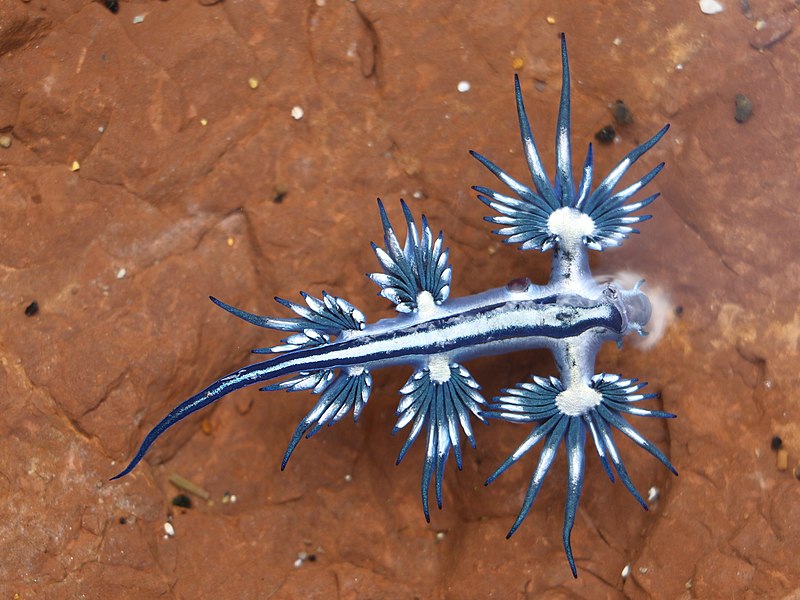
Glaucus atlanticus photograph by Peter Woodard.

   The bright colors of many aeolid nudis are usually enough to deter predators, but if that fails, they get a nasty sting, courtesy of their own prey. Even with the warning colorations and kleptocnidae, there is the inevitability that some predators will persist. When this does occur, there are a few final parlor tricks up the slug’s proverbial sleeve. Not all nudibranchs have the ability, but many can just swim away if they’ve had enough. And remember our friend Elysia who can decapitate itself? As it turns out, plenty of aeolid nudibranchs can autotomize too, though not to the same level of drama. Many studies have demonstrated that a firm pinch to a slug’s ceras will result in its detachment, leaving the predator distracted with a squirming, mucus spewing appendage as the owner swims away. As with Elysia and many other animals that can autotomize, nudibranchs can regenerate lost cerata. It usually takes just over 40 days to fully regenerate one – a small price to pay for survival and the chance to reproduce.

An adorably plump “shaggy mouse” nudibranch (Aeolidia loui) on a shell.

   Speaking of reproduction, all nudibranchs are hermaphroditic. This means they have both male and female sex organs. Although they possess the equipment and the potential to fertilize themselves, there is little indication that they actually do so. These slugs prefer to have a partner involved. They find each other through chemicals in the trails of mucus left behind while traveling. A pair of structures on the head, the rhinophores, detect these chemicals in the water. This is akin to how a moth follows pheromones in the air with the help of its feathery antennae. The closest human analogue to this is our sense of smell, though it still differs quite radically. Many species, such as the barnacle eating dorid (Onchidoris bilamellata), often have mass spawning orgies that can cover entire rocks, but generally it is more of a quiet affair. When two slugs find each other and are both ready to mate, they participate in a circling, dance-like courtship before aligning their genitals. The reproductive opening is located on the right side of the head and contains both a penis and a vagina. One species of slug, Goniobranchus reticulatus, is famous for its disposable penis that detaches in the recipient and then regrows within a day. Plenty of others do this too, but G. reticulatus was the first to make headlines. Once mating is complete, both partners tend to go their separate ways. Sperm is stored inside a special sac until the eggs are ready to be fertilized internally. Eggs are laid in a ribbon on or near the nudibranch’s preferred prey and typically hatch within a week or 2 as tiny larvae called veligers.

Barnacle eating dorids during an orgy.

Aeolidia sp. pair with eggs.

A Heath’s dorid (Geitodoris heathi) sitting under its yellow ribbon of eggs.

   The mating behaviors discussed above are shared by both kinds of nudibranchs, but there are plenty of other things unique to the dorids. One of the most obvious of these is that they completely lack the billowing cerata that make aeolids so recognizable. Instead, they blatantly demonstrate where they get their name. Nudibranch is a mashup of Latin and Greek derived words meaning “naked” and “gills”, respectively. Cerata are multifaceted and have no single obvious function that can be visually ascertained at a quick glance and aeolids are clearly shell-less and therefore still naked as far as mollusks go. Dorids, however, display their gills right out in the open and it is very easy to recognize them as such. This tuft of gills, often referred to as “butt fluff”, is situated on top of the animal’s rear and can be drawn into the body when necessary. The gills also happen to surround the slug’s anus which… works for them. You may be wondering how these naked squishies avoid being eaten if they don’t have the fancy cerata defenses of their aeolid brethren. As it turns out, dorids have some nasty tricks of their own. Rather than stealing stingers, these not so garden variety slugs steal poisons and sequester them in their tissues. This makes them toxic. *Cue Britney Spears* A few are able to synthesize their own toxins, but most get them from prey. Dorids usually feed on sponges and can be very specialized, often only feeding on a single species. Many are very well camouflaged to their prey due to the necessity of living on or near it. Predators may have a difficult time spotting nudis like this and if they do, they may get a bad tasting surprise. Others choose to loudly advertise their toxicity with bright colors. Plenty of aeolids do this too and it is a fantastic example of aposematic coloration. “Eat me and you’ll regret it!” or “Touch me and you’ll get hurt!” These vibrant warning patterns and colors are exactly what make these animals so visually appealing to us. We see beautiful little dragons while predators see a bad time.
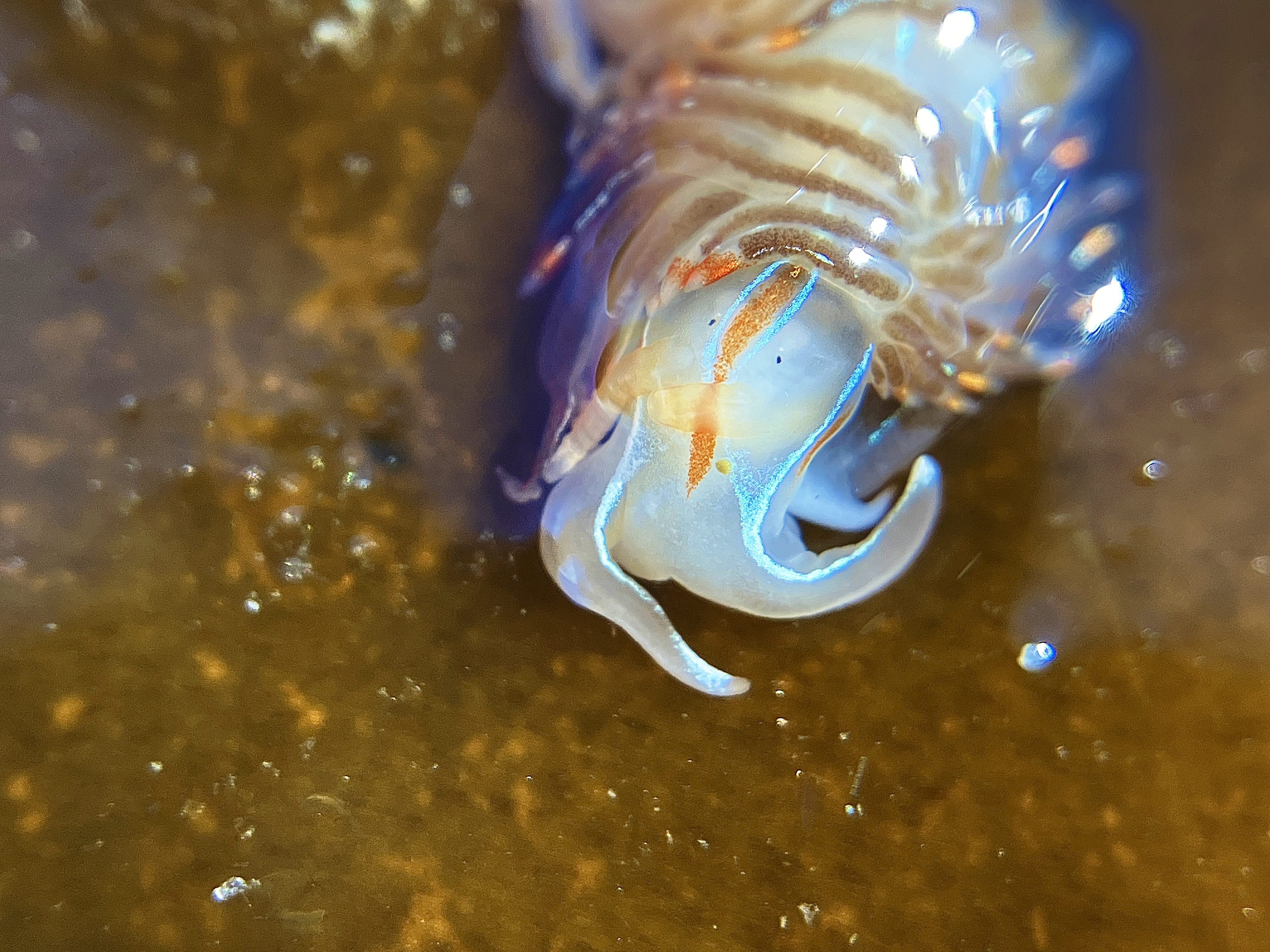
This thick-horned nudibranch looks like it’s glowing! You can even see its tiny eyespots.

   Nudibranchs are varied and complex animals that are continually revealing new secrets to us. If you weren’t a fan of sea slugs before, I hope you are now. It is unfortunate that their land dwelling cousins aren’t nearly as beautiful, but remember that they are still cut from the same cloth. Maybe that will change your perspective a little the next time you encounter one. Perhaps when you hear the word “slug”, your reaction will no longer be one of disgust if it was before.

Here is a link to a group of sea slug photos that show off just how diverse they are. Only one of these, the “leaf sheep” (Costasiella sp.) is not a nudibranch, although it is labeled as such: https://www.scubadiving.com/photos/photo-contest-gallery-nudibranch-central

Please also enjoy this video of slugs from the Philippines. Keep in mind, this is just one small spot, but has a mind boggling array of species. This group of animals is so insanely diverse, it’s hard not to drop your jaw in awe.

References:
1. Mitoh, Sayaka, and Yoichi Yusa. “Extreme Autotomy and Whole-Body Regeneration in Photosynthetic Sea Slugs.” Current Biology, vol. 31, no. 5, 8 Mar. 2021, doi:10.1016/j.cub.2021.01.014.

2. Rudman, Bill W. “Aplysia Vaccaria.” The Sea Slug Forum, Australian Museum, 2006, http://www.seaslugforum.net/showall/aplyvacc.

3. Greenwood, Paul G. “Acquisition and Use of Nematocysts by Cnidarian Predators.” Toxicon, vol. 54, no. 8, 6 Mar. 2009, pp. 1065–1070., doi:10.1016/j.toxicon.2009.02.029.

4. Miller, Jennifer A., and Maria Byrne. “Ceratal Autotomy and Regeneration in the Aeolid Nudibranch Phidiana Crassicornis and the Role of Predators.” Invertebrate Biology, vol. 119, no. 2, 11 May 2005, pp. 167–176., doi:10.1111/j.1744-7410.2000.tb00005.x. Accessed 22 Oct. 2022.

5. Sekizawa, Ayami, et al. “Disposable Penis and Its Replenishment in a Simultaneous Hermaphrodite.” Biology Letters, vol. 9, no. 2, 23 Apr. 2013, pp. 1–4., doi:10.1098/rsbl.2012.1150. Accessed 8 Nov. 2022.

6. Sekizawa, Ayami, et al. “Another Usage of Autotomized Penis.” Journal of Ethology, vol. 39, no. 3, 15 May 2021, pp. 319–328. Springer, doi:10.1007/s10164-021-00706-1. Accessed 8 Nov. 2022.

7. Ottuso, Patrick Thomas. “Close Encounters With the Environment.” MDedge, May 2009, cdn.mdedge.com/files/s3fs-public/Document/September-2017/083050237.pdf. Accessed 5 Nov. 2022.

8. Faulkner, D.John, et al. “Geographical Variation in Defensive Chemicals from Pacific Coast Dorid Nudibranchs and Some Related Marine Molluscs.” Comparative Biochemistry and Physiology Part C: Comparative Pharmacology, vol. 97, no. 2, 19 Apr. 1990, pp. 233–240. Science Direct, Elsevier, doi:10.1016/0742-8413(90)90133-t. Accessed 5 Nov. 2022.

Photo Sources:
1. https://www.youtube.com/watch?v=15I8eIqh9iI
2.
https://commons.wikimedia.org/wiki/File:Glaucus_atlanticus_Long_reef.jpg
All other photos  taken by me.

Video Link: https://www.youtube.com/watch?v=_f3GpKiaQUA

Curious Cuttles – Dwarf Cuttlefish (and friends)

    There appears to be some unspoken rule that tiny versions of things are exponentially more adorable. Take for instance hummingbirds, pygmy marmosets, dwarf elephants, pygmy hippos, or Brookesia micra (the chameleon that fits comfortably on the head of a match). The dwarf cuttlefish (Sepia bandensis), with a mantle length of under three inches, is no exception. Dwarf cuttlefish are at home in the warm waters of the Indo-Pacific including, but not limited to, the Philippines, New Guinea, and Sulawesi. Living mostly in shallow coastal waters, these tiny cephalopods are most active at night, feeding on small crustaceans or fish found over sand and reef. Like almost all members of their group, dwarf cuttlefish are exclusively shallow water inhabitants. This is because of the vestigial cuttlebone that’s contained within the mantle. The cuttlebone is a remnant from the ancient history of cephalopods. Like the ancestral shell, it still retains tiny chambers filled with gas that assist with buoyancy. As a consequence, the cuttlebone will implode if the poor creature swims too deep. Being relatively restricted to shallow water does have its perks, though. Since there is so much light, cuttlefish get to fully utilize their incredible skin to create a wide variety of colors, patterns, and textures to communicate with each other and other animals.

     One of the most spectacular displays used by these tiny cuttles is known as the “passing cloud”. It consists of dark bands of color moving down the animal’s mantle via the pulsing of chromatophores in the skin. While this occurs, the cuttlefish keeps the rest of its body’s color and pattern static (unchanging).

Here you can see the passing cloud display in action on this dwarf cuttlefish that I filmed at the Seattle Aquarium. It does it at the beginning and the end of the video.

S. bandensis is not the only cuttlefish species to display these strange, psychedelic waves. Many other cuttlefish do this as well, and also some octopuses. Not surprisingly, the display differs in each species and there are many variations of it. These bands can occur on almost any part of the body and go in different directions depending on the species. The delightfully named Wunderpus photogenicus, an octopus, pulses dark bands over its eyestalks. Perhaps the most interesting thing about pulsing displays like the passing cloud is that no one knows for sure what the purpose is.

Did you notice the pulses on Wunderpus’s eyestalks?

     There is a myriad of possibilities of what the displays could be used for. Some cephalopods, such as the broadclub cuttlefish (Sepia latimanus), almost certainly use these displays for hunting. These cuttlefish can sometimes be seen rapidly pulsing the chromatophores on their arms before pouncing on prey. It’s possible that the chromatic pulses mesmerize prey, holding them in place while the cuttlefish positions itself for a deadly strike. The Australian giant cuttlefish (Sepia apama) has been observed using pulse displays in spawning aggression and while drifting in and out of seaweed. These are both notable examples of how pulse displays can be used. Male cuttlefish are well known for displaying aggression to rivals with one half of the body, while showing receptivity to females with the other half. Communication is extremely important among cephalopods and pulse displays seem to serve this purpose well. Camouflage is also a famous attribute of cuttlefish and octopuses alike. Creating rhythmic waves that mimic the rippling light coming from the surface while drifting with the weeds is an excellent way to hide. It definitely puts those chromatophores to good use by helping protect the animal from predators.

This broadclub cuttlefish is using its chromatic pulses to hypnotize a crab. It has its two outer arms positioned in what is called a “branched coral” pose.

     The functions of chromatic pulse displays like the passing cloud are not as obvious in other contexts. The extraordinarily cute and adorably named flamboyant cuttlefish (Metasepia pfefferi) will pass waves over its body in as simple a situation as sauntering over an open mudflat. There is a possibility that, along with its bright colors, this could serve as a warning to potential predators. Cephalopod expert Mark Norman has found that the flesh of this little cuttlefish is incredibly toxic. However, this is only anecdotally recorded in the NOVA special Kings of Camouflage and there has been no scientific study published yet that analyzes the toxins. Toxic or not, the flamboyant cuttlefish uses it’s chromatophores to send a message, supporting the potential communication function of pulse displays.

This tiny flamboyant cuttlefish is too cute as it walks around strutting its stuff. Could it be saying “Don’t eat me, I’m toxic!”?

     It’s pretty clear that passing clouds and other pulses have specific uses depending upon the environmental or behavioral context of the animal creating them. That is, it’s pretty clear for most of the cuttlefish I’ve mentioned. Alas, the star of this article – the diminutive dwarf cuttlefish – still hides its secrets. Although I am privileged to have seen and video recorded the passing cloud behavior at the Seattle Aquarium many times, I still can’t figure out what these little cuttles are using it for. One minute, an individual may be hovering in place with wave after wave passing over its mantle and the next it will be almost completely black and fighting with a tank mate. From my pathetically inferior human perspective, it seems random. There is the possibility that these captive bred cuttlefish are behaving a little differently than they would in the wild, or that they are influenced by the presence of people. With so many variables, it’s difficult to tell what the dwarf cuttlefish are using it for without a full blown scientific study. Even with the most skilled researchers giving it their all, we will probably never know just what goes on in the minds of these tiny cuttlefish (or any of the other species).

fullsizeoutput_c68

This is a photo I took at the Seattle Aquarium. You can see the tiny suckers on this dwarf cuttlefish’s adorable little arms as it watches me through the glass.

     Cephalopod nervous systems are so different from our own that we can only make feeble guesses at how they think and feel about the world. Can you imagine having your brain directly connected to your skin so you could change color and texture in fractions of a second just by thinking? Me neither, but wouldn’t it be cool? That’s an everyday reality for almost all modern cephalopods and something we can’t even begin to relate to. As our understanding of these fascinating creatures improves and science gives us new ways of studying them, we may come closer to discovering what it all means. Until then, let’s just admire their beautiful and complex alien language for what it is – one of the many wonderful mysteries of the natural world.

References:
1. Mustain, Andrea. “World’s Tiniest Chameleon Discovered.” LiveScience. Purch, 14 Feb. 2012. Web. 12 July 2017

2.“Stumpy-spined Cuttlefishes, Sepia bandensis.” MarineBio.org. MarineBio Conservation Society, n.d. Web. 2 March 2017.

3. How, Martin J., et al. “Dynamic Skin Patterns in Cephalopods.” Frontiers in Physiology, vol. 8, 2017, Accessed 31 July 2017.

4. Cuthill, Innes C. “Animal Behaviour: Strategic Signalling by Cephalopods.” Current Biology, vol. 17, no. 24, 2007, pp. 1059–1060. ScienceDirect, Accessed 31 July 2017.

5. Hanlon, Roger. “Cephalopod Dynamic Camouflage.” Current Biology, vol. 17, no. 11, 2007, pp. 400–404. ScienceDirect, Accessed 31 July 2017.

6. Osorio, Daniel. “Cephalopod Behavior: Skin Flicks.” Current Biology, vol. 24, no. 15, 2014, pp. 684–685. ScienceDirect, Accessed 31 July 2017.

7. Laan, Andres, et al. “Behavioral Analysis of Cuttlefish Traveling Waves and Its Implications for Neural Control.” Current Biology, vol. 24, no. 15, 2014, pp. 1737–1742. ScienceDirect, Accessed 31 July 2017.

8. Kaufmann, Gisela, director. Kings of Camouflage. NOVA, 2011.

9. Staaf, Danna. “Sheathing the Shell.” Squid Empire: the Rise and Fall of the Cephalopods, ForeEdge, an Imprint of University Press of New England, 2017, p. 112.

Video Links:
1.https://www.youtube.com/watch?v=u76P3gCLWn4

2.https://www.youtube.com/watch?v=baNp8bgOtok

3.https://www.youtube.com/watch?v=qjloPutUCeo

4.https://www.youtube.com/watch?v=51jB8YljliM

Unfishy Fish

     What do you think of when someone says “fish”? The image of a salmon or goldfish probably pops into your mind. Or perhaps a colorful tropical reef fish. Odds are, you’re not thinking of a lipstick wearing, pancake shaped animal with frog feet and a long, pointy nose. You’re most likely not thinking of a Toblerone shaped shark with swirly nostrils either. The fact is, evolution doesn’t care what your idea of a fish is. It’s going to go with what’s successful and if it looks like a nightmare clown, so be it. Evolution doesn’t have a goal or a grand plan. What happens will happen and if something works, it persists.

fishdiagrams1

A generalized fish body plan.

     So here we are with and ocean of oddities to explore. To start with, let me introduce you to something that looks more or less like a ‘proper’ fish, but didn’t get the memo about how to swim like one. Enter, the razorfish (Aeoliscus strigatus). This fish is elongated and laterally compressed, giving it a razor thin appearance, hence the name. It feeds on tiny zooplankton such as brine shrimp as it hides among corals and seagrasses. Razorfish swim vertically in small schools with their snouts pointed down at all times. It is not known exactly why they do this, but it’s certainly entertaining to watch. With razorfish, it’s always a synchronized swim show. For the razorfish, the warm waters of the western Indo-Pacific are the perfect place to engage in these underwater ballets.

poisson-rasoir-01

A school of razorfish.

     Another weird, warm water inhabitant to be featured here is at home in the lower estuary of Derwent River in Tasmania and several other locations along the southeastern coast of Australia. Unfortunately, it is now critically endangered because of a multitude of factors including a low reproduction rate, habitat destruction, and suspected predation by an introduced sea star. The spotted handfish (Brachyonichthys hirsutus) has a sail like dorsal fin and large, webbed ‘hands’ which it uses to walk along the silty bottom. It belongs to of the order Lophiiformes, along with other strange members like deep sea anglerfishes and frogfish.

spotted-handfish

Spotted handfish.

Unlike many other fish, which hatch out as larvae that further develops outside the egg, spotted handfish emerge as tiny, fully formed versions of their parents. Rather than floating among the plankton of the open water, these babies stick to the sandy floor and live out the rest of their lives there. The peculiar reproduction habits of this fish are exactly what make it vulnerable to the northern Pacific sea star (Asterias amurensis). Before they become fish, the eggs are attached to stalked sea squirts and other vertical organisms that are extremely appetizing to the star. As a consequence, the eggs are devoured along with the sea star’s target prey. Conservation efforts have since been set in motion to save this unique Australian animal. Along with a captive breeding program and hope of reintroduction, there has been some success with providing manmade alternatives for the handfish to lay their eggs on. Handfish have been using these sticks and as a result fewer eggs are lost to the ravenous sea star. The spotted handfish is a protected species and one of the benefits that comes with that status is efforts to reduce silt and pollution within the Derwent River estuary and restore quality to the fish’s habitat. Even though the spotted handfish is still very much at risk, there is hope for it and therefore hope for other endangered animals.

     Our next fish is not nearly as well known as some of the others on this list. It doesn’t live in warm water either and instead spends its life thousands of feet down on continental slopes where the majority of the sun’s light fails to reach. Chaunax pictus, the pink frogmouth, is another member of the anglerfish order. It can only be glimpsed from the window of a submersible or through the eyes of an ROV sent to explore the depths of the ocean. There is virtually no data about its reproductive habits, life cycle, or population trend. One study of C. pictus in the Arabian Sea observed that it only eats small shrimps. With a dearth of information like this, the most interesting thing about this fish is its appearance. Imagine a squat, pink or orange potato with a scowl to rival that of Grumpy Cat and you’re pretty much there.

pink_frogmouth_chaunax_pictus

Pink frogmouth

The pink frogmouth uses its odd fins to crawl around over rocky slopes in search of prey when it’s not sitting motionless, camouflaged as a pissed off lump of cheese. The Chaunax in the video below starts walking at 1:55 if you’d like to see it in action.

     Slightly more attractive, though no more at home in shallow water, is the Caribbean roughshark (Oxynotus caribbaeus). One of the few fish on here that isn’t part of the anglerfish order, it is closely related to the more commonly seen prickly dogfish (Oxynotus bruniensis). Almost nothing is known about the natural history of the Caribbean roughshark other than that it inhabits the upper continental slope from the Gulf of Mexico to Venezuela. This shark has sloping sides and a concave belly that give it the appearance of an animal that was forced through a triangular Play-Doh mold. Its sandpapery skin is pale gray to white with dark brown patches, which actually make it quite striking.

600xnxoxynotus_caribbaeus2-pagespeed-ic-iaz2swwcfo

Caribbean roughshark.

500px-caribbean_roughshark

Swimming Toblerone

The prickly dogfish is less showy, but just as oddly shaped. The scales are raised and conical like studs making it truly deserving of its name. Like the Caribbean roughshark, it is small, only reaching a little over two feet from snout to tail. It has a mouth reminiscent of the cookie cutter shark and feeds on the eggs of other Chondrichthyans (cartilaginous fish). Prickly dogfish can be found in shallower water than roughsharks, but are also seen at great depths.

Ichthyology

Prickly dogfish.

Sharks are generally thought of as sleek and streamlined predators designed to kill, but these two species just reinforce the fact that every family has some real weirdos.

     Now we get to my personal favorite, and arguably weirdest of this group, the batfish. Despite their name, the batfishes, or Ogcocephalidae, don’t resemble bats in the least. In fact, they might be more suited to the name clownfish if that weren’t already claimed by the well known anemonefish everyone knows and loves from “Finding Nemo”. All batfishes are strange looking, but the red lipped batfish (Ogcocephalus darwini) takes the cake. With flattened body, nose-like face protrusion, and bright red lipstick looking like it was put on while drunk, this fish could be mistaken for a clown at a sorority party gone a little too far.

NGS Picture ID:1231868

Hey there, beautiful!

Also called the Galapagos batfish, it does indeed inhabit the warm, shallow waters of the Galapagos islands and nowhere else. It can be found swimming very awkwardly along reef edges over sandy substrate where its prey resides. Much of the time, it doesn’t even bother to swim. Instead, it crawls along the sand like a squashed frog and pauses frequently to lure prey.

Whereas many of its angler relatives use a nifty lure that comes out near the head region, the red-lipped batfish has one just above its lips under that pointy nose, which makes it look exactly like it has a perpetual booger hanging out of its nostril. The lure is bobbed up and down, acting as both a visual and chemical attractant for small invertebrates and a turn off for anyone else.

     Of course, it’s not this poor batfish’s fault that it looks so ridiculous. It has evolution to thank for that. For some reason, this strange body plan worked and stuck around as a result. The same goes for the rest of the fish featured in this article and so many more that it would be impossible to cover them all here. This was just a taste of the numerous odd ducks of the fish world and hopefully another motivation to keep exploring the stranger things out there. You never know what we might find next.

References:

1. Clemens, Danny. “The Red-Lipped Batfish Is Always Ready for a Night on the Town.” DSCOVRD. Discovery Channel, 07 July 2015. Web. 21 July 2016.

2. Montoya, P. Zelda, et al. “The Natural History and Husbandry of the Walking Batfishes (Lophiiformes: Ogcocephalidae).”DRUM and CROAKER: 6.

3. Schulz, Katja. “Galápagos Batfish – Ogcocephalus darwini.” Encyclopedia of Life. EOL, 2014. Web. 21 July 2016.

4. Rijnsdorp, A. D., M. Costa, and T. Munroe. “Chaunax pictus (Pink Frogmouth, Redeye).” IUCN. IUCN Red List of Threatened Species, 2015. Web. 21 July 2016.

5. Leandro, L. “Oxynotus caribbaeus (Caribbean Roughshark).” IUCN. IUCN Red List of Threatened Species, 2004. Web. 21 July 2016.

6. McGrouther, Mark. “Prickly Dogfish, Oxynotus bruniensis.” Australian Museum. Australian Museum, 2 Dec. 2013. Web. 21 July 2016.

7. McGrouther, Mark. “Spotted Handfish, Brachyonichthys Hirsutus.” Australian Museum. Australian Museum, 3 Sept. 2015. Web. 21 July 2016.

8. “Spotted Handfish (Brachyonichthys hirsutus).” Arkive.org. Wildscreen, n.d. Web. 21 July 2016.

9. Capuli, Emily Estelita. “Aeoliscus Strigatus.” FishBase. Ed. Roxanne Rei Valdestamon. Sea Around Us, n.d. Web. 21 July 2016.

Photo and Video Links:

1. http://evolution.berkeley.edu/evolibrary/article/fishtree_02

2. http://les-z-animaux.e-monsite.com/k/poissons-marins-tropicaux/autres-poissons-marins-tropicaux/poissons-lapins-et-poissons-rasoirs/poisson-rasoir-aeoliscus-strigatus.html

3. https://www.youtube.com/watch?v=PN9Rc5DrOzw

4. http://www.arkive.org/spotted-handfish/brachionichthys-hirsutus/

5. http://www.uniprot.org/taxonomy/242967

6. https://www.youtube.com/watch?v=WC69Iq8oMlo

7. http://shark-references.com/species/view/Oxynotus-caribbaeus

8. http://www.wikiwand.com/en/Oxynotus

9. https://australianmuseum.net.au/prickly-dogfish-oxynotus-bruniensis-ogilby-1893

10. http://www.natgeocreative.com/photography/1231868

11. https://www.youtube.com/watch?v=bjwnHDR7t_I