The spotted lanternfly (Lycorma delicatula) is the new kid on the block and current poster child for runaway invasive pest insects in the United States. This bug, a member of the planthoppers (Auchenorrhyncha), hails from China and its surrounding countries. One of the reasons for its off the charts threat level is its polyphagous diet. The insect feeds on the phloem of plants in a broad range of taxonomic groups (Urban and Leach 2023). Many of those groups contain economically important plants, including but not limited to hops, grapes, apples, stone fruit, almonds, pine, and hardwoods like walnut (USDA 2023). The tree of heaven (Ailanthus altissima) is its preferred host. The spotted lanternfly was first detected in Pennsylvania in 2014 and it has since spread across a large portion of the eastern U.S. (New York State Integrated Pest Management Program 2023). The range is rapidly expanding and is projected to reach a majority of the country. Many quarantine zones have been established to help slow the spread (Urban 2020). Despite these efforts, the bug will almost certainly breach these boundaries and continue to grow in numbers. Although it does best with its preferred host, mentioned above, the lanternfly is capable of reproducing without access to this resource (Uyi et al. 2020). However, development time is slower and fewer egg masses are laid before the northeastern winter kills the remaining adults. But in states with warmer climates, it could potentially survive the winter and create more offspring (Uyi et al. 2020, Xin et al. 2020). This adaptability makes it an even more threatening economical and ecological pest.
The tree of heaven – a lanternfly’s favorite food (Credit: Pixbay)
The spotted lanternfly itself is quite stunning. In adults, the forewings are leathery in texture and a pinkish grey with contrasting black spots. This color becomes criss-crossed with a mosaic of yellow veins on the distal third of the wings. Underwings are striking red and black with a white bar on each one. The first three instars of the immature stage are black with white spots and become an intense red with black and white spots by the fourth and final instar. Being beautiful does not give these insects a pass, though. Large congregations, sometimes up to 1,000 per tree (Urban 2020), in urban and suburban areas excrete large quantities of honeydew that results in sticky buildup beneath the plants on which they feed. This sugary coating encourages the growth of sooty mold that severely impacts the health of affected plants (Urban and Leach 2023). This is becoming particularly problematic in vineyards (Urban, 2020). The mouthparts of lanternflies also leave seeping wounds in plants, causing physiological stress and leaving an entry point for pathogens (Uyi et al. 2020). Controlling the dispersal of spotted lanternflies can be very difficult because of how flexible the insects are with where they lay their eggs.
Sooty mold growth caused by honeydew (Credit: Scott Nelson)
Management strategies are evolving as more is learned about the lanternfly’s life history and ecology as it pertains to the United States. Great care must be taken when transporting goods and equipment from areas where infestations occur. Lanternflies will lay their eggs on trees, cut wood, concrete, in the wheel wells of vehicles, and on any other natural or artificial surface that is suitable (Urban and Leach 2023). Local and federal government departments have information readily available about the pestilential planthoppers and how citizens can combat them. The primary directives are to smash adults and nymphs on site, check belongings before traveling or transporting anything in and out of buildings, destroy any egg masses found, and report sightings to help track the spread (USDA 2023).
The life cycle of a spotted lanternfly (Credit: USDA)
The standard method of agricultural and environmental industry control remains the application of chemical insecticides, particularly the neonicotinoid dinotefuran and a variety of pyrethroids. The downside to these treatment strategies is the negative effect they can have on non-target species when applied to large areas (Urban and Leach 2023). Emerging control methods that are less environmentally harsh consist of exclusion netting, targeted insecticide application, and bio pesticides such as Beauveria bassiana, a soil dwelling fungus. Other entomopathogenic fungi are currently being explored as options as well (Urban and Leach 2023). Xin et al. (2021) surveyed parasitoids of the spotted lanternfly that occur in its native range, but more research is needed to determine whether they are practical as biological control agents.
A spotted lanternfly adult with its brilliant red hind wings displayed (Credit: Chesapeake Bay Program)
As the spotted lanternfly invasion problem continues to evolve, many challenges are arising. The use of pesticides, as mentioned, can impact unintended targets. There is also potential for the bugs to develop resistance to the chemical weapons we throw at them. Less environmentally harmful substances including neem and essential oils have shown only mild efficacy at a local level. Sticky traps encircling tree trunks sometimes kill birds and small mammals as bycatch and do not really have a significant impact on heavy populations of lanternflies anyway (Urban and Leach 2023). There is no perfect solution and management strategies will have to change along with the pest. Only time will tell what level of havoc this beautiful destroyer will wreak upon our economy, agricultural industries, and environment.
References: 1. Urban, Julie M., and Heather Leach. “Biology and management of the spotted lanternfly, Lycorma delicatula (Hemiptera: Fulgoridae), in the united states.” Annual Review of Entomology 68 (2023): 151-167.
4. Urban, Julie M. “Perspective: shedding light on spotted lanternfly impacts in the USA.” Pest management science 76.1 (2020): 10-17.
5. Uyi, Osariyekemwen, et al. “Spotted lanternfly (Hemiptera: Fulgoridae) can complete development and reproduce without access to the preferred host, Ailanthus altissima.” Environmental Entomology 49.5 (2020): 1185-1190.
6. Xin, Bei, et al. “Exploratory survey of spotted lanternfly (Hemiptera: Fulgoridae) and its natural enemies in China.” Environmental Entomology 50.1 (2021): 36-45.
Ants. Can’t live with them, can’t live without them. They’ve been around for ages and outnumber us by over a million to one. They’re not just home invaders and picnic crashers; they’re the only other animal known to have sophisticated agriculture and manage herds of livestock. With more than ten thousand species to choose from, there’s an ant for every occasion. Did you rip your favorite shirt? Make friends with some weaver ants. Are you looking for someone to mow your lawn? Hire an army of grass cutter ants. Is life dull and you just want a thrill? Try bothering a stampede of African driver ants and get the adrenaline rush of a lifetime. I’ve mentioned ants before, but now is their time to have the spotlight.
African driver ants, or Siafu, are infamous for their nomadic colonies that devour anything and everything in their path. Blind soldiers with massive jaws guard the perimeters as the workers march on, carrying the young and the queen. Photo by Peter Steward on Flickr.
I couldn’t possibly cover every ant I would like to in this article, but I did manage to choose a select few, starting with the infamous bullet ant (Paraponera clavata). This ant is well known to have the most painful known insect sting in the world. As its name infers, the sting is likened to having a bullet wound. Justin Schmidt, a dedicated and somewhat eccentric entomologist, has painstakingly (pun intended) stung himself with as many insects as possible to compile the Schmidt Sting Pain Index. The pain of various insect stings, which he describes in wildly imaginative detail, are ranked from 1 to 4 (with 4 being the most painful). Can you guess who won that coveted number 4 on the scale? Take a moment. I’ll wait. Okay, now that you’ve guessed I can confidently assume that you thought about the bullet ant. After all, it is the star of this section. If you did choose the bullet ant, you’re wrong. That honor actually goes to the tarantula hawk wasp. No, the bullet ant doesn’t play by the rules. It has a sting so awful that it got its very own ranking of 4 plus. Not even the scale could contain the pain. As with many other animal toxins, bullet ant stings affect voltage gated sodium channels on cell membranes. This can wreak havoc on a cell’s ability to transmit signals, especially in the central nervous system (CNS). The blocked signals in nociceptors and skeletal muscles are what leads to the intense pain, paralysis, uncontrollable shaking, nausea, and more. The legendary sting of P. clavata is the reason it has become the gatekeeper of boys on their way to becoming warriors. The Sateré-Mawé tribe of Brazil has used this ant for years as part of a culturally important initiation rite. One sting is more than enough to cope with, but Mawé boys must endure multiple stings. Bullet ants are collected and dipped into a natural sedative to be safely woven into large gloves made from palm leaves. At the start of the initiation, a young man must slip both his hands into gloves filled with, now irate, immobilized ants. Only a thin layer of charcoal protects his hands and he must wear these gloves for five minutes straight and take the pain. What’s worse is the effects of the venom last well beyond these five excruciating minutes and boys hoping to become warriors must undergo this nightmare a total of twenty times before they are fully initiated. Forget jaguars, caimans, and anacondas. The Mawé people consider this humble ant to be the worst their rainforest home has to offer.
Great bullet ant photo by Graham Wise on Flickr.
Despite the potency of the venom delivered by the ant itself, one component may have medical significance. This compound of P. clavata, known as poneratoxin (PoTX),can have an analgesic effect in rats if administered in a small, controlled amount. Not only that, but it could potentially serve as a biological insecticide thanks to its ability to block transmission in the insect CNS.
Now it’s time for an ant that poses no threat to people, but is an amazing survivor. Meet the Saharan silver ant (Cataglyphis bombycina). This ant is capable of surviving conditions that would cook virtually any other living creature. In the Sahara desert, the surface of the sand can reach temperatures of up to 158℉ under the brutal midday sun. Several ingenious evolutionary adaptations give C. bombycina the ability to cope with this unforgiving environment while all others must either hide or perish. One strategy is to limit the time of exposure. Even these hardy ants will die if they are out on the scorching sands for long enough. That’s why they turn their foraging trips into a mad dash for their lives. Groups of ants leave their nest in a frantic search for other arthropods, such as desert beetles, that were too slow to escape the sun’s deadly rays. Once located, prey is dragged back to the nest as fast as possible via extraordinary teamwork. The poor animals that die and end up providing for these ants have succumbed to what is known as heat shock. Every living organism produces substances called heat shock proteins (HSPs). HSPs are tied to specific genes (heat shock genes) that, when activated by high temperature, are expressed and direct synthesis of HSPs by the cells. The purpose of these proteins is to protect the body from severe heat shock. Normally they are not produced until there is an environmental trigger, but Saharan silver ants start to produce them before leaving their nests. HSPs are synthesized preemptively to give the ants protection so they don’t die upon exiting their nest. This is because their foraging trips are usually too short to trigger synthesis of HSPs the normal way and the temperature rise would kill them before they got the chance. Not only are these HSPs produced before exposure, they continue to be synthesized beyond temperatures that would kill other animals, giving silver ants an even greater edge.
Another advantage over everyone else is long legs and a fast gate. Even though the sand itself may reach temperatures past what C. bobmbycina can tolerate, it is significantly cooler just a few millimeters off the surface. The long, stilt-like legs of this ant raise it off the sand just enough to keep its body below its critical maximum of 128.5℉. Long legs generally mean an animal can run faster, and C. bombycina is no exception. Its gait is a frenzied sprint that, at top speed, becomes quadrupedal. That’s right, these ants will actually lift their front legs off the ground completely to pelt forward as quickly as they can, and to minimize exposure to the sand. Running fast and limiting each foot’s contact with the ground allows them to go farther and keep cooler in their short bursts of foraging. They use the sun to navigate so that they can keep track of where they are in relation to their nest and how long they have been out.
Unfortunately, special proteins, great legs, and excellent navigational ability aren’t enough to beat the heat. Silver ants actually spend the majority of their scavenging forays offloading heat while sitting atop dry vegetation or stones. What allows them to do this so efficiently is the hair that gives them their name. These gleaming, silvery coats are what put them above and beyond everyone else when it comes to desert survival. Each individual hair is a triangular shape with two ridged surfaces and one smooth surface. The smooth surface sits against the body and the ridged surfaces face outward. When solar radiation hits the surfaces of these hairs, the ridges trap it and scatter that radiation back out in all directions. This is called “Mie scattering” and enhances the hairs’ reflectivity in the visible and near infrared range where solar radiation is at its strongest. In the mid infrared, the silvery hairs become antireflective and help the ants offload heat through emissivity. But what about the heat radiating off the ground? C. bombycina is prepared for that too. The undersides of their bodies are bare and reflect the mid infrared radiation from the sand better than if they were covered in hairs. All of these features, and more, combine to optimize survival and allow silver ants to be the lean, mean, foraging machines that they are.
There are countless ways to protect yourself from all kinds of threats if you’re an ant. Wearing what is essentially a heat shield or having a sting that will cripple your attacker with pain are just two. How about being heavily armored and using your head as a door to seal everyone out of your house? Using your own body as a barrier is called phragmosis and it’s what several genera of ants choose to do. Ants, as colonial animals, all have specific jobs to help their family. For ants in these phragmotic genera, usually the soldiers, that job is protecting the nest with their heads when the colony is threatened. The head structures, or cranial discs, that aid this can come in a variety of shapes and sizes that match their purpose. Some are even covered with sticky, fibrous secretions that accumulate environmental debris to help escape detection (cryptic phragmosis). Not only can they be used for blocking entrances, they can also be used like bulldozers to physically push intruders out of the nest. In one species of ant, Blepharidatta conops, it is the queen who possesses a head disc that she uses to block her nest chamber. The diameter is much too small to be of use blocking the nest entrance, but it certainly gets the job done when it comes to protecting her young. Perhaps one of the most diverse phragmotic genera is Cephalotes, also called turtle ants. In Cephalotes, generally all castes from workers to queens possess some kind of highly adapted head shield. These arboreal ants dwell high in the canopies of neotropical forests and use their heads to plug the holes of their wood cavity nests. They are also capable of gliding down from the canopy using what is known as Directed Aerial Descent, which is pretty cool. These ants are basically weird insect superheroes. Anyway, the morphology of the cranial discs prevents exposure of eyes, antennae, and mandibles to predators, just leaving them with a perfectly fitted, armored door to deal with. As mentioned before, these discs can be covered in organic material that sticks to glandular secretions, making entrances hard to locate in the first place.
For some really breathtaking photography of Cephalotes, please check out Alex Wild.
In a fantastic example of convergent evolution, there is a genus of Old World ant, Carebara, that has independently developed a very similar head shape to that seen in Cephalotes. The convex, shield-like head disc shape may have evolved independently even among separate species of Carebara. As ground nesting ants found in the leaf litter of African forests, Carebara workers have cephalic discs that collect soil and other debris, thereby camouflaging the nest entrances. They do not possess the sticky secretions of Cephalotes, but litter and soil easily collect on small hairs. When threatened by an intruder, they lock their heads down, making them both harder to see and the nest more difficult to invade.
Figure 1. from Fischer et al. 2015. The phragmotic workers of two Carebara species.
Reverse phragmosis has also been hypothesized, but as of now not proven, in the queens of the species Pheidole embolopyx. This is when the ant has a truncated (shortened), shield-like abdomen. So basically it’s a butt door. Or it would be if it was used to block nest tunnels. In the numerous experiments performed by E.O. Wilson and B. Hölldobler, not once did the study queen use her abdomen defensively. She always went on the attack, using her mandibles to nip at any threat they presented her with. She even turned completely around in her tunnel to attack the dissecting needle approaching her from behind rather than using her abdomen as a shield. It’s still a mystery what purpose this flat and potentially phragmotic abdomen serves. However, it does really reinforce the saying “Don’t judge a book by its cover.”
That goes for any of the ants in this article or anywhere in the world. Ants have a bad reputation and we’re all too quick to judge them and make assumptions based on the bad experiences we’ve had with a handful of species. In reality, there are trillions more ants out there that are just going about their own business, often in a truly fascinating manner, and want nothing to do with us. Let’s appreciate and think about those ants before we go judging any ant we see.
The wonderful Justin O. Schmidt sadly left us in February of 2023. He was an invaluable and pioneering contributor to the scientific community and will be dearly missed.
The “King of Sting”
References:
1. Rykaczewska-Czerwinska, Monika, et al. “Antinociceptive Effect of Poneratoxin (PoTX) in Rats.” Pestycydy, no. 1-2, 2008, pp. 135–141.
2. “Sateré-Mawé Initiation.” Culture and Customs, Penn State and WordPress, 16 Nov. 2015, 1:15pm, sites.psu.edu/mgeitnerrcl/2013/11/16/satere-mawe-initiation/.
3. Torres, A.f.c., et al. “Molecular Pharmacology and Toxinology of Venom from Ants.” An Integrated View of the Molecular Recognition and Toxinology – From Analytical Procedures to Biomedical Applications, 2013, doi:10.5772/53539
4. Palma, Mario Sergio. “Insect Venom Peptides.” Handbook of Biologically Active Peptides, 2006, pp. 389–396., doi:10.1016/b978-012369442-3/50059-3.
8. Gehring, Walter J., and Rüdiger Wehner. “Heat Shock Protein Synthesis and Thermotolerance in Cataglyphis, an Ant from the Sahara Desert.” Proceedings of the National Academy of Sciences, vol. 92, no. 7, 28 Mar. 1995, pp. 2994–2998., doi:10.1073/pnas.92.7.2994.
9. Zollikofer, Christoph P. E. “Stepping Patterns in Ants II. Influence of Body Morphology.” Journal of Experimental Biology, vol. 192, no. 1, 15 July 1994, pp. 107–118.
10. Shi, Norman N., et al. “Keeping Cool: Enhanced Optical Reflection and Radiative Heat Dissipation in Saharan Silver Ants.” Science, vol. 349, no. 6245, 18 June 2015, pp. 298–301., doi:10.1126/science.aab3564.
12. Brandão, C. R. F., et al. “The First Case of Intranidal Phragmosis in Ants. The Ergatoid Queen of Blepharidatta Conops (Formicidae, Myrmicinae) Blocks the Entrance of the Brood Chamber.” Insectes Sociaux, vol. 48, no. 3, Sept. 2001, pp. 251–258., doi:10.1007/pl00001774.
13. Fischer, Georg, et al. “Two New Phragmotic Ant Species from Africa: Morphology and next-Generation Sequencing Solve a Caste Association Problem in the Genus Carebara Westwood.” ZooKeys, vol. 525, 2015, pp. 77–105., doi:10.3897/zookeys.525.6057.
14. Yanoviak, Stephen P., et al. “Evolution and Ecology of Directed Aerial Descent in Arboreal Ants.” Integrative and Comparative Biology, vol. 51, no. 6, 2011, pp. 944–956., doi:10.1093/icb/icr006.
15. Wilson, E. O., and B. Hölldobler. “Caste-Specific Techniques of Defense in the Polymorphic AntPheidole Embolopyx (Hymenoptera: Formicidae).” Insectes Sociaux, vol. 32, no. 1, 1985, pp. 3–22., doi:10.1007/bf02233223.
It may be hard to believe when you first look at it, but this is not a hummingbird. This is a hummingbird hawk-moth (Macroglossum stellatarum) from the Old World. It comes from the family Sphingidae, which contains the hawk moths, also called sphinx moths or hornworms. Unlike many moth species, this little one likes to be out during the day. Their hummingbird disguises are so superb that they even have tiny tails with markings on them and hold their legs against their bodies to make it appear as if they only have two. This is an excellent example of convergent evolution, in which unrelated species independently develop the same design or biological traits and fill the same niche.
Hummingbird hawk-moths feed on nectar like most other moths. Some other their favorite plants include butterfly bush, honeysuckle, foxgloves, and delphiniums. Just like hummingbirds, they hover by beating their wings with blinding speed and fly with extreme precision. The moth somehow knows not to visit the same flower twice in a row, as this would be an unnecessary expenditure of energy for nothing in return. How they keep track of which flowers they have gone to and which they have not isn’t currently known. Flying like they do takes so much energy that they must spend almost every minute feeding to replenish what they burn. Even while mating, the female moth may continue to feed.
Although it looks so bird-like in the air, the hummingbird hawk-moth looks very much like the moth that it is when perched.
A resting hummingbird moth by Christophe Quintin
The larvae, of course, are even less bird-like. It’s remarkable that this large grub turns into such a dainty and elegant little moth.
Hummingbird moth caterpillar
Hummingbird hawk-moths have relatively good vision and are able to recognize different colors quite well. Perhaps this is one of the ways they visit the individual flowers of a plant only once. They also have good navigation as they have been found to visit the same flower patches daily, similar to bees. Hummingbird hawk-moths like to fly most in bright sun, but they will also feed at dawn, dusk, and occasionally while it is raining.
Photo by Frans (fotoopa)
So next time if you are somewhere in Southern Europe, Asia, or North Africa, find some flowers and watch them to see if you can get a glimpse of this beautiful little moth.
References:
1. Jacinto, Valtar. “Macroglossum stellatarum” Encyclopedia of Life. Eol.org, n.d. Web. 25 June 2015. < http://eol.org/pages/396579/overview>
2. Kelber, A. L. M. U. T. “Colour learning in the hawkmoth Macroglossum stellatarum.” The Journal of experimental biology 199.5 (1996): 1127-1131.
3. Kelber, Almut, and U. Henique. “Trichromatic colour vision in the hummingbird hawkmoth, Macroglossum stellatarum L.” Journal of Comparative Physiology A 184.5 (1999): 535-541.
I’m sure, even if you haven’t seen them, most of you are at least somewhat familiar with the movies in the Alien franchise and the premise behind them. You’re probably extremely grateful that there aren’t any terrifying creatures like xenomorphs stalking the earth, right? Well, that’s not entirely true. For tobacco hornworms (Manduca sexta), the caterpillars of a species of sphinx moth throughout the Americas, the horrifying scenario of Alien is a regular occurrence. This is thanks to a tiny parasitoid wasp called Cotesia congregata in the braconid family. Parasitoids are different from parasites in that they depend on the host for survival and keep it alive until they no longer have a use for it. At this point, they move on to a different stage of life, destroying the host in the process.
When it comes time to reproduce, the female wasp seeks out a larval tobacco hornworm and lays her eggs inside the body of the unfortunate caterpillar. With the eggs, she deposits a special symbiotic polyDNAvirus as well. This virus lives and multiplies exclusively inside the wasp’s reproductive system and is like a part of the wasp itself. The virus can’t reproduce on its own because it doesn’t possess the necessary genes to replicate. Instead, the genetic codes for the virus are present in the wasp’s genome. When this virus enters the caterpillar along with the eggs, it infects the caterpillar’s cells and dismantles its immune system. This protects the wasp eggs from being encapsulated and killed by the caterpillar’s hemocytes (insect blood cells). In addition to immune suppression, the virus arrests the development of the host and prevents metamorphosis into a moth. It also causes the accumulation of certain proteins in the host’s nervous system that allow it to survive for longer periods of time without food or water and alters its metabolism. This serves to keep the host alive to protect the developing wasps until they move onto their next life stage.
A fantastic close-up by Doug Smith on bugguide.net.
While inside the tobacco hornworm caterpillar, the C. congregata larvae hatch from their eggs and feed on the host while they grow larger and larger. By the time they are old enough to move on, the larvae have essentially eaten the host from the inside and chew their way out of its body to spin cocoons so they can pupate into adults. The larvae don’t travel away from the caterpillar at all to do this and create their cocoons right there on its body. After they pupate, the wasps emerge as fully formed adults and take to the air in search of mates in order to start the gruesome cycle all over again.
This poor fellow will never fulfill its destiny to become a moth
As terrible as it is for the hosts, C. congregata and many other species of parasitoid wasps are used as a means of biological control for a myriad of Lepidopterans (butterflies and moths) and other insects. There are many different species of parasitoid wasps and each of them primarily parasitizes a specific host insect. Many hosts are considered agricultural pests and wasps can be purchased and released to do their horrifying work without the destructive effects of pesticides or other artificial pest control techniques. Still, not all the insects that parasitoid wasps prey upon become hosts. The majority of them get to develop into their adult stage like our intriguing friend, the tobacco hornworm.
This one made it to adulthood! Congratulations on not dying!
References:
1. Shaw, M. R., and T. Huddleston. “Classification and biology of braconid wasps.” Handbooks for the identification of British insects 7.11 (1991): 126.
2. Beckage, Nancy E., et al. “Characterization and biological effects of Cotesia congregata polydnavirus on host larvae of the tobacco hornworm, Manduca sexta.” Archives of Insect Biochemistry and Physiology 26.2‐3 (1994): 165-195.
3. Beckage, Nancy E., and Michael R. Kanost. “Effects of parasitism by the braconid wasp Cotesia congregata on host hemolymph proteins of the tobacco hornworm, Manduca sexta.” Insect biochemistry and molecular biology 23.5 (1993): 643-653.
4. Beckage, Nancy E., and Dale B. Gelman. “WASP PARASITOID DISRUPTION OF HOST DEVELOPMENT: Implications for New Biologically Based Strategies for Insect Control*.” Annual Reviews in Entomology 49.1 (2004): 299-330.
Yes, it’s another mantis, but they’re really cool insects, so why not?
The Ghost mantis (Phyllocrania paradoxa) is a tiny mantis found throughout Eastern and Western Africa and occasionally in the South, including the island of Madagascar. It mainly lives in drier areas and clings to the leaves and twigs of different plants in its habitat. It only grows up to about two inches in length and is considered to be miniature for a mantis. Ghost mantis males and females are roughly the same length, but the male is slimmer and has slightly longer wing cases that are partially transparent. Males also have eight abdominal segments, whereas females possess only 6. They can be a variety of different colors ranging from a subtle brownish green to almost black. The most common color is dark brown, however.
Two females next to a 50 euro coin.
Like the orchid mantis, ghost mantises boast some of the most impressive camouflage of the insect world. The thorax is slightly flattened into a leaf-like shape and each of the walking legs and abdomen have projections that mimic dead leaves as well. A ghost mantis’ back is laced with thin veins and mottled with pigmentation that mimics leaf folds. The head is probably the weirdest and most intriguing part of the animal’s body. Its eyes are almost invisible due the fact that they are the exact color as the rest of its exoskeleton. Above them is a long, ghoulish crest that resembles a dried and withered leaf. In addition to the ghost mantis’ physical camouflage, it also displays behavioral camouflage. It will often tuck its forelegs up tight against its body to give it an unusual shape that may confuse potential predators. When disturbed, it will start to rock back and forth to mimic a leaf blowing in a gentle breeze.
Ghost mantises aren’t typically very active. They mainly hang upside down on leaves and branches while waiting for prey. They possess no attributes that help lure other creatures to them, so their only hunting strategy is to hide and stay still. Crawling insects are the most common prey items as they have more trouble taking down flying insects. A ghost mantis can stay motionless in the same spot for hours ready to seize prey that comes too near. It may quickly turn its head to look at something it sees, but the rest of its body remains unmoving. If something comes by that is a threat rather than food, the first line of defense will be to get away or use that quaking motion described earlier. If that fails, it uses thanatosis (plays dead) to try to fool whatever is startling it. It does this by folding all of its legs into its body and dropping to the ground. This may seem like it would make the mantis an easy target, but most of its predators are only interested in live prey so it actually works quite well.
Similar to many other species of mantis, ghost mantis babies are disguised as ants to avoid being eaten. Many mantis predators such as spiders and large insects avoid ants because they can be so dangerous. A baby ghost mantis is just the right size for this gimmick to work before the second molt, but after that it becomes too big to pull it off and begins to take on the appearance of an adult. Although the ghost mantis is slightly longer lived than other mantises, its life is still short. Even so, it’s very special that such a cool animal like this exists.
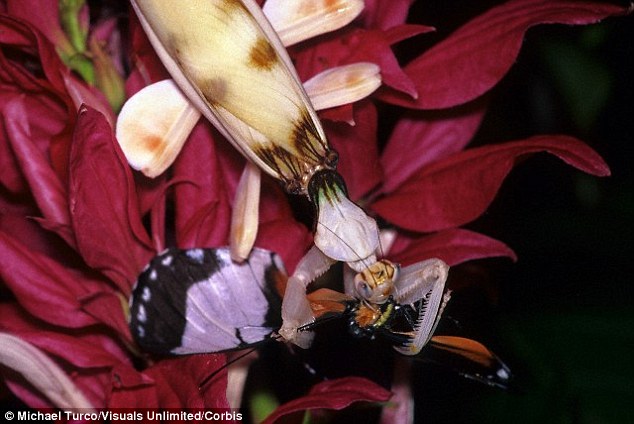
The Malaysian orchid mantis (Hymenopus coronatus) is a unique species of mantis that lives in the South Asian rainforests of Malaysia, Sumatra, and Indonesia. It is quite small, only about two and a half inches long at most for the female, and displays the greatest sexual dimorphism of all the mantids. Males are half the size of the female and there is even a slight difference in the coloring of a band-like marking around the neck. This marking is green in sub-adult females and a brownish purple on sub-adult males. Either color goes nicely with the subtle, creamy pastel shades of the mantis’ body. The species itself can come in a range of colors depending on what environment it matures in. Most often it is white or pink, but there can be purple, yellow, green and a variety of other colors.
Adult male and female.
Although the Malaysian orchid mantis is a beautiful creature, it is also a vicious predator. As the name suggests, this mantis often chooses orchid flowers as its hunting grounds. Its body is camouflaged perfectly to match the botanical backdrop on which it hides. The four walking legs are even equipped with petal mimicking projections so as to camouflage better. All the mantis needs to do is lie in wait, perfectly still, for some poor unsuspecting insect to visit the flower. Once this occurs, the mantis grabs it up in its sharp, spiny forelegs with lightning speed and proceeds to rip it apart with its powerful jaws. It uses this same weaponry to defend itself from harm when threatened and can become quite aggressive if disturbed. First it will rise up into a threat display with its arms outstretched and wings spread wide. If it still feels bothered then it will attack. Those arms can actually inflict a good amount of damage to a human hand and the mantis will not hesitate to bite any place it can reach.
Another very interesting defense is used only by orchid mantises when they are very young nymphs. The little baby mantises walk around disguised as a dangerous species of ant. They hold their abdomens curled over their bodies and move with an ant-like motion. They walk on all six legs, which are tipped in black, contrasting with their bright red bodies. This allows them to avoid predators that aren’t looking to mess around with getting stung or bitten by ants and also as a cover-up to go hunting real ants. It is evident that these clever insects are masters of camouflage at every stage of life.
Ant mimicking nymph.
Although the ant disguise is a striking technique, it doesn’t last long. A nymph loses this costume after the first molt and begins to look like a tiny adult instead. Orchid mantis females go through seven molts to reach adulthood and males go through five, maturing much quicker but living shorter lives. The average female lives about eight months while a male will only live to be five or six months old. Once a nymph becomes an adult, it develops large wings and becomes a very good flier and can travel more effectively. Orchid mantises don’t just frequent orchids. They will hang around in many other flowering plants and trees such as papayas and the wonderfully scented plumeria. So if you live in Southern Asia, definitely go check out some flowers to see if you can find one of these stunning insect beauties.
Sub-adult female by “Frupus” on Flickr (see link below).
2. O’hanlon, J. C., D. Li, and Y. Norma-Rashid. “Coloration and morphology of the orchid mantis Hymenopus coronatus (Mantodea: Hymenopodidae).” Journal of Orthoptera Research 22.1 (2013): 35-44.
3. “Malaysian Orchid Mantis.” WAZA. World Association of Zoos and Aquariums, n.d. Web. 23 June 2015. <http%3A%2F%2Fwww.waza.org%2Fen%2Fzoo%2Fchoose-a-species%2Finvertebrates%2Finsects-and-millipedes%2Fhymenopus-coronatus>.
When a person says dance fly, most people would likely think of a dancing housefly. However, there is actually such an insect that goes by this name, though it is very different from the common housefly. Dance flies, also called balloon flies or dagger flies, are predatory Dipterans that are members of the family Empididae. Empids are characterized by their long, pointy mouth parts and their extravagant mating rituals. If a fly can be charming, the dance fly is certainly the one that is most likely to be. During the breeding season, swarms of male dance flies will gather together and perform for nearby females while carrying delicate, specially crafted silk balloons. These balloons are called nuptial gifts and a successful male will pass his balloon to his partner during mating and they will often tumble to the ground together.
Credit: Mark Shields
Nuptial gifts in the form of silk balloons are unique to this family. Often, these balloons will contain a protein rich meal for the female to consume whilst mating. Typically, the larger the prey item, the more time the male gets to mate and the more sperm he can deliver. Other insects such as scorpionflies show this behavior as well, but they do not construct balloons to carry the prey items as dance flies do.
Jennifer Sadowski and her team (1998) have shown that an interesting phenomenon has evolved in certain species of dance flies, more specifically, Empis snoddyi. What they’ve learned is that males of this species no longer offer prey to their female mates, but just the silken balloon, which has no nutritional value and serves no purpose for the female other than to hold during copulation. This is called an “empty” nuptial gift. Although females will accept gifts of no direct or indirect benefit to themselves, they can still be choosy about who they take as their partners. This study found that there is an inverse correlation between balloon size and body size within successful males. It appears that female choice over generations has selected for a smaller balloon size and bigger male body size. Sadowski et al. noticed that the most successful males weren’t necessarily the ones with the smallest balloons, though. They observed that males with large body sizes and intermediate sized balloons took the most mates. There are a number of reasons why this may be. When sexual selection favors female choice, there are often signs that females look for in a mate that are indicative of their health and good genetics. In dance flies, females will chase their chosen male out of the swarm before deciding to mate with him. This could possibly be an assessment of his flying ability and fitness. It makes sense, then, that males with larger balloons would have a more difficult time performing at the top of their game. The bigger a balloon is, the more cumbersome it might be and could hinder a male’s flight displays. On the other end of the spectrum, a female requires a gift to mate and if a balloon is so small that it is not readily visible to her, she may ignore the male carrying it. As we can see from these animals, the courtship and mating process of insects can be complex, elaborate, and elegant. It isn’t just the more charismatic animals like mammals and birds that can show fascinating sexual behavior. Next time you go outside and notice the insects around you, consider the intricacies of their intimate behaviors and marvel at the great variation of life on this planet.
This photo was taken in my very own garden and is what inspired the article. I suspected they were scorpionflies just based on the behavior, but they didn’t look right. I did some research and found out how awesome dance flies are.
References:
1. Sadowski, Jennifer A., Allen J. Moore, and Edmund D. Brodie III. “The evolution of empty nuptial gifts in a dance fly, Empis snoddyi (Diptera: Empididae): bigger isn’t always better.” Behavioral ecology and sociobiology 45.3-4 (1999): 161-166.
2. Cumming, Jeffery M. “Sexual selection and the evolution of dance fly mating systems (Diptera: Empididae; Empidinae).” The Canadian Entomologist 126.03 (1994): 907-920.