Otterly Adorable

Otters! Who doesn’t love ‘em? From the fluffy and adorable sea otter to the giant Amazonian river otter; there’s an otter for every occasion! Most are fairly social, but the Asian small-clawed otter (Aonyx cinerea) beats all the others out when it comes to gregariousness. It is the most social of all the world’s 13 otter species, forming lifelong pair bonds that lead to extended family groups of as many as 15 or even 20 individuals. In addition to being a family oriented otter, it’s also the chattiest; you have to be to communicate with your many relatives. Along with the classic mustelid trait of scent marking, sound is one of the primary ways in which this animal discusses the intricacies of life. Small-clawed otters are known to use a repertoire of at least 12 different kinds of vocalization including chirps, squeals, barks, and shrieks. They’re like a group of excited tweens who won’t shut up about whatever boy band is popular with the kids these days. Unlike tween girls, though, the small-clawed otters’ company is actually enjoyable because they’re so darn cute and fuzzy!

9174391704_f09ef6ce44_z

An adorable Asian small-clawed otter by David Ellis on Flickr.

Native to southern and eastern Asia, these little rascals thrive near clean freshwater streams and rivers with lots of vegetation. Occasionally, they can be found in rice paddies or along the coast near saltwater. Although small-clawed otters need a water source, they are happy to spend time on land as well. Their paws are only partially webbed due to this more terrestrial lifestyle and they use them to search for and capture prey both in the water and on land. Just like raccoons, small-clawed otters hold whatever they are eating in their delightful little hands. Sometimes they can be a nuisance in rice paddies because they will pull up rice plants while on the hunt. As mustelids, otters are playful and mischievous by nature after all.

14414655148_eb67ac283a_z

Another fantastic small-clawed otter photo by David Ellis.

Unfortunately, their numbers are currently on the decline because of habitat destruction caused by land development and competition with humans for food resources. The favorite foods of these otters, which include crabs, mussels, and clams, are also harvested by people and can be overexploited. In addition to reduction of food biomass, there is more frequent chemical contamination of these food sources from human activity. Since small-clawed otters are considered to be a vulnerable species, they are protected throughout much of their range. This is a good start, but areas that were once home to these otters have still seen them disappear.

One such case comes from Singapore. Small-clawed otters were historically common there, but are now only visitors from its offshore islands rather than permanent residents. Fortunately, though, Singapore has not remained an otter free zone. Thanks to pollution cleanup efforts in local waterways, smooth-coated otters (Lutrogale perspicillata) have recently made a return. These much larger cousins of the small-clawed otter now number over 60 individuals and can often be seen and photographed by locals and tourists alike… or so it was thought! Recent research indicates that these water weasels are not actually smooth-coated otters. As it turns out, they are a hybrid between smooth-coated and small-clawed otters. This is the first recorded observation of a wild otter hybridization.

31091942_1959808447425027_8993325990683869184_n

A family of Singaporean otters from OtterWatch’s Facebook. Go check them out!

The story behind these fuzzy hybrids is even more interesting. The research team, led by Beatrice Moretti, came up with several reasons why this union occurred and settled on the “sexual selection hypothesis” as the most likely. Years ago when small-clawed and smooth-coated otter populations overlapped in Singapore’s waters, there may have been a dearth of small-clawed males. The smooth-coated otter was more common in this region, so small-clawed females likely would have interacted with them. Initially, these females may have rejected the smooth-coated males while they searched for males of their own species. Upon being unsuccessful, the females might have settled for the smooth-coated males instead. So why were the frisky locals seen today mistaken for smooth-coated otters in the first place? Well, it’s because they look exactly like smooth-coated otters. The initial objective of the study mentioned above was to learn about smooth-coated otter populations around the world, not phylogeny and hybridization. So naturally, the researchers were confused. They thought the samples collected from their smooth-coated otters might have been contaminated by small-clawed otters swimming by for a visit! After rerunning tests and making sure that no mistakes had been made, they realized that what they found was genuine and set out to figure out why and how. This hybridization happened so many generations ago that the offspring of the first few couples who bred ended up back-crossing with smooth-coated otters. The otters that now live in Singapore contain small-clawed DNA, but superficially appear to be smooth-coated otters because of the continued back-crossing with that latter species.

18791236193_f10ce2f8a4_z

A smooth-coated otter by Marie Hale on Flickr.

Examples like this prove that even when we think we know something, nature always has surprises for us hidden up its sleeves. Perhaps with continued conservation efforts and habitat restoration, small-clawed otters will return to the waters of Singapore to frolic with their not so distant cousins.

References:
1.Hamman, David. “Aonyx Cinerea.” ADW, Animal Diversity Web, 2004, animaldiversity.org/site/accounts/information/Aonyx_cinerea.html.

2.Wright, L., et al. “Aonyx Cinereus” IUCNRedlist, The IUCN Red List of Threatened Species, 2015, http://www.iucnredlist.org/details/44166/0. Wright, L., de Silva, P., Chan, B. & Reza Lubis, I. 2015. Aonyx cinereus. The IUCN Red List of Threatened Species 2015

3.Scheifele, Peter M., et al. “Vocal Classification of Vocalizations of a Pair of Asian Small-Clawed Otters to Determine Stress.” The Journal of the Acoustical Society of America, vol. 138, no. 1, 2015, doi:10.1121/1.4922768.

4.Hong, Jose. “Surprising Branch in Singapore’s Otter Family Tree.” The Straits Times, 14 Jan. 2018, www.straitstimes.com/singapore/surprising-branch-in-otter-family-tree?xtor=CS1-10.

5.Moretti, Beatrice, et al. “Phylogeography of the Smooth-Coated Otter (Lutrogale Perspicillata): Distinct Evolutionary Lineages and Hybridization with the Asian Small-Clawed Otter (Aonyx Cinereus).” Scientific Reports, vol. 7, 27 Jan. 2017, doi:10.1038/srep41611.

Photo Links:
1.https://flic.kr/p/eYHa2j

2.https://flic.kr/p/nXLSM3

3.https://www.facebook.com/OtterWatch/?ref=page_internal

4.https://flic.kr/p/uCvZQV

Ancient Treasures of Puget Sound – Bluntnose Sixgill Shark

Love them or hate them, sharks are critically important to the health of our oceans. That’s just an undeniable fact. As apex predators, they have far reaching effects that help regulate the ecosystem down to the level of organisms on which they do not even directly prey. These incredible, ancient fish have been around for many millions of years longer than any dinosaur and have remained relatively unchanged since. Currently, however, more than 60 percent of all shark species on the planet are somewhere on the spectrum of threatened to critically endangered. This is extremely wrong. Animals that have survived for so long and through so much should not be pushed to the edge of extinction by the ridiculous blunders of such a self-absorbed species. Thankfully, there has recently been a worldwide effort to protect sharks and a decline of practices like the slaughtering of sharks for their fins or livers and recreational shark fishing.

brian_skerry_mako_finning1

Pictured: A cruel, wasteful, and shameful practice.

Here in Puget Sound we are very fortunate to have bluntnose sixgill sharks (Hexanchus griseus). These Sound sharks are now protected after a closure on recreational sixgill fishing was put into action by the Washington State Department of Fish and Wildlife (WDFW). This ban was in response to public outrage over the capture of several local sixgills from Elliot Bay fishing piers. The WDFW also initiated a research program with the Seattle Aquarium, the National Oceanographic and Atmospheric Association (NOAA) Fisheries Service, and other scientific partners such as the University of Washington, Point Defiance Zoo and Aquarium, and Vancouver Aquarium in an effort find more about these little known, deep water sharks.

600xnxhexanchus_griseus_fao-pagespeed-ic-ljur_yq7qn

Thanks to efforts like these, we now have more information about sixgills, especially in Puget Sound. Sixgills, as with other deep water animals, have consistent daily patterns. They migrate down to great depths during the day and rise to shallower water at night. This is called diel vertical migration and is largest mass movement of organisms on the planet at one time. However, Puget Sound sixgills are often found in much shallower water than is typical elsewhere – sometimes as shallow as about ten feet during the day. Fortunately, this makes them easier to research. Through capture and tagging studies, it has been determined that most of the sharks in Puget Sound are sub-adults. It is suggested that Puget Sound may serve as a nursery for these animals until they have reached sexual maturity and leave to lead a more pelagic lifestyle. Not only are these sixgills young, but there is a high level of relatedness among juveniles that inhabit the same area. DNA studies found that sharks that were punch biopsied within the same set were significantly more likely to be related to each other than not. These sets consisted mostly of siblings and half siblings. From all the sharks sampled in Puget Sound during this study, analysis resulted in the identification of 33 cohorts. The stranding of a large adult female carrying 71 full-term pups in southern Puget Sound gave researchers an opportunity to look at relatedness within a litter, and confirmed the suspicion that females are polyandrous, that is, mating with more than one male during a breeding season. Six male sharks contributed to the genetics of this litter, but the contribution was unequal because only a few of them contributed the majority of the genotypes found.

neonatal_h_griseus

This neo-natal pup shows the green eyes and long upper portion of the caudal fin that are characteristic features of sixgill sharks.

Litters can range from 22 to 108 pups and gestation is hypothesized to be no less than 12 months and quite likely closer to 24 months or more. During breeding, male sharks appear to nip at the female’s gill area to get her attention and to entice her to mate as evidenced by white marks observed by biologist divers only during this time of the year. Similar behavior is seen in other shark species. Female sixgills mature at around 14 feet and males at closer to 10. As with many sharks, sixgills seem to grow slowly, but not a lot is known about age at maturity or rate of growth. One shark was found to double in size over its first year of life and then was recaptured later appearing to have grown around a third of an inch per month since. This is just one individual, however, and a much larger sample across different populations would be needed to fully understand sixgill growth rate.

bluntnose-six-gill-shark-swimming-near-sea-bed

At full size, the biggest sixgills can grow to a little over 15 feet, making this shark the largest fish in Puget Sound and one of the largest living sharks in the world. As their name suggests, they have six gill slits behind the head rather than the usual five found in most sharks. Their snouts are large and rounded, hence bluntnose, and protrude in front of jaws containing very unique teeth. The upper jaw has rows of thin, hook-like teeth that are common in many shark species. However, the lower jaw contains teeth that differ highly from those of other sharks. These teeth from rows of six on either side of the jaw and are deeply serrated like saw blades. Teeth like this are very similar to those seen in Jurassic sharks, suggesting that this species is quite ancient and primitive. Since these animals normally spend their time in very deep water (up to over 8,000 feet down – to put this in perspective, a mile is 5,280 feet) where food is scarce, they take every opportunity to scavenge when they can. Having saw like teeth on the lower jaw and puncturing teeth on the top jaw help them hold and saw through large chunks of flesh such as whale blubber. This allows them to remove more manageable pieces from huge carcasses, which they then swallow whole.

5bb029_hexa-gris_2fao_zzmx

Illustration of upper and lower teeth

Not only are sixgills adaptable, deep sea scavengers, they are also skilled predators. These fish are capable of surprisingly great bursts of speed that contrasts with their sluggish appearance and behavior. Prey can include anything from crabs, mollusks, and teleosts (bony fish) to other cartilaginous fish or even marine mammals. Despite this, there has never been a serious injury or fatality recorded as a result of interaction with a sixgill shark. On the contrary, people often go on dives in Puget Sound specifically to see them. Sixgills do not appear to fear humans and show inquisitive behavior when they encounter one. If a person gets too close for the animal’s comfort, it will calmly swim away. Touching a sixgill may cause it to whip around and nip at the diver in warning, but no injuries usually occur and those that do are minor. Still, sixgill sharks are very big and powerful animals that should always be treated with caution. Even biologists who study sixgill behavior and are very knowledgeable will conduct their research from the safety of a shark cage or a boat and give the sharks their space when diving with them.

sixgillshark-560

For the research that has been done on bluntnose sixgill sharks, we have barely touched the surface when it comes to understanding their lives and the ecological roles they play. What we do know gives us even more incentive to protect and study these amazing creatures. If Puget Sound is in fact a nursery for pups and young adult sharks, then it is a valuable resource for maintaining the genetic diversity of this species. Many shark species suffer from low genetic diversity caused by human actions and the fact that they reproduce slowly. Puget Sound sixgills, even with the relatively high number of related individuals, still shows moderate genetic diversity. Preserving safe and productive areas like Puget Sound is crucial to the survival of shark species worldwide. Sharks are excellent indicators of environmental health and where they do well, other species will undoubtedly thrive as well. Helping sharks like Puget Sound sixgills helps improve our planet’s oceans little by little, and in turn, our lives.

References:
1. Martin, R. Aidan.  “Swimming with Jurassic Sharks.” ReefQuest Centre for Shark Research (2003). http://www.elasmo-research.org/education/topics/d_jurassic_shark.htm

2. Larson, Shawn, et al. “Relatedness and polyandry of sixgill sharks, Hexanchus griseus, in an urban estuary.” Conservation Genetics 12.3 (2011): 679-690.

3. Ebert, David A. “Biological aspects of the sixgill shark, Hexanchus griseus.” Copeia (1986): 131-135.

4. Andrews, Kelly S., et al. “Diel activity patterns of sixgill sharks, Hexanchus griseus: the ups and downs of an apex predator.” Animal Behaviour 78.2 (2009): 525-536.

5. Andrews, K. S., et al. “Acoustic monitoring of sixgill shark movements in Puget Sound: evidence for localized movement.” Canadian Journal of Zoology 85.11 (2007): 1136-1143.

6. Rupp, J. “A natural history of the sixgill shark, Hexanchus griseus.” Proc Puget Sound Res (2001).

7. Bauml, J. “Hexanchus griseus.” Animal Diversity Web (2004). Web. 11 Feb. 2016 http://animaldiversity.org/accounts/Hexanchus_griseus/

Photo and Video Links:
1.https://www.bostonglobe.com/metro/2014/07/23/massachusetts-ban-shark-fin-trade/S1eoogIdZ8W9UbqalQguQO/story.html

2.http://shark-references.com/species/view/Hexanchus-griseus

3.http://wdfw.wa.gov/fishing/bottomfish/identification/sharks_skates_ratfish/h_griseus.html

4.http://www.arkive.org/bluntnose-six-gill-shark/hexanchus-griseus/

5.http://cookislands.bishopmuseum.org/showImage.asp?file=MM/MX5/5BB029_Hexa-gris_2FAO_zzMX.JPG&title=Hexanchus+griseus++%28Bluntnose+Sixgill+Shark%29&height=400&width=600

6.http://www.seattleaquarium.org/sixgill-sharks

7.https://www.youtube.com/watch?v=P4cAlgiX59I

Saving A Serpent – Mangshan Pit Viper

The only places in the world you can find the Mangshan pit viper (Protobothrops mangshanensis) are Mt. Mang and the Hunan and Guangdong Provinces of China. It is currently listed as an endangered species by the International Union for Conservation of Nature and Natural Resources (IUCN) because of its restricted range in combination with deforestation and human encroachment into its habitat. There is also a demand for it in the illegal pet trade business because of the stunningly gorgeous colors and patterns on its scales and its lovely green eyes. Fortunately, there are populations present in the Mangshan Natural Nature Reserve and captive breeding has been going on in several countries with fair success since 1994. 100 snakes have been bred as of 2010.

Closeup of the beautiful scales

The Mangshan pit viper lives in mountainous, mixed pine and broad leaf forests in leaf litter, rotting wood, and caves. It typically reaches lengths of 5-7 feet and is a particularly heavy snake, getting up to about 11 pounds or so. This pit viper preys on frogs, rodents, birds, and insects. The tip of its tale is a pale, greenish white and is used to lure in the animals it hunts by mimicking a caterpillar or worm. The snake hides the rest of its body from sight and sticks up its tail, which is wriggled back and forth. When prey comes close enough, it strikes and injects a mix of hemotoxic and myotoxic venom with its 0.8 inch long fangs. Hemotoxin prevents blood coagulation and leads to hemorrhaging while myotoxin causes muscle paralysis and necrosis. Most vipers deliver large amounts of venom in a bite and this snake is no exception. Up to 960 milligrams can be injected by a single fang. As with all pit vipers, the Mangshan pit viper possesses small, temperature sensitive pits beneath its eyes that help it locate prey.
800px-Chřestýšovec_mangšanský_zoo_praha_2

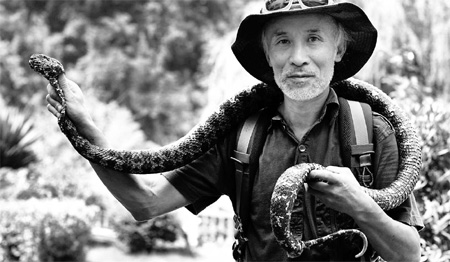
One man, Dr. Chen Yuanhui, has dedicated his life to protecting these snakes since 1990 when the species was officially recorded. Nicknamed “Dr. Snake”, Yuanhui first heard about the pit viper in 1984 when he was given a description of it by a snakebite victim in the hospital where he worked. Several years later, in 1989, he was notified about a nest of 23 snakes that had been captured nearby. He went to investigate and the snakes that were caught fit the exact description his patient had given him years ago – green and yellow markings with a white tail tip. Ever since then, Dr. Yuanhui has kept several Mangshan pit vipers in his home and has conducted research and raised awareness about the need to conserve this species. He is also curator for the Mangshan Museum of Natural History.

Dr. Chen Yuanhui with a wild Mangshan pit viper, 2010.

It takes a lot of love and dedication to continue to care for and research these gorgeous pit vipers after having survived 9 bites over the past 30 years. It’s a great thing there are people like Dr. Yuanhui in the world to set an example for the rest of us about what can be done for endangered animals like the Mangshan pit viper.

References:
1. Gong, Shi-ping, et al. “Population status, distribution and conservation needs of the Endangered Mangshan pit viper Protobothrops mangshanensis of China.” Oryx 47.01 (2013): 122-127.

2. O’Shea, Mark. Venomous Snakes of the World. Princeton: Princeton UP, 2011. 160. Print.

3. “Mangshan Pit Viper Fact Sheet.” San Diego Zoo. San Diego Zoo Global, 4 Apr. 2011. Web. 21 May 2015. <http://library.sandiegozoo.org/factsheets/mangshan_pit_viper/pit_viper.html&gt;.

4. “Mangshan Pit Viper.” Arkive.org. Wildscreen, n.d. Web. 20 May 2015. <http%3A%2F%2Fwww.arkive.org%2Fmangshan-pit-viper%2Fprotobothrops-mangshanensis%2F>.

5. China Daily. “‘Dr. Snake’ Bears Fangs for Conservation.” China.org.cn. China Daily, 17 Feb. 2011. Web. 21 May 2015. <http://www.china.org.cn/environment/2011-02/17/content_21940781.htm&gt;.

Photo Links:
1.https://www.wallpaperflare.com/snake-reptile-animal-memphis-zoo-memphis-tn-usa-camouflage-wallpaper-efpip

2.https://commons.wikimedia.org/wiki/File:Ch%C5%99est%C3%BD%C5%A1ovec_mang%C5%A1ansk%C3%BD_zoo_praha_2.jpg

3.http://www.chinadaily.com.cn/china/images/attachement/jpg/site1/20110217/0023ae6962090ec6a81847.jpg

The Tiniest Snake On Earth – Barbados Threadsnake

If you were walking along and happened to come across one of these little snakes, you would probably mistake it for an earthworm. The Barbados threadsnake (Leptotyphlops carlae) was officially identified relatively recently, in 2008, by S. Blair Hedges from Pennsylvania State University and is currently the smallest known snake species in the world. It is endemic to the island of Barbados and lives on the oldest part of the island where there is still secondary forest. Unfortunately, Barbados has been mostly deforested and populated by humans, so this snake may only have a little over a square mile of suitable habitat left to sustain it and could be considered critically endangered. Very little is known about it yet, but it has been discovered that the species can come in different sizes. Threadsnakes only lay one egg at a time and the smaller snakes will have hatchlings that are proportionally larger than the hatchlings of larger snakes.

Barbados threadsnakes generally only reach a length of 4 inches and feed on termite and ant larvae that they seek out underground. They are completely blind and hunt using scent trails. This snake is so small possibly because of island dwarfism. It may have evolved to fill the predatory niche of a centipede, which would normally prey on termites and ants. It is thought that the Barbados threadsnake may be the minimum size that is possible for a snake to still be able to produce offspring.
OHoTdKwFVoXjhbBpDTdI_UksXLoTzR_5AI2LAxwvLDk
Let’s hope that in the coming years, more will be learned about this fascinating little animal and conservation measures will be taken to protect it and restore its habitat. It would be a shame to lose something so special when we have only just begun to get to know it.

References:
1.Hedges, S. Blair. “At the lower size limit in snakes: two new species of threadsnakes (Squamata: Leptotyphlopidae: Leptotyphlops) from the Lesser Antilles.” Zootaxa 1.30 (1841): 2008.

2.Kennedy, Barbara. “World’s Smallest Snake Found in Barbados.” Penn State News. Pennsylvania State University, 3 Aug. 2008. Web. 02 May 2015. <http://news.psu.edu/story/184803/2008/08/03/worlds-smallest-snake-found-barbados&gt;.

Photo Links:
1.http://upload.wikimedia.org/wikipedia/commons/thumb/7/7e/Relative-offspring-size-hi-res.jpg/1280px-Relative-offspring-size-hi-res.jpg

2.https://www.reddit.com/r/Awwducational/comments/2y1lae/the_barbados_threadsnake_is_the_smallest/

Ghost of the Forest – Clouded Leopard

The clouded leopard (Neofelis nebulosa) is a beautiful cat found in Southeast Asia, China, and Himalayan foothills. It is a slightly different species from the Sunda clouded leopard (Neofelis diardi) of Sumatra and Borneo. The Sunda clouded leopard was originally thought to be just a subspecies of the clouded leopard, but genetic analysis has since shown that the Sunda diverged into a separate species about 1.5 million years ago. It might have traveled over a once existent land bridge spanning from mainland Asia to Sumatra and Borneo. Furthermore, the Sunda species is split into two subspecies: N. diardi diardi on the island of Sumatra and N. diardi borneensis in Borneo.

2901090110_a31dfcff72_c
Neofelis diardi
48472605796_60ed3cf413_c
Neofelis nebulosa

The clouded leopard is the smallest of the big cats – only four to six feet including the long tail. It is named for the cloud like markings on its coat and the Sunda’s cloud spots are darker and smaller than the mainland species’. The markings provide camouflage in the dappled sunlight of its rainforest home while hunting or hiding. Clouded leopards are excellent climbers and primarily spend time up in the trees. Their legs are short to give them a lower center of gravity and their three foot long tails provide good balance. Their paws and claws are quite large and their back ankles are flexible enough to rotate backwards, allowing them to climb down a tree head first. The paw pads are special in that they can conform to the tree bark when the cat is climbing.

Clouded leopards have extremely formidable jaws, which can open up to 100 degrees. Their upper canine teeth are the longest in comparison to their skull size of any other living carnivore known. This, and other structural evidence, suggests that there is a connection between the clouded leopard and prehistoric saber-toothed cats such as Smilodon. It is possible that clouded leopards also use a similar hunting technique to saber-toothed cats. All other living big cats take down prey by attacking the throat or muzzle whereas the saber-tooth used its fangs to sever the spine, nerves, and blood vessels in the neck and strangulate the animal. This is a method that kills instantly.

Clouded leopards are cats that need help, but they are difficult to breed in captivity because there is so much aggression between the males and females. One way that was found to combat this is to introduce leopard pairs around one year old so that a successful pair bond is created and aggression is lessened. Leopards become sexually mature around two years of age. Female leopards give birth to one to five cubs in a litter, although it is most often two, and those cubs will be fully independent by ten months.

Clouded leopards are incredibly rare and elusive in the wild, so there is still not much known about them. Their habitat is threatened by rampant deforestation and they are poached for their beautiful fur as well as teeth and claws. This leopard is listed as an endangered species in the United States, which prohibits the trade of any live cats, parts, or products. Over most of its range, it remains protected, but some areas such as India, Malaysia, and Thailand have more lax and poorly enforced regulations. Breeding programs have been set up in many places around the world and the practice of introducing prospective pairs when young has shown relatively good success in recent years. In 2011, a pair of cubs was born at Tacoma’s Point Defiance Zoo and Aquarium in my home state of Washington and three were born at the Nashville Zoo in Tennessee, then four in 2012.

Let’s hope that captive breeding programs continue to be a success and more attention is given to the conservation of the clouded leopard’s habitat and life in all areas of its range.

UPDATE!!! 6/5/15
Four new clouded leopard cubs have been born at Point Defiance Zoo & Aquarium in Tacoma, Washington!
They are now officially on display, so go see them if you’re in the area! 🙂


http://www.king5.com/story/news/2015/05/19/1-week-old-clouded-leopard-cubs-at-point-defiance-healthy-and-adorable/27613921/

References:
1. World Wildlife Fund. “New Species Declared: Clouded Leopard On Borneo And Sumatra.” ScienceDaily. ScienceDaily, 15 March 2007. .

2. McGinley, Mark. “Clouded Leopard.” The Encyclopedia of Earth. Ed. C. Michael Hogan. The Encyclopedia of Earth, 23 Feb. 2010. Web. 02 May 2015. .

3. “About the Clouded Leopard.” Clouded Leopard Project. Clouded Leopard Project, 2003. Web. 02 May 2015. .

4. Christiansen, Per. “Sabertooth characters in the clouded leopard (Neofelis nebulosa Griffiths 1821).” Journal of Morphology 267.10 (2006): 1186-1198.

5. “Clouded Leopard Cubs.” Welcome Our New Clouded Leopard Cubs. Point Defiance Zoo & Aquarium, June 2011. Web. 02 May 2015. .

6. “The Nashville Zoo Celebrates Two Sets of Clouded Leopard Cubs.” The Associated Press. The Associated Press, 29 Mar. 2012. Web. 02 May 2015.

Photo Links:
1.https://flic.kr/p/5qmR21

2.https://flic.kr/p/2gRmLWG

3.http://img2.timeinc.net/people/i/2013/sandbox/leopards/clouded-leopard-1-600×450.jpg

4.http://polimaty.pl/wp-content/uploads/2015/03/leop11.jpg

5.http://cdn2.arkive.org/media/CC/CC232D1C-14CF-4169-AFFD-10C6F2058FFC/Presentation.Large/Clouded-leopard-resting.jpg

6.http://mediad.publicbroadcasting.net/p/kplu/files/styles/medium/public/201106/PDZA_clouded_leopards_Day_9_1_no_watermark.jpg

7.http://www.look.com.ua/large/201209/23461.jpg

8.http://www.gannett-cdn.com/-mm-/fe286d436c8f0a373e03adfa196a1fc6cd281ba1/c=19-0-781-573&r=x513&c=680×510/local/-/media/2015/05/19/NWGroup/KING/635676622701274568-150517-pdza-cubs-54-L.jpg