Curious Cuttles – Dwarf Cuttlefish (and friends)

    There appears to be some unspoken rule that tiny versions of things are exponentially more adorable. Take for instance hummingbirds, pygmy marmosets, dwarf elephants, pygmy hippos, or Brookesia micra (the chameleon that fits comfortably on the head of a match). The dwarf cuttlefish (Sepia bandensis), with a mantle length of under three inches, is no exception. Dwarf cuttlefish are at home in the warm waters of the Indo-Pacific including, but not limited to, the Philippines, New Guinea, and Sulawesi. Living mostly in shallow coastal waters, these tiny cephalopods are most active at night, feeding on small crustaceans or fish found over sand and reef. Like almost all members of their group, dwarf cuttlefish are exclusively shallow water inhabitants. This is because of the vestigial cuttlebone that’s contained within the mantle. The cuttlebone is a remnant from the ancient history of cephalopods. Like the ancestral shell, it still retains tiny chambers filled with gas that assist with buoyancy. As a consequence, the cuttlebone will implode if the poor creature swims too deep. Being relatively restricted to shallow water does have its perks, though. Since there is so much light, cuttlefish get to fully utilize their incredible skin to create a wide variety of colors, patterns, and textures to communicate with each other and other animals.

     One of the most spectacular displays used by these tiny cuttles is known as the “passing cloud”. It consists of dark bands of color moving down the animal’s mantle via the pulsing of chromatophores in the skin. While this occurs, the cuttlefish keeps the rest of its body’s color and pattern static (unchanging).

Here you can see the passing cloud display in action on this dwarf cuttlefish that I filmed at the Seattle Aquarium. It does it at the beginning and the end of the video.

S. bandensis is not the only cuttlefish species to display these strange, psychedelic waves. Many other cuttlefish do this as well, and also some octopuses. Not surprisingly, the display differs in each species and there are many variations of it. These bands can occur on almost any part of the body and go in different directions depending on the species. The delightfully named Wunderpus photogenicus, an octopus, pulses dark bands over its eyestalks. Perhaps the most interesting thing about pulsing displays like the passing cloud is that no one knows for sure what the purpose is.

Did you notice the pulses on Wunderpus’s eyestalks?

     There is a myriad of possibilities of what the displays could be used for. Some cephalopods, such as the broadclub cuttlefish (Sepia latimanus), almost certainly use these displays for hunting. These cuttlefish can sometimes be seen rapidly pulsing the chromatophores on their arms before pouncing on prey. It’s possible that the chromatic pulses mesmerize prey, holding them in place while the cuttlefish positions itself for a deadly strike. The Australian giant cuttlefish (Sepia apama) has been observed using pulse displays in spawning aggression and while drifting in and out of seaweed. These are both notable examples of how pulse displays can be used. Male cuttlefish are well known for displaying aggression to rivals with one half of the body, while showing receptivity to females with the other half. Communication is extremely important among cephalopods and pulse displays seem to serve this purpose well. Camouflage is also a famous attribute of cuttlefish and octopuses alike. Creating rhythmic waves that mimic the rippling light coming from the surface while drifting with the weeds is an excellent way to hide. It definitely puts those chromatophores to good use by helping protect the animal from predators.

This broadclub cuttlefish is using its chromatic pulses to hypnotize a crab. It has its two outer arms positioned in what is called a “branched coral” pose.

     The functions of chromatic pulse displays like the passing cloud are not as obvious in other contexts. The extraordinarily cute and adorably named flamboyant cuttlefish (Metasepia pfefferi) will pass waves over its body in as simple a situation as sauntering over an open mudflat. There is a possibility that, along with its bright colors, this could serve as a warning to potential predators. Cephalopod expert Mark Norman has found that the flesh of this little cuttlefish is incredibly toxic. However, this is only anecdotally recorded in the NOVA special Kings of Camouflage and there has been no scientific study published yet that analyzes the toxins. Toxic or not, the flamboyant cuttlefish uses it’s chromatophores to send a message, supporting the potential communication function of pulse displays.

This tiny flamboyant cuttlefish is too cute as it walks around strutting its stuff. Could it be saying “Don’t eat me, I’m toxic!”?

     It’s pretty clear that passing clouds and other pulses have specific uses depending upon the environmental or behavioral context of the animal creating them. That is, it’s pretty clear for most of the cuttlefish I’ve mentioned. Alas, the star of this article – the diminutive dwarf cuttlefish – still hides its secrets. Although I am privileged to have seen and video recorded the passing cloud behavior at the Seattle Aquarium many times, I still can’t figure out what these little cuttles are using it for. One minute, an individual may be hovering in place with wave after wave passing over its mantle and the next it will be almost completely black and fighting with a tank mate. From my pathetically inferior human perspective, it seems random. There is the possibility that these captive bred cuttlefish are behaving a little differently than they would in the wild, or that they are influenced by the presence of people. With so many variables, it’s difficult to tell what the dwarf cuttlefish are using it for without a full blown scientific study. Even with the most skilled researchers giving it their all, we will probably never know just what goes on in the minds of these tiny cuttlefish (or any of the other species).

fullsizeoutput_c68

This is a photo I took at the Seattle Aquarium. You can see the tiny suckers on this dwarf cuttlefish’s adorable little arms as it watches me through the glass.

     Cephalopod nervous systems are so different from our own that we can only make feeble guesses at how they think and feel about the world. Can you imagine having your brain directly connected to your skin so you could change color and texture in fractions of a second just by thinking? Me neither, but wouldn’t it be cool? That’s an everyday reality for almost all modern cephalopods and something we can’t even begin to relate to. As our understanding of these fascinating creatures improves and science gives us new ways of studying them, we may come closer to discovering what it all means. Until then, let’s just admire their beautiful and complex alien language for what it is – one of the many wonderful mysteries of the natural world.

References:
1. Mustain, Andrea. “World’s Tiniest Chameleon Discovered.” LiveScience. Purch, 14 Feb. 2012. Web. 12 July 2017

2.“Stumpy-spined Cuttlefishes, Sepia bandensis.” MarineBio.org. MarineBio Conservation Society, n.d. Web. 2 March 2017.

3. How, Martin J., et al. “Dynamic Skin Patterns in Cephalopods.” Frontiers in Physiology, vol. 8, 2017, Accessed 31 July 2017.

4. Cuthill, Innes C. “Animal Behaviour: Strategic Signalling by Cephalopods.” Current Biology, vol. 17, no. 24, 2007, pp. 1059–1060. ScienceDirect, Accessed 31 July 2017.

5. Hanlon, Roger. “Cephalopod Dynamic Camouflage.” Current Biology, vol. 17, no. 11, 2007, pp. 400–404. ScienceDirect, Accessed 31 July 2017.

6. Osorio, Daniel. “Cephalopod Behavior: Skin Flicks.” Current Biology, vol. 24, no. 15, 2014, pp. 684–685. ScienceDirect, Accessed 31 July 2017.

7. Laan, Andres, et al. “Behavioral Analysis of Cuttlefish Traveling Waves and Its Implications for Neural Control.” Current Biology, vol. 24, no. 15, 2014, pp. 1737–1742. ScienceDirect, Accessed 31 July 2017.

8. Kaufmann, Gisela, director. Kings of Camouflage. NOVA, 2011.

9. Staaf, Danna. “Sheathing the Shell.” Squid Empire: the Rise and Fall of the Cephalopods, ForeEdge, an Imprint of University Press of New England, 2017, p. 112.

Video Links:
1.https://www.youtube.com/watch?v=u76P3gCLWn4

2.https://www.youtube.com/watch?v=baNp8bgOtok

3.https://www.youtube.com/watch?v=qjloPutUCeo

4.https://www.youtube.com/watch?v=51jB8YljliM

Unfishy Fish

     What do you think of when someone says “fish”? The image of a salmon or goldfish probably pops into your mind. Or perhaps a colorful tropical reef fish. Odds are, you’re not thinking of a lipstick wearing, pancake shaped animal with frog feet and a long, pointy nose. You’re most likely not thinking of a Toblerone shaped shark with swirly nostrils either. The fact is, evolution doesn’t care what your idea of a fish is. It’s going to go with what’s successful and if it looks like a nightmare clown, so be it. Evolution doesn’t have a goal or a grand plan. What happens will happen and if something works, it persists.

fishdiagrams1

A generalized fish body plan.

     So here we are with and ocean of oddities to explore. To start with, let me introduce you to something that looks more or less like a ‘proper’ fish, but didn’t get the memo about how to swim like one. Enter, the razorfish (Aeoliscus strigatus). This fish is elongated and laterally compressed, giving it a razor thin appearance, hence the name. It feeds on tiny zooplankton such as brine shrimp as it hides among corals and seagrasses. Razorfish swim vertically in small schools with their snouts pointed down at all times. It is not known exactly why they do this, but it’s certainly entertaining to watch. With razorfish, it’s always a synchronized swim show. For the razorfish, the warm waters of the western Indo-Pacific are the perfect place to engage in these underwater ballets.

poisson-rasoir-01

A school of razorfish.

     Another weird, warm water inhabitant to be featured here is at home in the lower estuary of Derwent River in Tasmania and several other locations along the southeastern coast of Australia. Unfortunately, it is now critically endangered because of a multitude of factors including a low reproduction rate, habitat destruction, and suspected predation by an introduced sea star. The spotted handfish (Brachyonichthys hirsutus) has a sail like dorsal fin and large, webbed ‘hands’ which it uses to walk along the silty bottom. It belongs to of the order Lophiiformes, along with other strange members like deep sea anglerfishes and frogfish.

spotted-handfish

Spotted handfish.

Unlike many other fish, which hatch out as larvae that further develops outside the egg, spotted handfish emerge as tiny, fully formed versions of their parents. Rather than floating among the plankton of the open water, these babies stick to the sandy floor and live out the rest of their lives there. The peculiar reproduction habits of this fish are exactly what make it vulnerable to the northern Pacific sea star (Asterias amurensis). Before they become fish, the eggs are attached to stalked sea squirts and other vertical organisms that are extremely appetizing to the star. As a consequence, the eggs are devoured along with the sea star’s target prey. Conservation efforts have since been set in motion to save this unique Australian animal. Along with a captive breeding program and hope of reintroduction, there has been some success with providing manmade alternatives for the handfish to lay their eggs on. Handfish have been using these sticks and as a result fewer eggs are lost to the ravenous sea star. The spotted handfish is a protected species and one of the benefits that comes with that status is efforts to reduce silt and pollution within the Derwent River estuary and restore quality to the fish’s habitat. Even though the spotted handfish is still very much at risk, there is hope for it and therefore hope for other endangered animals.

     Our next fish is not nearly as well known as some of the others on this list. It doesn’t live in warm water either and instead spends its life thousands of feet down on continental slopes where the majority of the sun’s light fails to reach. Chaunax pictus, the pink frogmouth, is another member of the anglerfish order. It can only be glimpsed from the window of a submersible or through the eyes of an ROV sent to explore the depths of the ocean. There is virtually no data about its reproductive habits, life cycle, or population trend. One study of C. pictus in the Arabian Sea observed that it only eats small shrimps. With a dearth of information like this, the most interesting thing about this fish is its appearance. Imagine a squat, pink or orange potato with a scowl to rival that of Grumpy Cat and you’re pretty much there.

pink_frogmouth_chaunax_pictus

Pink frogmouth

The pink frogmouth uses its odd fins to crawl around over rocky slopes in search of prey when it’s not sitting motionless, camouflaged as a pissed off lump of cheese. The Chaunax in the video below starts walking at 1:55 if you’d like to see it in action.

     Slightly more attractive, though no more at home in shallow water, is the Caribbean roughshark (Oxynotus caribbaeus). One of the few fish on here that isn’t part of the anglerfish order, it is closely related to the more commonly seen prickly dogfish (Oxynotus bruniensis). Almost nothing is known about the natural history of the Caribbean roughshark other than that it inhabits the upper continental slope from the Gulf of Mexico to Venezuela. This shark has sloping sides and a concave belly that give it the appearance of an animal that was forced through a triangular Play-Doh mold. Its sandpapery skin is pale gray to white with dark brown patches, which actually make it quite striking.

600xnxoxynotus_caribbaeus2-pagespeed-ic-iaz2swwcfo

Caribbean roughshark.

500px-caribbean_roughshark

Swimming Toblerone

The prickly dogfish is less showy, but just as oddly shaped. The scales are raised and conical like studs making it truly deserving of its name. Like the Caribbean roughshark, it is small, only reaching a little over two feet from snout to tail. It has a mouth reminiscent of the cookie cutter shark and feeds on the eggs of other Chondrichthyans (cartilaginous fish). Prickly dogfish can be found in shallower water than roughsharks, but are also seen at great depths.

Ichthyology

Prickly dogfish.

Sharks are generally thought of as sleek and streamlined predators designed to kill, but these two species just reinforce the fact that every family has some real weirdos.

     Now we get to my personal favorite, and arguably weirdest of this group, the batfish. Despite their name, the batfishes, or Ogcocephalidae, don’t resemble bats in the least. In fact, they might be more suited to the name clownfish if that weren’t already claimed by the well known anemonefish everyone knows and loves from “Finding Nemo”. All batfishes are strange looking, but the red lipped batfish (Ogcocephalus darwini) takes the cake. With flattened body, nose-like face protrusion, and bright red lipstick looking like it was put on while drunk, this fish could be mistaken for a clown at a sorority party gone a little too far.

NGS Picture ID:1231868

Hey there, beautiful!

Also called the Galapagos batfish, it does indeed inhabit the warm, shallow waters of the Galapagos islands and nowhere else. It can be found swimming very awkwardly along reef edges over sandy substrate where its prey resides. Much of the time, it doesn’t even bother to swim. Instead, it crawls along the sand like a squashed frog and pauses frequently to lure prey.

Whereas many of its angler relatives use a nifty lure that comes out near the head region, the red-lipped batfish has one just above its lips under that pointy nose, which makes it look exactly like it has a perpetual booger hanging out of its nostril. The lure is bobbed up and down, acting as both a visual and chemical attractant for small invertebrates and a turn off for anyone else.

     Of course, it’s not this poor batfish’s fault that it looks so ridiculous. It has evolution to thank for that. For some reason, this strange body plan worked and stuck around as a result. The same goes for the rest of the fish featured in this article and so many more that it would be impossible to cover them all here. This was just a taste of the numerous odd ducks of the fish world and hopefully another motivation to keep exploring the stranger things out there. You never know what we might find next.

References:

1. Clemens, Danny. “The Red-Lipped Batfish Is Always Ready for a Night on the Town.” DSCOVRD. Discovery Channel, 07 July 2015. Web. 21 July 2016.

2. Montoya, P. Zelda, et al. “The Natural History and Husbandry of the Walking Batfishes (Lophiiformes: Ogcocephalidae).”DRUM and CROAKER: 6.

3. Schulz, Katja. “Galápagos Batfish – Ogcocephalus darwini.” Encyclopedia of Life. EOL, 2014. Web. 21 July 2016.

4. Rijnsdorp, A. D., M. Costa, and T. Munroe. “Chaunax pictus (Pink Frogmouth, Redeye).” IUCN. IUCN Red List of Threatened Species, 2015. Web. 21 July 2016.

5. Leandro, L. “Oxynotus caribbaeus (Caribbean Roughshark).” IUCN. IUCN Red List of Threatened Species, 2004. Web. 21 July 2016.

6. McGrouther, Mark. “Prickly Dogfish, Oxynotus bruniensis.” Australian Museum. Australian Museum, 2 Dec. 2013. Web. 21 July 2016.

7. McGrouther, Mark. “Spotted Handfish, Brachyonichthys Hirsutus.” Australian Museum. Australian Museum, 3 Sept. 2015. Web. 21 July 2016.

8. “Spotted Handfish (Brachyonichthys hirsutus).” Arkive.org. Wildscreen, n.d. Web. 21 July 2016.

9. Capuli, Emily Estelita. “Aeoliscus Strigatus.” FishBase. Ed. Roxanne Rei Valdestamon. Sea Around Us, n.d. Web. 21 July 2016.

Photo and Video Links:

1. http://evolution.berkeley.edu/evolibrary/article/fishtree_02

2. http://les-z-animaux.e-monsite.com/k/poissons-marins-tropicaux/autres-poissons-marins-tropicaux/poissons-lapins-et-poissons-rasoirs/poisson-rasoir-aeoliscus-strigatus.html

3. https://www.youtube.com/watch?v=PN9Rc5DrOzw

4. http://www.arkive.org/spotted-handfish/brachionichthys-hirsutus/

5. http://www.uniprot.org/taxonomy/242967

6. https://www.youtube.com/watch?v=WC69Iq8oMlo

7. http://shark-references.com/species/view/Oxynotus-caribbaeus

8. http://www.wikiwand.com/en/Oxynotus

9. https://australianmuseum.net.au/prickly-dogfish-oxynotus-bruniensis-ogilby-1893

10. http://www.natgeocreative.com/photography/1231868

11. https://www.youtube.com/watch?v=bjwnHDR7t_I

Are Pokémon Animals?

I have mentioned Pokémon before in my articles, but have only in passing. I now think it is time to take a scientific approach and look at these interesting, fictional organisms through the lens of science. Before we explore the title question, we first need to define what constitutes an animal. Animalia is one of the seven (as per the most recent revision of biological classification) kingdoms of life. The others are Plantae, Fungi, Protozoa, Chromista (diatoms, brown algae, etc.), Archaea, and Bacteria. Animals are multicellular, eukaryotic, heterotrophic organisms that lack cell walls. The cells are grouped into tissues, with each tissue having a specific purpose. Sponges, which are essentially just a clump of cells without any body symmetry, are the exception. As there are no sponge Pokémon to date, we do not have to worry about this. Animals must be able to move voluntarily and independently at some stage in their lives and develop until they reach a fixed body plan.

tol1

Protista is used here rather than Protozoa, but they both constitute the same types of organisms.

So, are Pokémon animals? The answer is, it’s hard to tell, but they probably are. There isn’t a way to know whether or not a Pokémon’s cells have cell walls because there is no data about their cellular structure, so we don’t have this to go on. All Pokémon appear to have body symmetry, one exception being Ditto. Ditto throws a wrench into the equation because it has an amorphous form, but can reorganize its body structure to take on the appearance and abilities of any other Pokémon. However, Ditto may be the result of a failed human experiment to clone Mew, the ancestor of all Pokémon. For this reason, we will exclude Ditto from our discussion because it was created through human intervention and did not evolve naturally. We’ll come back to Pokémon “evolution” later.

d34dc8b3ced7ee3023be42864f33cd5399bc3228_hq

This Ditto is sad because it doesn’t fit in.

Another stumper is when we start to consider Pokémon diets. Most seem to be heterotrophs, like animals, but some are described feeding exclusively on rock or metal (lithotrophs), while some can photosynthesize (autotrophs). Heterotrophs are organisms that must use organic carbon sources for energy because they cannot fix it themselves like other organisms. Plants can. They convert light energy into more complex organic compounds through photosynthesis. A handful of Pokémon actually are able to sustain themselves on nothing more than electricity. Does this mean that these rock, metal, and electron eating Pokémon species are not animals? Not necessarily. We haven’t learned all there is to know about Animalia yet and it is possible that there are animals yet to be discovered with highly diverse diets that deviate from the standard heterotroph. Many of Pokémon are also capable of enjoying Pokémon food that is made from berries and other organic material, as well as treats such as Pokéblocks (candy for Pokémon) or Poffins (a pastry-like Pokémon treat). Even Pokémon of the Ghost Type, the majority of which appear to be non-corporeal beings, will take Pokémon food if it is offered.
Many real life animals will often consume non-organic substances such as clay to supplement their diets or neutralize toxins in their food. However, this alone is not enough to sustain them. Animals MUST ingest other living things or their products to survive. There is nothing that says that the stranger Pokémon species need to eat something other than iron ore or enough dirt to make an entire mountain.

Aron

Aron, the iron eater.

600px-246larvitar

Larvitar, the mountain eater.

Some Pokémon are very plant-like. These are the Grass Type Pokémon. Many of them have abilities like Chlorophyll or Solar Power. Some of these Pokémon species look more like animals that others, though, so how can they be plants? The answer is: they don’t have to be if they participate in mutualism. Mutualism is a form of symbiosis in which both parties benefit from an interaction. It could be that all of the photosynthesizing Pokémon are hosts for special algae or other organisms that can fix carbon so that it is usable. In return, these Pokémon provide their little sun factories with precious nutrients. A few existing animals do this too, so it’s not really that out there to consider it in Pokémon.
Pokémon fill all the requirements of being animals except for their diets. We are still learning much about many strange metabolisms and food preferences in the animal kingdom, so I don’t think we can exclude Pokémon from Animalia just for this, as I mentioned above. We’ll keep exploring their biology.
Getting back to that “evolution” thing. Most, but not all Pokémon, go through “evolution”. Pokémon “evolution” is different from the Darwinian evolution that we know and love. It is predictable and occurs within the same individual. Pokémon evolution is analogous to metamorphosis in the real world. In fact, there are some Pokémon species that perfectly follow metamorphosis in real animals like butterflies, moths, and frogs. Pokémon can also be confirmed to have a Darwinian evolutionary history simply because of the fact that there are “ancestor Pokémon” like Mew that contain the basic genetic blueprints of all future Pokémon, and “fossil Pokémon” such as Omanyte and Anorith. Natural Selection seen in the Pokémon world emphasizes the presence of Darwinian evolution as well. Different regions provide a wide variety of habitats and the Pokémon found in these areas are well adapted to the conditions. This suggests that there is a process of adaptation over generations of Pokémon that resulted in the ones we see today that thrive in their respective environments.

mew-pokemon

Mew, the ridiculously cute ancestor of all Pokémon.

At this point, I feel that is safe to place Pokémon within Animalia. If they existed, they would make up their own separate phylum. Pokémon are incredibly diverse, and many don’t even look like they are related at all. But, just take a look at our own phylum, Chordata. There is a ridiculous amount of variation within it. Chordata contains animals ranging from simple, filter feeding tunicates, all the way to elephants, whales, birds, snakes, and of course, humans. Pokémon can take the form of gargantuan, dragon like creatures, or something as out there as a living pile of garbage. As briefly mentioned, there are different Types (18 in all) of Pokémon. Pokémon of the same type share similar abilities, weaknesses, and strengths. There is a Primary Type, and a Secondary Type. These Types could be thought of as analogous to classes within biology. Secondary Types would comprise the subclasses. For example, a Pokémon could be of the Fire Type class, but also belong to the Ground Type as its subclass.

types

The 18 Types of Pokémon.

But why did I choose class rather than some other higher or lower taxonomic ranking? It is because class seems to fit the variation observed within Pokémon types quite nicely and is a good reflection of a class such as Mammalia (our class). Every member of Mammalia is, by definition, a mammal. The blue whale is the most massive animal to have ever lived on this planet, yet falls into the same biological class as the tiny, extinct Batodonoides vanhouteni (a shrew-like mammal) and egg-laying mammals like platypuses and echidnas. Though they differ greatly, all these animals have a handful of defining features that set them apart from any other class. As is their namesake, all mammal species are capable of producing milk through mammary glands. Likewise, a Pokémon belonging to a specific Type will also share similar traits with fellow members of that Type that others don’t possess (unless those others have it as their Secondary Type/subclass). Water Types, for example, all appear to have increased fitness in rain and become weakened and dehydrated by hot, dry weather.

swampert-full-890856

Swampert is a Water/Ground Pokémon. This means that its Primary Type is Water and its Secondary Type is Ground. Because of this, it has the unique traits of both Types. It is also one of my favorite Pokémon!

As with animals, there are many other ways to rank Pokémon taxonomically. We could break them into phyla, orders, families, genera, and individual species. Analysis of all taxonomic rankings like this would probably go on for pages and pages, so we will cut it off at classification by Type and the educated assumption that Pokémon are in fact part of Animalia. Even though these creatures are not real, it is always fun to speculate and dig into the “what ifs”. This curiosity and exploration is the whole basis for science fiction, one of the most popular genres of all time, and it enriches our imaginations and our lives.

References:
1. Myers, Phil. “Animalia (animals).” Animal Diversity Web. Univerisity of Michigan Museum of Zoology, 2001. Web. 04 Dec. 2015.

2. Ruggiero, Michael A., et al. “A higher level classification of all living organisms.” PloS one 10.4 (2015): e0119248.

3. Venn, A. A., J. E. Loram, and A. E. Douglas. “Photosynthetic symbioses in animals.” Journal of Experimental Botany 59.5 (2008): 1069-1080.

4. Trench, R. K. “The cell biology of plant-animal symbiosis.” Annual Review of Plant Physiology 30.1 (1979): 485-531.

5. Barbo, Maria S. The Official Pokémon Handbook. New York: Scholastic, 1999. Print.

6. “Type.” Bulbapedia. Web. 23 Dec. 2015.

7. Bloch, Jonathan I., Kenneth D. Rose, and Philip D. Gingerich. “New Species of Batodonoides (lipotyphla, Geolabididae) from the Early Eocene of Wyoming: Smallest Known Mammal?”. Journal of Mammalogy 79.3 (1998): 804–827.

Photo Links:
1.http://www.tanelorn.us/data/mycology/myc_kingdom.htm

2.http://www.aminoapps.com/page/pokemon/2097774/ditto

3.http://www.serebii.net/card/risingrivals/057.shtml

4.http://bulbapedia.bulbagarden.net/wiki/Larvitar_%28Pok%C3%A9mon%29

5.http://attackofthefanboy.com/guides/get-mew-pokemon-red-blue-yellow/

6.https://people.rit.edu/~dap4092/230/project1/basics.html

7.http://www.deviantart.com/art/Swampert-118686577

Ancient Treasures of Puget Sound – Bluntnose Sixgill Shark

Love them or hate them, sharks are critically important to the health of our oceans. That’s just an undeniable fact. As apex predators, they have far reaching effects that help regulate the ecosystem down to the level of organisms on which they do not even directly prey. These incredible, ancient fish have been around for many millions of years longer than any dinosaur and have remained relatively unchanged since. Currently, however, more than 60 percent of all shark species on the planet are somewhere on the spectrum of threatened to critically endangered. This is extremely wrong. Animals that have survived for so long and through so much should not be pushed to the edge of extinction by the ridiculous blunders of such a self-absorbed species. Thankfully, there has recently been a worldwide effort to protect sharks and a decline of practices like the slaughtering of sharks for their fins or livers and recreational shark fishing.

brian_skerry_mako_finning1

Pictured: A cruel, wasteful, and shameful practice.

Here in Puget Sound we are very fortunate to have bluntnose sixgill sharks (Hexanchus griseus). These Sound sharks are now protected after a closure on recreational sixgill fishing was put into action by the Washington State Department of Fish and Wildlife (WDFW). This ban was in response to public outrage over the capture of several local sixgills from Elliot Bay fishing piers. The WDFW also initiated a research program with the Seattle Aquarium, the National Oceanographic and Atmospheric Association (NOAA) Fisheries Service, and other scientific partners such as the University of Washington, Point Defiance Zoo and Aquarium, and Vancouver Aquarium in an effort find more about these little known, deep water sharks.

600xnxhexanchus_griseus_fao-pagespeed-ic-ljur_yq7qn

Thanks to efforts like these, we now have more information about sixgills, especially in Puget Sound. Sixgills, as with other deep water animals, have consistent daily patterns. They migrate down to great depths during the day and rise to shallower water at night. This is called diel vertical migration and is largest mass movement of organisms on the planet at one time. However, Puget Sound sixgills are often found in much shallower water than is typical elsewhere – sometimes as shallow as about ten feet during the day. Fortunately, this makes them easier to research. Through capture and tagging studies, it has been determined that most of the sharks in Puget Sound are sub-adults. It is suggested that Puget Sound may serve as a nursery for these animals until they have reached sexual maturity and leave to lead a more pelagic lifestyle. Not only are these sixgills young, but there is a high level of relatedness among juveniles that inhabit the same area. DNA studies found that sharks that were punch biopsied within the same set were significantly more likely to be related to each other than not. These sets consisted mostly of siblings and half siblings. From all the sharks sampled in Puget Sound during this study, analysis resulted in the identification of 33 cohorts. The stranding of a large adult female carrying 71 full-term pups in southern Puget Sound gave researchers an opportunity to look at relatedness within a litter, and confirmed the suspicion that females are polyandrous, that is, mating with more than one male during a breeding season. Six male sharks contributed to the genetics of this litter, but the contribution was unequal because only a few of them contributed the majority of the genotypes found.

neonatal_h_griseus

This neo-natal pup shows the green eyes and long upper portion of the caudal fin that are characteristic features of sixgill sharks.

Litters can range from 22 to 108 pups and gestation is hypothesized to be no less than 12 months and quite likely closer to 24 months or more. During breeding, male sharks appear to nip at the female’s gill area to get her attention and to entice her to mate as evidenced by white marks observed by biologist divers only during this time of the year. Similar behavior is seen in other shark species. Female sixgills mature at around 14 feet and males at closer to 10. As with many sharks, sixgills seem to grow slowly, but not a lot is known about age at maturity or rate of growth. One shark was found to double in size over its first year of life and then was recaptured later appearing to have grown around a third of an inch per month since. This is just one individual, however, and a much larger sample across different populations would be needed to fully understand sixgill growth rate.

bluntnose-six-gill-shark-swimming-near-sea-bed

At full size, the biggest sixgills can grow to a little over 15 feet, making this shark the largest fish in Puget Sound and one of the largest living sharks in the world. As their name suggests, they have six gill slits behind the head rather than the usual five found in most sharks. Their snouts are large and rounded, hence bluntnose, and protrude in front of jaws containing very unique teeth. The upper jaw has rows of thin, hook-like teeth that are common in many shark species. However, the lower jaw contains teeth that differ highly from those of other sharks. These teeth from rows of six on either side of the jaw and are deeply serrated like saw blades. Teeth like this are very similar to those seen in Jurassic sharks, suggesting that this species is quite ancient and primitive. Since these animals normally spend their time in very deep water (up to over 8,000 feet down – to put this in perspective, a mile is 5,280 feet) where food is scarce, they take every opportunity to scavenge when they can. Having saw like teeth on the lower jaw and puncturing teeth on the top jaw help them hold and saw through large chunks of flesh such as whale blubber. This allows them to remove more manageable pieces from huge carcasses, which they then swallow whole.

5bb029_hexa-gris_2fao_zzmx

Illustration of upper and lower teeth

Not only are sixgills adaptable, deep sea scavengers, they are also skilled predators. These fish are capable of surprisingly great bursts of speed that contrasts with their sluggish appearance and behavior. Prey can include anything from crabs, mollusks, and teleosts (bony fish) to other cartilaginous fish or even marine mammals. Despite this, there has never been a serious injury or fatality recorded as a result of interaction with a sixgill shark. On the contrary, people often go on dives in Puget Sound specifically to see them. Sixgills do not appear to fear humans and show inquisitive behavior when they encounter one. If a person gets too close for the animal’s comfort, it will calmly swim away. Touching a sixgill may cause it to whip around and nip at the diver in warning, but no injuries usually occur and those that do are minor. Still, sixgill sharks are very big and powerful animals that should always be treated with caution. Even biologists who study sixgill behavior and are very knowledgeable will conduct their research from the safety of a shark cage or a boat and give the sharks their space when diving with them.

sixgillshark-560

For the research that has been done on bluntnose sixgill sharks, we have barely touched the surface when it comes to understanding their lives and the ecological roles they play. What we do know gives us even more incentive to protect and study these amazing creatures. If Puget Sound is in fact a nursery for pups and young adult sharks, then it is a valuable resource for maintaining the genetic diversity of this species. Many shark species suffer from low genetic diversity caused by human actions and the fact that they reproduce slowly. Puget Sound sixgills, even with the relatively high number of related individuals, still shows moderate genetic diversity. Preserving safe and productive areas like Puget Sound is crucial to the survival of shark species worldwide. Sharks are excellent indicators of environmental health and where they do well, other species will undoubtedly thrive as well. Helping sharks like Puget Sound sixgills helps improve our planet’s oceans little by little, and in turn, our lives.

References:
1. Martin, R. Aidan.  “Swimming with Jurassic Sharks.” ReefQuest Centre for Shark Research (2003). http://www.elasmo-research.org/education/topics/d_jurassic_shark.htm

2. Larson, Shawn, et al. “Relatedness and polyandry of sixgill sharks, Hexanchus griseus, in an urban estuary.” Conservation Genetics 12.3 (2011): 679-690.

3. Ebert, David A. “Biological aspects of the sixgill shark, Hexanchus griseus.” Copeia (1986): 131-135.

4. Andrews, Kelly S., et al. “Diel activity patterns of sixgill sharks, Hexanchus griseus: the ups and downs of an apex predator.” Animal Behaviour 78.2 (2009): 525-536.

5. Andrews, K. S., et al. “Acoustic monitoring of sixgill shark movements in Puget Sound: evidence for localized movement.” Canadian Journal of Zoology 85.11 (2007): 1136-1143.

6. Rupp, J. “A natural history of the sixgill shark, Hexanchus griseus.” Proc Puget Sound Res (2001).

7. Bauml, J. “Hexanchus griseus.” Animal Diversity Web (2004). Web. 11 Feb. 2016 http://animaldiversity.org/accounts/Hexanchus_griseus/

Photo and Video Links:
1.https://www.bostonglobe.com/metro/2014/07/23/massachusetts-ban-shark-fin-trade/S1eoogIdZ8W9UbqalQguQO/story.html

2.http://shark-references.com/species/view/Hexanchus-griseus

3.http://wdfw.wa.gov/fishing/bottomfish/identification/sharks_skates_ratfish/h_griseus.html

4.http://www.arkive.org/bluntnose-six-gill-shark/hexanchus-griseus/

5.http://cookislands.bishopmuseum.org/showImage.asp?file=MM/MX5/5BB029_Hexa-gris_2FAO_zzMX.JPG&title=Hexanchus+griseus++%28Bluntnose+Sixgill+Shark%29&height=400&width=600

6.http://www.seattleaquarium.org/sixgill-sharks

7.https://www.youtube.com/watch?v=P4cAlgiX59I

What You Didn’t Want to Know About Part III: Sexy Legs – Ricinuleids

The arachnids belonging to the order Ricinulei, or hooded tick spiders, are neither spiders nor ticks. At first glance, these primitive arachnids look a lot like your typical spider. However, if you look closely you will notice that they have segmented abdomens unlike spiders and a complete lack of eyes. It’s like they were trying really hard to cosplay as a spider but missed most of the critical details on their costume. Even so, you’ll probably never have to worry about making this distinction because ricinuleids are rare in comparison to other arthropods. Though locally abundant, only 55 species worldwide have been identified since the order’s discovery in 1838 and specimens are few and far between. A fossil of an extinct Carboniferous species was found in 1837, but the guy who found it thought it kind of looked like a beetle, so it wasn’t identified as a ricinuleid until later. Extant species are found in tropical regions of Central America and western and central Africa where they live in soil and litter.

cryptocellus_iaci_ricinulei_01

“I can’t decide what I want to be, so I’ll be everything!”

Very little is known about this animal group even today, but scientists do know that males use their modified third pair of legs for sex. That’s important. Not just because it’s funny, but because looking at ricinuleid junk can be critical to species identification. These legs are used to hold and then transfer seminal fluid into a mounted female’s genital opening. Females store the sperm for later when they are ready to fertilize their eggs. The eggs are laid singly and sometimes carried around by the mother that laid them. Interestingly, baby ricinuleids hatch with only six legs instead of the usual eight that is the signature of arachnids. This and other morphological features is shared with Acari, or mites and ticks, and is believed to be indicative of a close relationship with that order. As the young develop, they grow their final pair of legs and start to look more like proper arachnids.

Fig-1-The-pedipalps-of-Pseudocellus-pearsei-a-Dorsal-view-of-a-tritonymph-The

This is what the female gets stuck up her lady parts…

If you are so inclined, this paper has an even better picture of the male pedipalp: http://www.scielo.br/pdf/zool/v29n5/v29n5a12

Why are they called “hooded” tick spiders? The spider and tick parts of the common name are understandable, as they look a bit like spiders and are related to mites and ticks, but what about them is hooded? As it happens, ricinuleids have a cute little hood on their heads called the cucullus that can be raised or lowered at will. When the hood is down, it covers their mouthparts completely. How polite! The purpose and function of this structure is not yet understood, but it is one of their most defining features.

cryptocellus_goodnighti

“I’m not going to show you my mouth because that would be rude.”

Ricinuleids may not be as fierce looking as amblypygids or as cool as vinegaroons, but they’ve been around the block and certainly have their own special quirks. So give them a round of applause for just sticking with it and existing all these years. If any order goes unappreciated, it’s the hooded tick spiders.

References:
1. Harvey, Mark S. Catalogue of the smaller arachnid orders of the World: Amblypygi, Uropygi, Schizomida, Palpigradi, Ricinulei and Solifugae. CSIRO publishing, 2003.

2. Harvey, Mark S. “The neglected cousins: what do we know about the smaller arachnid orders?.” Journal of Arachnology 30.2 (2002): 357-372.

3. Adis, Joachim U., et al. “On the abundance and ecology of Ricinulei (Arachnida) from Central Amazonia, Brazil.” Journal of the New York Entomological Society (1989): 133-140.

4. Ewing, H. E. “A synopsis of the American arachnids of the primitive order Ricinulei.” Annals of the Entomological Society of America 22.4 (1929): 583-600.

5. Platnick, Norman I. “A new Cryptocellus (Arachnida: Ricinulei) from Brazil.” Journal of the New York Entomological Society (1988): 363-366.

6. Talarico, G., J. G. Palacios-Vargas, and G. Alberti. “The pedipalp of Pseudocellus pearsei (Ricinulei, Arachnida)–ultrastructure of a multifunctional organ.” Arthropod structure & development 37.6 (2008): 511-521.

Photo Links:
1.http://museum.wa.gov.au/catalogues-beta/ricinuleids

2.https://www.researchgate.net/publication/5346975_The_pedipalp_of_Pseudocellus_pearsei_Ricinulei_Arachnida_-_ultrastructure_of_a_multifunctional_organ

3.https://en.wikipedia.org/wiki/Ricinulei#/media/File:Cryptocellus_goodnighti.jpg

What You Didn’t Want to Know About Part II: Smells Like Vinegar – Uropygids

The order Uropygi (Thelyphonida) contains animals that are essentially really buff scorpions with whips on their butts instead of stinger tipped tails. They are often called whip scorpions for this reason. Another popular name for uropygids is vinegaroon because they use this whip to spray a mixture of acetic acid (vinegar) and other compounds when threatened or harmed. Their bodies are bulky and well armored, with powerful crushing structures on their pedipalps. These spine-like protrusions are used to capture and hold prey before tearing it apart. Similar to amblypygids, their elongated first pair of walking legs are held out in front to help with navigation. All of these features can make vinegaroons appear larger and scarier than they actually are, at least to us. The largest species in the world, Mastigoproctus giganteus, only reaches a maximum length of 3.3 inches, which is not huge compared to other arachnids.

1307601869_5bf608212e_b

“Come at me bro!”

Fearsome as they may look, vinegaroons fit with our running theme of tender arachnid sex. When it’s time to make babies, the male gently grasps the female’s antenniform legs and then turns around so that they are both facing the same direction. He deposits a spermatophore on the ground and then grabs it, turns around again, and places it into the female during an abdominal embrace. She can then fertilize her eggs and will lay them within a few months. To do this, she digs a burrow and seals herself inside. Eggs are laid into a sac on the underside of her abdomen, which she holds aloft so as not to drag the eggs on the ground when moving. She does not eat during this time, which is impressive because it can take several months for the eggs to develop and hatch. Newly hatched vinegaroons ride on their mother’s back until their first molt.

8zzl2zhlbz7hlruhch9hrr2hyhmh4zrl9zxlfhuhyhxlbz5lbzil5zll6zih4z8hbhihpz5lpzmhvhghahklvzgl3h

Arachnid sex in action!

Most species from this order inhabit tropical regions, but a few, like M. giganteus, live in arid desert environments like many of their true scorpion cousins. M giganteus can be found in the American Southwest and Mexico where it serves an important role as a predator of pests such as cockroaches and crickets. This vinegaroon was the subject in a study by Schmidt et al. (2000) to better understand the composition of the spray. It was often believed that vinegaroon secretions contain formic acid in addition to acetic acid, but this is false. The study analyzed the fluid within the pygidial glands of vinegaroons of different ages and sexes and found that none contained formic acid. The major components of vinegaroon spray are acetic acid, which gives it the strong vinegar smell, octanoic acid, and water. The purpose of this fluid cocktail was also reevaluated in the study. It was only ever used in self-defense, and even then only if that vinegaroon was directly attacked. It appears as though predators are not deterred by being sprayed inside the mouth. However, any contact with sensory tissue such as the eyes, skin, or an arthropod’s feelers can be irritating enough to put off the attacker. In one particular trial, the researchers placed a sulfugid (camel spider) in with a first instar (between first and second molt) vinegaroon and it got a face full of spray. After that, it ran around the cage frantically trying to clean its face with sand and refused to touch another vinegaroon after that. Adult vinegaroons have little to fear, for they are powerful predators themselves and have tough armor to protect them. In the event that they are attacked, though, the spray is an effective way of letting the predator know to back off.

These animals demonstrate that you don’t have to be big, aggressive, or venomous to make it in this world. When faced with danger, you don’t have to fight. Just be really irritating and maybe you’ll be left alone!

References:
1. Schmidt, Justin O., et al. “Chemistry, ontogeny, and role of pygidial gland secretions of the vinegaroon Mastigoproctus giganteus (Arachnida: Uropygi).” Journal of insect physiology 46.4 (2000): 443-450.

2. Rowland, J. Mark, and John AL Cooke. “Systematics of the arachnid order Uropygida (= Thelyphonida).” Journal of Arachnology (1973): 55-71.

3. Harvey, Mark S. Catalogue of the smaller arachnid orders of the World: Amblypygi, Uropygi, Schizomida, Palpigradi, Ricinulei and Solifugae. CSIRO publishing, 2003.

4. Harvey, Mark S. “The neglected cousins: what do we know about the smaller arachnid orders?.” Journal of Arachnology 30.2 (2002): 357-372.

5. Pocock, R. I. “Arachnida.” The Fauna of British India, including Ceylon and Burma. London: Taylor and Francis, 1900. 100-131.

Photo and Video Links:
1. https://www.flickr.com/photos/slopjop/1307601869/

2. http://bugguide.net/node/view/341893

3. https://www.youtube.com/watch?v=nNnKzoQwdAc

Soft-bodied Brainiacs – Giant Pacific Octopus

Most people have heard that octopuses are smart. But how smart are we talking about, and how did they get that way independent of vertebrates? Cephalopoda, which includes octopuses, squid, cuttlefish, and nautiluses, is highly a specialized and advanced class of invertebrates dating back to the late Cambrian. These animals share the same phylum, Mollusca, with slugs and snails, clams, and other “lower” organisms. So what made them so different? All but the nautilus have completely lost their shells, and in cuttlefish, it is reduced to a small internal structure called the cuttlebone – you know, that thing people give parrots and rodents to chew on as a supplement. This has given the group a ridiculous amount of flexibility (both literally and figuratively) to hunt, explore, manipulate, and perform complex behaviors not seen in other mollusks.

33_22cephalopoda

We will explore the reasons behind the development of intelligence and the extent to which we understand it in these amazing animals by looking at the giant Pacific octopus (Enteroctopus dofleini). This cephalopod, also called the North Pacific giant octopus, is the largest of its kind in the world that has been discovered so far. Only the female seven-armed octopus (Haliphron atlanticus) and the giant (Architeuthis sp.) and colossal (Mesonychoteuthis hamiltoni) squids can contend with it in a battle of size. The largest specimens can reach up to 30 feet from arm tip to arm tip and weigh several hundred pounds. Despite its large size, this octopus is generally considered to be a curious, gentle giant. That is, unless you’re a tasty crab. Unfortunately, a long lived octopus will only get to be 5 years old. If an animal has such a short life, why and how is it so intelligent?

gpo_drewcollins

Photo by Drew Collins.

There are several hypotheses as to the rapid evolution of intelligence in cephalopods. One idea is that coleoids, the taxon that includes all shell-less cephalopods, evolved side by side with teleosts, or bony fish, during the Jurassic. Teleost fish during this period, all of which possessed complex vertebrate behavior, were undergoing rapid diversification and occupying countless environmental niches. In response, the coleoids developed intelligence of their own in order to survive in a quickly changing environment filled with new pressures from these vertebrate predators and prey. These cephalopods had to be able to learn, remember, interpret and predict the behaviors and actions of the bony fish to survive. Their positions within the trophic web (food chain) and their life habits created a demanding existence, making higher cognition a necessity.

Giant Pacific octopuses typically use one den for several weeks at a time in the wild. After a foraging outing, they are able to remember where they are in the environment in relationship to their home, and travel back quickly, often jetting over the sea floor. This shows that they have a sense of self as separate from their surroundings and can understand where they are positioned in space. Cognition like this is typical of vertebrates, but cephalopods are the only group of invertebrates that display this advanced form of spatial navigation and problem solving. Not only are they able to return to a den site with ease after hunting, giant Pacific octopuses will not visit the same foraging area consecutively. Behavior such as this demonstrates that these animals have an awareness of how they themselves have impacted the environment in which they live (removed prey from it) in the past, and modify their hunting strategies accordingly. Thus, the octopuses are able to remember where they were and what took place. The navigational abilities of octopuses are still not well understood, but they do use many tactile cues, such as following the contours of the sea floor to relocate a den. Their excellent vision helps them navigate in clear, shallow waters and allows them to use jet propulsion as a movement option.

den6338283887_db4f3f753d_z

It is not surprising that the giant Pacific octopus is able to navigate and live successfully in such a complicated environment when you consider that cephalopods have the largest brain to body ratio of any invertebrate. This ratio is comparable to that of mammals and birds. Octopuses are strange in that their arms are radially symmetrical, yet they have bilateral brains. Half of the arms are controlled by one half of the brain and half are controlled by the other. Because of this, octopuses often display “handedness” like humans do. The front pair of tentacles is the pair mainly used for manipulation of objects and the environment, and octopuses can show favoritism towards the left or right tentacle, depending on the individual. Three fifths of the octopus nervous system is concentrated in these arms. The arm and sucker control is highly complex and very precise, allowing possibly the widest range of motion seen in any animal. Such freedom of motion allows these cephalopods to explore their environment in ways that other species would not be capable of. With this exploration comes lots of learning.

Exploration through sight and touch is everything to an octopus. When something novel is presented, such as a new environment, it will proceed to gather as much information as it can through these senses, building a mental map and gaining an understanding of how things work. As familiarity is established, the octopus’ exploratory behavior will decline, and more time will be spent resting and hiding, suggesting that the animal remembers what it learned and has no need for continued exploration. This is seen often in tanks when an octopus is brought in from the wild or a different aquarium. After the territory and sense of safety is established, the octopus has a tendency to display very play-like behavior when given a novel object. One such study, performed at Washington’s very own Seattle Aquarium, presented eight giant Pacific octopuses with a toy (an empty pill bottle with a float in it) and observed their behavior over ten trials. Two of the octopuses took the bottle with a stretched out arm and held it in place before jetting water to make it float to the other side of the tank. They waited until the slow current returned the bottle to them and then repeated the process over 20 times. Other studies with the common octopus (Octopus vulgaris) also described play behavior. When given a choice of clam prey, empty shells, and plastic blocks, the octopuses ignored the shells, ate the clams, and often manipulated the blocks for quite some time. They were seen passing a single block from arm to arm, pulling it around with them when they moved, and bringing it back and forth from the center of their bodies. Octopuses are solitary and do not need to play to learn about their place in a social group, and the play-behavior displayed is not restricted to a specific environment as it would be in a vertebrate (like the safety of a family group). Also unlike vertebrates, play occurs equally throughout the lifespan, though it is infrequent.

octopus-football_1649735i

Ramsey the octopus from Plymouth’s National Marine Aquarium with a soccer ball.

Wild and captive giant Pacific octopuses are also capable of human recognition, among their many other astounding abilities. Another study done at the Seattle Aquarium collected eight octopuses from Neah Bay in Washington and Seaside, Oregon. The animals were transported to the Seattle Aquarium and placed in separate tanks. Three researchers, dressed identically, interacted with the octopuses over ten days with a two day break in the middle. The interactions were done in a non-predictable order. One tester fed the octopus while the other “mildly irritated” it by gently touching it with a bristly stick for 30 seconds. A range of behaviors from these interactions was catalogued. At the end of the experimentation period, each researcher looked into the octopuses’ tanks and recorded their reactions. The order of researchers was reversed for each octopus and presentations were ten minutes apart. When the irritator appeared, octopuses overwhelmingly reacted with responses consistent with their irritation trials, such as displaying a dark Eyebar or jetting water at the observer. Likewise, the octopuses’ behavior toward feeders reflected that of the feeding trials. This just adds to the already impressive array of cognitive abilities in these amazing animals.

4007619242_a19fdbf912

Eyebar on Octopus vulgaris. Photo Credit: Lawrence Tulissi

If I haven’t already convinced you that giant Pacific octopuses and other cephalopods are fascinating creatures, then you have no sense of wonder and should reevaluate your life. To top everything off, here is one more thing to impress you. I could list more, but then I would be writing this article forever!

Octopuses have personalities too! Yet another study conducted at the Seattle Aquarium demonstrated that giant Pacific octopuses vary across three dimensions: Activity, Reactivity, and Avoidance. For comparison, the standard temperament dimensions established for humans are Activity, Emotionality, and Sociability. As mentioned before, octopuses are solitary animals, so it is not realistic to measure variance in the Sociability or Emotionality dimensions. Because of this, the researchers designated Reactivity and Avoidance as the analogues. The results from the study showed that variance in octopus behavior accounted for by these three dimensions was 45%. To give you an idea of how amazing this is, compare that to 43% of the individual variance explained by Sanson et al.’s nine factors for human babies. In addition, much of this variance was across the Approach and Activity dimensions. It is not known why octopuses display so much difference between individuals, but it may again be due to their ever changing and demanding environments and evolutionary competition with teleost fish. There are many adaptive reasons for this variance and octopuses are highly intelligent, learning animals that are shaped by life experiences. It is no wonder that each octopus has its own way of behaving and thinking about the world.

Cephalopods like the giant Pacific octopus can teach us so much about the minds of invertebrate animals and the heights to which intelligence can rise. We really know very little about how other animals perceive the world and solve the problems that they are faced with throughout their lives. Learning about cephalopods opens a door to other mollusks and in turn other invertebrates. Intelligence is something that fascinates us because we consider it to be a key factor of what makes us “different” from other animals. Animals such as the giant Pacific octopus may make us question what really sets us apart as we discover more about them.

References:
1. “The Elusive Giant Pacific Octopus.” NOAA Fisheries. United States Department of Commerce, n.d. Web. 22 Sept. 2015. <http://www.afsc.noaa.gov/species/octopus.php&gt;.

2. Anderson, Roland C., et al. “Octopuses (Enteroctopus dofleini) recognize individual humans.” Journal of Applied Animal Welfare Science 13.3 (2010): 261-272.

3. Tzar, Jennifer, and Eric Scigliano. “Through the Eye of an Octopus.” Discover. Kalmbach Publishing Co., 1 Oct. 2003. Web. 22 Sept. 2015. <http://discovermagazine.com/2003/oct/feateye&gt;.

4. Mather, Jennifer A., and Michael J. Kuba. “The cephalopod specialties: complex nervous system, learning, and cognition 1.” Canadian Journal of Zoology 91.6 (2013): 431-449.

5. Scheel, D., and L. Bisson. “Movement patterns of giant Pacific octopuses, Enteroctopus dofleini (Wülker, 1910).” Journal of Experimental Marine Biology and Ecology 416 (2012): 21-31.

6. Mather, Jennifer A., and Roland C. Anderson. “Personalities of octopuses (Octopus rubescens).” Journal of Comparative Psychology 107.3 (1993): 336.

7. Mather, Jennifer A. “To boldly go where no mollusc has gone before: Personality, play, thinking, and consciousness in cephalopods*.” American Malacological Bulletin 24.1 (2008): 51-58.

Photo and Video Links:
1.http://bio1152.nicerweb.com/Locked/media/ch33/33_22Cephalopoda.jpg

2.http://www.uwphotographyguide.com/images/GPO_drewcollins.jpg

3.https://bioweb.uwlax.edu/bio203/s2012/kalupa_juli/den6338283887_db4f3f753d_z.jpg

4.http://i.telegraph.co.uk/multimedia/archive/01649/octopus-football_1649735i.jpg

5.http://farm3.static.flickr.com/2441/4007619242_a19fdbf912.jpg

6.https://www.youtube.com/watch?v=CYK2i2tR7gU

There Will Be Blood – Stephen’s Banded Snake

It has already been established numerous times, but I feel like I should re-emphasize this well-known fact: Australia is a terrifying continent! The Stephen’s banded snake (Hoplocephalus stephensii) just gives us one more reason never to set foot in this country, specifically in New South Wales. H. stephensii has a feisty temperament and will readily bite those who try to handle it or accidentally threaten it in some way. As the “banded” part of its name suggests, this snake is covered in striking dark grey to black bands over and white or light brown body. It is a member of Elapidae, a family of snakes with hollow, usually small, fixed fangs (meaning they do not fold back when the mouth is closed as in vipers). The snakes in this family include cobras, taipans, sea snakes, brown snakes, tiger snakes, mambas, coral snakes, and many others.

stephens-banded-snake

Because of deforestation and other forms of habitat destruction, the Stephen’s banded snake is at risk. It is also slow to reproduce and has small litter sizes. Neither of these traits support an ability to bounce back from disturbance. Nocturnal and tree dwelling, this snake only inhabits unbroken areas of dense tropical forest. Unlike other elapids, H. stephensii feeds very infrequently and is therefore slow to grow, further adding to its vulnerability. The habitat of Stephen’s banded snake does overlap with some protected areas of forest, but there is more that needs to be done in order to conserve this species.

10559326416_45d7cccf8f_z

This photo was taken by Bernard Dupont on Flickr.

Although H. stephensii is rare and not often encountered, its venomous bite is extremely dangerous to those who do come into contact. The procoagulant nature of the snake’s venom leads to excessive bleeding due to the consumption of clotting factors by microclots throughout the body. More simply, this means that the microclots lead to more bleeding because the factors involved in making blood clot are being used up, so they are not available to do their job. The exact medical terminology for altered coagulation by a snakebite, such as with Stephen’s banded snake, is venom-induced consumption coagulopathy (VICC). Bleeding can be from practically any part of the body. Any wounds or small cuts that are still healing will reopen, bleeding in the brain is a possibility, and a person with this coagulopathy could potentially bleed from their eyes, nose, and mouth. You get the idea. Snake bites like this are not injuries that will just resolve on their own. They should always be considered a medical emergency and treated appropriately.

There is currently no antivenom specific to H. stephensii, though closely related elapid antivenom does seem to work. Tiger snake (Notechis  spp.) antivenom has been used on several occasions to successfully treat a banded snake bite. One dose of antivenom typically comes in a 9-12mL ampoule that contains 3,000 units, but up to as many as four of these were needed to effectively treat a bite from H. stephensii in studies.

Web

Tiger snake antivenom is sometimes used for banded snake bites.

As deadly as the Stephen’s banded snake appears to be, there is only one death from its bite on record and this person did not receive proper medical assistance for several hours. All other bite victims survived. Still, caution definitely needs to be taken around this animal and its many Australian relatives.

To reiterate, Australia is crawling, slithering, flying, and swimming with deadly creatures. I know I keep presenting it as a place you would never want to visit, but I say this in a joking manner. There are many wonderful things about Australia too and I’m sure it would be an amazing place to visit! Just be careful, use common sense, and treat wild animals with the respect they deserve, as you would anywhere else.

References:
1. Fitzgerald, Mark, Richard Shine, and Francis Lemckert. “Life history attributes of the threatened Australian snake (Stephen’s banded snake Hoplocephalus stephensii, Elapidae).” Biological Conservation 119.1 (2004): 121-128.

2. “Stephen’s Banded Snake – Profile.” Office of Environment & Heritage. New South Wales Government, n.d. Web. 22 Sept. 2015. <http://www.environment.nsw.gov.au/threatenedspeciesapp/profile.aspx?id=10414&gt;.

3. Hession, Michael. “Stephen’s Banded Snake envenomation treated with tiger snake antivenom.” Emergency Medicine Australasia 19.5 (2007): 476-478.

4. Gulati, Abhishek, Geoffrey K. Isbister, and Stephen B. Duffull. “Effect of Australian elapid venoms on blood coagulation: Australian Snakebite Project (ASP-17).” Toxicon 61 (2013): 94-104.

5. Isbister, Geoffrey K. “Snake bite: a current approach to management.” Australian Prescriber 29.5 (2006): 125-129.

6. Tapp, Jessica. “Snake Bite Kills Man after NSW Floods.” ABC News. Australian Broadcasting Corporation, 18 Mar. 2013. Web. 27 Sept. 2017.

Photo Links:
1.http://www.mirror.co.uk/news/world-news/camouflaged-deadly-animal-shows-real-7614216

2.https://www.flickr.com/photos/berniedup/10559326416/in/photolist-a7zfKZ-QK9Ni4-h69CX9-h6ac7u-h69BeN-h696Q8-h66iS1-h6aiui/

3.https://australianmuseum.net.au/image/western-tiger-snake-notechis-scutatus-occidentalis

The Origin of the Super Mario Bros. Tanooki Suit

It’s a raccoon! It’s a dog! No, it’s a raccoon dog!
The raccoon dog (Nyctereutes procyonoides), also called tanuki, is a very strange little canine that sports a black bandit mask, a wonderfully fluffy coat, and short, stubby legs. It’s also freaking adorable! These pups are small members of the family Canidae that share many morphological features with foxes, as they are closely related. They get the name raccoon dog from the black, mask like markings, bushy tails, and brownish gray coat that looks a lot like raccoon fur. Their resemblance to raccoons is also reflected in their species name, procyonoides, which means raccoon-like. Raccoons belong to Procyonidae – a family including coatis, ringtails, kinkajous, and olingos, among others.

Credit: Michelle Bender

The raccoon dog is historically native to East Asia, but was introduced from the late 1920s into the ‘50s over much of Europe and European Russia for fur trapping. There are now established populations in more than 20 countries outside its endemic range. Though most of these populations are stable, the animals are widely killed for the fur trade and eaten in some countries such as Japan. Despite this, the IUCN lists them as “Least Concern”, as there is no major threat to the species’ survival as a whole.

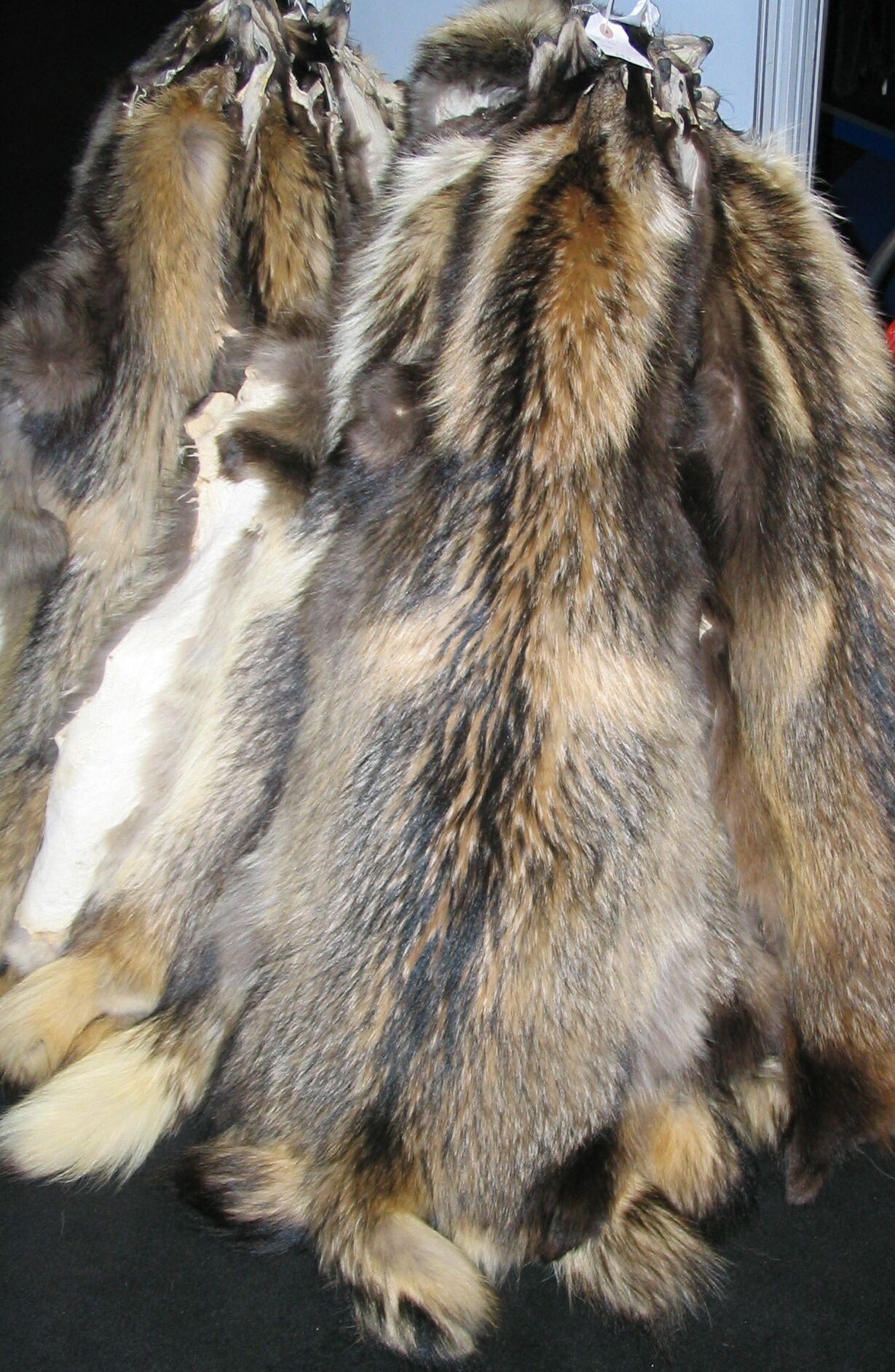
Raccoon dog pelts from the Chinese fur trade.

Being the dogs that they are, tanukis are omnivorous and will eat anything they can find, much like domestic dogs. In many areas of their range, they come into contact with humans and dwell near urban areas. This gives them access to unlimited buffets of delicious garbage, just like a real raccoon! Though they can tolerate living in close proximity to humans, raccoon dogs prefer the wilderness. They can be found in forests with dense vegetation, mountainous regions, and even along the coast.

Credit: Tambako the Jaguar

In day to day life, raccoon dogs tend to stay together and travel in pairs or small family groups. In the wild, tanukis are generally monogamous when it comes breeding time. Males and females will form a pair bond and stay together to raise their 5-7 puppies until they are ready to become independent. Raccoon dogs are altricial, meaning they are helpless when they are born. At birth, they have downy black fur and their eyes are closed. By 9 or 10 days, their eyes open and teeth can be seen on average at about 14 days. These dogs grow quickly and will reach sexual maturity by 10 months.

Like all dogs, raccoon dogs have an exceptional sense of smell. This super sense is used as a primary means of communication amongst a family or strangers. Groups of these animals will share communal “latrines” (because they are fancy) where they urinate and defecate. The scents associated with the leavings can reveal a lot about an individual dog, and this information is “read” by others like a Facebook status.
Vocal communication is also used, but, funnily enough, these dogs are the only member of their family that do not bark. Vocalizations consist of whines, mews, whimpers, and growls, which correspond to friendly, submissive, or aggressive behaviors.
So now that we’ve established how cute and awesome these creatures are, what does any of this have to do with Shigeru Miyamoto’s Super Mario Bros. franchise? I’ll tell you. The raccoon dog is actually the inspiration for the very useful Tanooki Suit that occurs in many Mario games. Although this suit is based on the Japanese mythology behind the small canid, it is often mistaken by people or mistranslated as a raccoon suit. This is not helped by the fact that the suit has a striped raccoon tail that is not shared by raccoon dogs. Japanese myths surrounding these dogs include their ability to use leaves to shape-shift and cause mischief. This is paralleled in the way that Mario can become Tanooki Mario by obtaining a Super Leaf, resulting in the ability to fly and transform into a statue to avoid or attack enemies.

Tanooki Mario.

Unfortunately, or fortunately (depends on how you look at it), real tanukis can’t fly or use leaves to transform themselves. Despite that, though, they’re pretty special pups that deserved to be acknowledged, if only for their cute little raccoon masks. From ancient legends, to Super Mario, to Animal Crossing’s Tom Nook, it’s no wonder they’ve become such an icon in Japanese culture. Animals that have such striking visual resemblance to completely unrelated species always offer something to talk about.

References:
1. Carr, Kelly and Shefferly, Nandy, ed. “Nyctereutes procyonoides”. Animal Diversity Web. University of Michigan Museum of Zoology, 2004 Web. 3 September 2015. < http://animaldiversity.org/accounts/Nyctereutes_procyonoides/>

2. Kauhala, K and Saeki, M. “Nyctereutes procyonoides (Raccoon Dog).” Red List. International Union for the Conservation of Nature, 2008. Web. 3 September 2015. <http://www.iucnredlist.org/details/14925/0&gt;.

3. “Raccoon Dog, Tanuki.” WAZA. World Association of Zoos and Aquariums, n.d. Web. 03 Sept. 2015. <http://www.waza.org/en/zoo/visit-the-zoo/dogs-and-hyenas/nyctereutes-procyonoides&gt;.

4. “Raccoon Dog – Nyctereutes Procyonoides (Eurasia’s Carnivores).” Large Herbivore Network. European Centre for Nature Conservation, n.d. Web. 3 Sept. 2015. <http://www.lhnet.org/raccoon-dog/&gt;.

5. “Tanooki Suit.” Super Mario Wiki, the Mario Encyclopedia. N.p., n.d. Web. 25 Sept. 2015. <http://www.mariowiki.com/Tanooki_Suit&gt;.

Photo Links:
1.http://www.factzoo.com/sites/all/img/mammals/raccoon-dog.jpg

2.https://flickr.com/photos/-mbender

3.https://en.wikipedia.org/wiki/File:Chinese_raccoon_fur_skins.jpg#filelinks

4.https://flickr.com/photos/tambako/

5.http://retrieverman.wordpress.com/files/2009/02/raccoon-dogs1.jpg

6.https://www.mariowiki.com/File:Tanooki_Mario_Artwork_-_Super_Mario_3D_World.png

The Scaly Monogamist – Shingleback Lizard

The shingleback lizard (Tiliqua rugosa) is most at home in the rugged, dry plains and shrublands of southern and western Australia. It is a large species of blue-tongued skink that can reach a foot in length. This lizard may not look like much with its dull, armored skin and stubby tail, but it forms a bond that is quite unusual in the world of reptiles, especially among lizards.

The very head-like tail of the shingleback lizard.

Unlike almost all other lizards, the shingleback is socially monogamous. When a male and female form a pair bond, they will maintain that bond for the rest of their lives. During the breeding season, they come together and stay with each other for a couple of months and then mate. Once the female is pregnant, the two will separate, but they will reunite again the next year. These lizards have been known to remain together for over 10 years or more and may sometimes spend time together outside of breeding season as well. Shinglebacks are slow moving and often bask in the sun on or near roadways. Unfortunately, some of them get hit and killed by cars because they aren’t able to move fast enough to get out of the way. This has revealed that even after the death of one lizard, its mate continues to keep that bond. A shingleback that has lost its mate by the roadside may stay with it for several days, gently nudging it and licking it. This may be one of the closest things to grieving that has been observed in reptiles, and it is really quite touching.

51642905977_081e793f93_c

A pair of mated shinglebacks by Melissa Bruton

Though they have no defenses against cars, shinglebacks do have several ways of dealing with natural predators. One defense adaptation is their tails. Short, stumpy, and rounded, the tail looks almost exactly like the lizard’s head and may trick a predator into attacking this much less crucial part of its body, or just confuse it enough to make it leave. If this fails, they can use the threat display that is famous within the Tiliqua genus – the blue tongue. When threatened, a shingleback may raise its head, hiss, and open its mouth to reveal its blue-black tongue to scare off a predator. This startling display is followed up with a painful bite if the message isn’t clear enough. The last option for this lizard is to flatten itself to the ground and continue hissing.

8604570652_36110ea7f0_b

A shingleback showing its blue tongue by “Al and Marie” on Flickr.

Most of the time, adult shinglebacks are left alone by predators and are allowed to go about their business, such as reproducing, in peace. Shortly after mating when a female shingleback parts ways with her partner, she will produce one to four large babies. This skink is ovoviviparous, which means she gives birth to live young without connection to a placenta. The eggs stay in her body and she incubates them by collecting thermal energy from basking in the sun. When they are mature enough and have hatched, she gives birth. All the babies together can weigh up to a third of her body weight, which is the equivalent of a human mother giving birth to a three year old child. After birth, the new shinglebacks will stay with their mother for several months until they are independent enough to fend for themselves. They won’t go too far, though, as families of shinglebacks tend to stay near each other within the area.

People generally think of reptiles as cold, unfeeling, and primitive. This quiet, desert skink, and many other reptiles, prove that there is more to them than just pure, unthinking instinct. They can be gentle, sophisticated, and tender, showing many of the characteristics which we find so endearing in our warm blooded relatives. So go out and show reptiles a little love. Some of them just might be able to return it in their own, scaly way.

References:
1. Loch, Thomas. “Tiliqua rugosa (Shingleback Lizard)”. Animal Diversity Web. University of Michigan Museum of Zoology, 17 Feb. 2009 Web. 24 June 2015. < http://animaldiversity.org/accounts/Tiliqua_rugosa/&gt;

2. Bull, C. Michael, Steven JB Cooper, and Ben C. Baghurst. “Social monogamy and extra-pair fertilization in an Australian lizard, Tiliqua rugosa.” Behavioral Ecology and Sociobiology 44.1 (1998): 63-72.

3. “Shingleback Lizard.” Australian Museum. Australian Museum, 16 Dec. 2013. Web. 24 June 2015. <http://australianmuseum.net.au/shingleback-lizard&gt;.

4. Bull, C. Michael. “Monogamy in lizards.” Behavioural Processes 51.1 (2000): 7-20.

Photo and Video Links:
1.https://upload.wikimedia.org/wikipedia/commons/1/19/Shingleback_Skink_at_Sydney_Wildlife_World.jpg

2.https://flic.kr/p/2mFvoJD

3.https://flic.kr/p/2mY39fT

4.https://www.youtube.com/watch?v=F4zau3U8aGU