The Origin of the Super Mario Bros. Tanooki Suit

It’s a raccoon! It’s a dog! No, it’s a raccoon dog!
The raccoon dog (Nyctereutes procyonoides), also called tanuki, is a very strange little canine that sports a black bandit mask, a wonderfully fluffy coat, and short, stubby legs. It’s also freaking adorable! These pups are small members of the family Canidae that share many morphological features with foxes, as they are closely related. They get the name raccoon dog from the black, mask like markings, bushy tails, and brownish gray coat that looks a lot like raccoon fur. Their resemblance to raccoons is also reflected in their species name, procyonoides, which means raccoon-like. Raccoons belong to Procyonidae – a family including coatis, ringtails, kinkajous, and olingos, among others.

Credit: Michelle Bender

The raccoon dog is historically native to East Asia, but was introduced from the late 1920s into the ‘50s over much of Europe and European Russia for fur trapping. There are now established populations in more than 20 countries outside its endemic range. Though most of these populations are stable, the animals are widely killed for the fur trade and eaten in some countries such as Japan. Despite this, the IUCN lists them as “Least Concern”, as there is no major threat to the species’ survival as a whole.
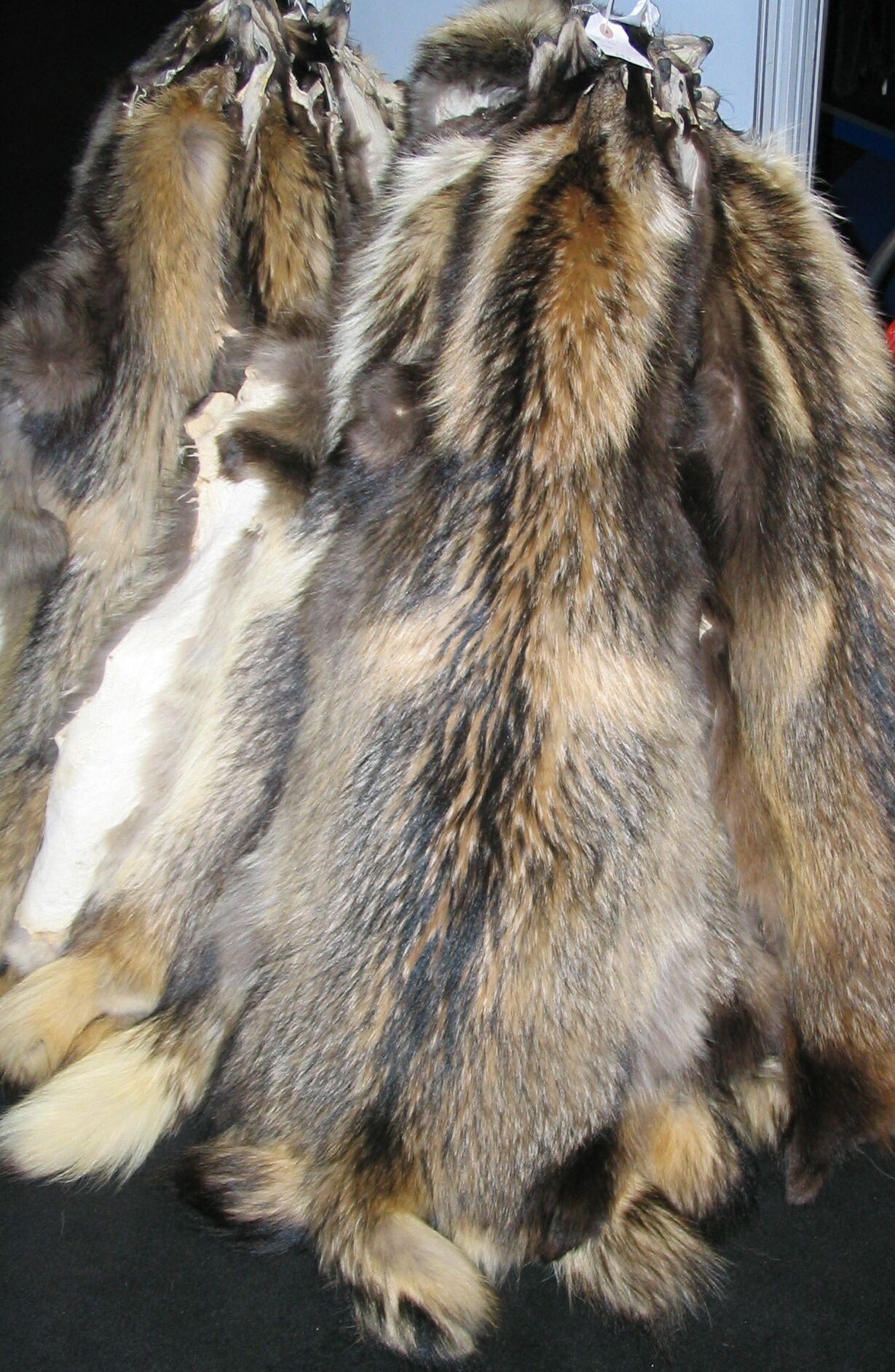
Raccoon dog pelts from the Chinese fur trade.

Being the dogs that they are, tanukis are omnivorous and will eat anything they can find, much like domestic dogs. In many areas of their range, they come into contact with humans and dwell near urban areas. This gives them access to unlimited buffets of delicious garbage, just like a real raccoon! Though they can tolerate living in close proximity to humans, raccoon dogs prefer the wilderness. They can be found in forests with dense vegetation, mountainous regions, and even along the coast.

Credit: Tambako the Jaguar

In day to day life, raccoon dogs tend to stay together and travel in pairs or small family groups. In the wild, tanukis are generally monogamous when it comes breeding time. Males and females will form a pair bond and stay together to raise their 5-7 puppies until they are ready to become independent. Raccoon dogs are altricial, meaning they are helpless when they are born. At birth, they have downy black fur and their eyes are closed. By 9 or 10 days, their eyes open and teeth can be seen on average at about 14 days. These dogs grow quickly and will reach sexual maturity by 10 months.

Like all dogs, raccoon dogs have an exceptional sense of smell. This super sense is used as a primary means of communication amongst a family or strangers. Groups of these animals will share communal “latrines” (because they are fancy) where they urinate and defecate. The scents associated with the leavings can reveal a lot about an individual dog, and this information is “read” by others like a Facebook status.
Vocal communication is also used, but, funnily enough, these dogs are the only member of their family that do not bark. Vocalizations consist of whines, mews, whimpers, and growls, which correspond to friendly, submissive, or aggressive behaviors.
So now that we’ve established how cute and awesome these creatures are, what does any of this have to do with Shigeru Miyamoto’s Super Mario Bros. franchise? I’ll tell you. The raccoon dog is actually the inspiration for the very useful Tanooki Suit that occurs in many Mario games. Although this suit is based on the Japanese mythology behind the small canid, it is often mistaken by people or mistranslated as a raccoon suit. This is not helped by the fact that the suit has a striped raccoon tail that is not shared by raccoon dogs. Japanese myths surrounding these dogs include their ability to use leaves to shape-shift and cause mischief. This is paralleled in the way that Mario can become Tanooki Mario by obtaining a Super Leaf, resulting in the ability to fly and transform into a statue to avoid or attack enemies.

Tanooki Mario.

Unfortunately, or fortunately (depends on how you look at it), real tanukis can’t fly or use leaves to transform themselves. Despite that, though, they’re pretty special pups that deserved to be acknowledged, if only for their cute little raccoon masks. From ancient legends, to Super Mario, to Animal Crossing’s Tom Nook, it’s no wonder they’ve become such an icon in Japanese culture. Animals that have such striking visual resemblance to completely unrelated species always offer something to talk about.

References:
1. Carr, Kelly and Shefferly, Nandy, ed. “Nyctereutes procyonoides”. Animal Diversity Web. University of Michigan Museum of Zoology, 2004 Web. 3 September 2015. < http://animaldiversity.org/accounts/Nyctereutes_procyonoides/>

2. Kauhala, K and Saeki, M. “Nyctereutes procyonoides (Raccoon Dog).” Red List. International Union for the Conservation of Nature, 2008. Web. 3 September 2015. <http://www.iucnredlist.org/details/14925/0&gt;.

3. “Raccoon Dog, Tanuki.” WAZA. World Association of Zoos and Aquariums, n.d. Web. 03 Sept. 2015. <http://www.waza.org/en/zoo/visit-the-zoo/dogs-and-hyenas/nyctereutes-procyonoides&gt;.

4. “Raccoon Dog – Nyctereutes Procyonoides (Eurasia’s Carnivores).” Large Herbivore Network. European Centre for Nature Conservation, n.d. Web. 3 Sept. 2015. <http://www.lhnet.org/raccoon-dog/&gt;.

5. “Tanooki Suit.” Super Mario Wiki, the Mario Encyclopedia. N.p., n.d. Web. 25 Sept. 2015. <http://www.mariowiki.com/Tanooki_Suit&gt;.

Photo Links:
1.http://www.factzoo.com/sites/all/img/mammals/raccoon-dog.jpg

2.https://flickr.com/photos/-mbender

3.https://en.wikipedia.org/wiki/File:Chinese_raccoon_fur_skins.jpg#filelinks

4.https://flickr.com/photos/tambako/

5.http://retrieverman.wordpress.com/files/2009/02/raccoon-dogs1.jpg

6.https://www.mariowiki.com/File:Tanooki_Mario_Artwork_-_Super_Mario_3D_World.png

Eight-legged, Bouncing Ball of Cute! – Peacock Jumping Spider

All Photo and Video Credits go to Jürgen Otto. Please visit his amazing website, Flickr, and YouTube accounts!
https://www.peacockspider.org/
https://www.flickr.com/photos/59431731@N05/
https://www.youtube.com/channel/UCA1shkhjIY_QiDdYfEYDqew

Peacock spiders of the genus Maratus are tiny jumping spiders barely four millimeters in length that are endemic to Australia. 53 species of Maratus spiders have been named as of 2015, 20 of which were recently discovered by researcher Jürgen Otto and his team. Though extremely small, these little jumping spiders make up for it with their spectacular colors and mating dances. It’s the males who are really the stars of the show. Females are all dull brown in color and don’t perform any sort of courtship display. They just watch and judge as the little males strut their stuff, trying to win some love.

5479964413_803612caf7_z
M. volans.

Males are equipped with elongated third legs which they wave and vibrate in accompaniment with their dance. The back of the abdomen is covered with a flap (which I like to refer to as the “butt flap”) containing brightly colored scales that form special patterns in separate species. These are held up over their heads like miniature peacock tails as they dance around in front of their potential mates. As a male dances, he slowly and cautiously approaches the female and gently places his front legs on her head. If he’s lucky, he will get to mate with her. If not, he must get away quickly to avoid being eaten. These displays can last anywhere from 20 minutes to over an hour!
Just recently, three new specie, M. jactatus, M. sceletus, and M. elephans were discovered. M. jactatus has been affectionately nicknamed “Sparklemuffin” by the graduate student who discovered it.

Sparklemuffin.

m. sceletus
M. sceletus (Skeletorus)

Peacock spiders have also been known as “flying” spiders because of their special flaps. This was because they were first falsely thought to use these flaps as wings to glide through the air, much like a flying squirrel. However, it has since been observed that they engage in no such behavior. When they jump, their flaps have no significant effects on their speed or trajectory. In fact, courtship is the only activity where these flaps are unfolded. One species, M. vespertilio, is an exception and displays his fan while sparring with other males. None of the other species have shown these male to male contests yet and this behavior was discovered accidentally while filming was taking place.

6343076673_e0a1fd2d19_z
M. vespertilio males facing off

These spiders are a perfect example of all the bizarre and amazing creature that we still haven’t found. It is amazing that something so tiny possesses such complex, fascinating, and adorable behavior. Until peacock spiders were observed, scientists had no idea that spiders displayed to each other like this. This just goes to show that there will always be more to learn and every tiny creature that we find is worth protecting.

References:
1. Girard, Madeline B., and John A. Endler. “Peacock spiders.” Current Biology 24.13 (2014): R588-R590.

2. Otto, J. C., and D. E. Hill. “Contests between male Maratus vespertilio (Simon 1901)(Araneae: Salticidae).” Peckhamia 98 (2012): 1-17.

3. Framenau, Volker W. “Australasian Arachnological Society.” (2006).

4. Arnold, Carrie. “Behold Sparklemuffin and Skeletorus, New Peacock Spiders.” National Geographic. National Geographic Society, 24 Mar. 2015. Web. 10 Aug. 2015. <http://news.nationalgeographic.com/2015/03/150324-australia-peacock-spider-sparklemuffin-new-species/&gt;.

Little Kitty – Kodkod

If you have never loved and been loved in return by a cat or other pet, I would argue that you have never really lived. The love you feel for a cat and the love that a cat gives to you is among the truest and purest form that love can take. When you experience that love, you become a better person with a greater capacity to share that love with others in your life.
I have very recently lost the light of my life, Elly, the cat that has been with me for 18 years. She went on her own time out in the garden where she loved to be and had loving support all the way. I have never missed anyone so much and the pain of her death is still raw. But that pain comes from my love for her. I am so thankful for the time I was given with her and will always love her infinitely. She was the most special friend that anyone could ever have and I am glad that she went peacefully and didn’t have to suffer.
This is for Elly. I will love you forever, little girl!

The kodkod (Leopardus guigna) is the smallest wild cat in the Americas, and rivals several other species for the title of smallest cat in the world. This tiny cat barely reaches 6 pounds (smaller than the average house cat) and lives in the montane areas of Chile and a small portion of Argentina. It prefers dense undergrowth in its moist, temperate evergreen forest habitat, and can be found up to the tree line at around 6,300 feet. Although this cat is usually brownish yellow with black spots, melanism is common. The paws are large with black pads and its ears are rounded with a white spot on the back of each one. The kodkod’s short, bushy tail, small frame, and petite facial features give it the appearance of a kitten, even when it is a full grow adult.

There is still not much known about this small cat, and its populations are dwindling. An estimated 10,000 cats are left in the wild, no single population exceeding 2,000 individuals. Kodkods are sometimes killed for raiding chicken coops or accidentally caught in fox traps. The cats are also illegally trapped for their fur. Perhaps the biggest threat to the kodkod, though, is habitat loss and fragmentation. Kodkods don’t do well in deforested areas. They need at least a thick ground cover such as scrub to survive, and stick exclusively to the forested corridors around developed or farmed areas.

In contrast to other cats, kodkods are equally active at night and during the day. Around humans, however, they are strictly nocturnal. They appear in areas where there are high numbers of small, mouse sized prey and not many larger predators. This relative lack of competition gives them the opportunity to flourish on the abundance of food and raise their one to three kittens.

There are many conservation laws and programs in place to protect this special little cat and its close relatives like the oncilla and Geoffroy’s cat. We treat our pets as family and give them all the love we have, doing whatever we can to support them. Why can’t we show wild cats this same love? They’re really not that different.

References:
1. “Kodkod.” Felidae Conservation Fund. Felidae Conservation Fund, 2013. Web. 22 July 2015. <http%3A%2F%2Fwww.felidaefund.org%2F%3Fq%3Dspecies-kodkod>.

2. “Guigna Facts.” Big Cat Rescue. Bigcatrescue.org, 15 Mar. 2015. Web. 22 July 2015. <http%3A%2F%2Fbigcatrescue.org%2Fkodkod-guigna-facts%2F>.

3. “Kodkod.” International Society for Endangered Cats (ISEC) Canada. ISEC Canada, 2014. Web. 22 July 2015. <http://www.wildcatconservation.org/wild-cats/south-america/kodkod/&gt;.

4. Napolitano, C., Gálvez, N., Bennett, M., Acosta-Jamett, G., and Sanderson, J. “Leopardus Guigna (Chilean Cat, Guiña, Kodkod).” Red List. International Union for the Conservation of Nature, 2015. Web. 22 July 2015. <http://www.iucnredlist.org/details/15311/0&gt;.

Photo and Video Links:

1.https://flic.kr/p/2iVdFMV

2.https://www.youtube.com/watch?v=BFA6hxfnVjM

3.http://d.ibtimes.co.uk/en/full/1360845/chile-cat.jpg

So i herd u liek mudkipz – Axolotl

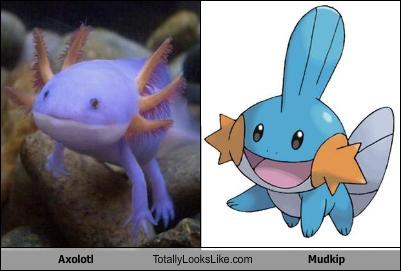
Just as the “so i herd u liek mudkipz” meme has popularized the water type starter, Mudkip, from the beloved Ruby, Sapphire, and Emerald Pokémon games (and, recently Omega Ruby and Alpha Sapphire), the internet seems to have somewhat familiarized the public with a peculiar and endangered salamander.

Mudkip beside an axolotl Photoshopped to be the same colors.

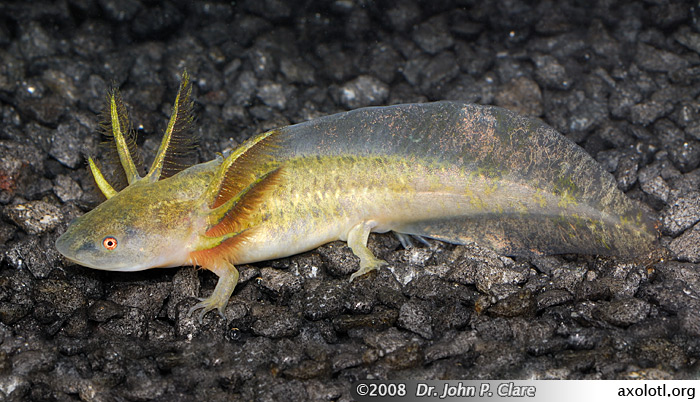
The Axolotl (Ambystoma mexicanum) lives exclusively in the fragmented remains of Central Mexico’s Lake Chalco and was once present in Lake Xochimilco before it was drained. These salamanders can come in a variety of different colors, two of them being wild type and the other two present in mutations. The wild colors are brown and black, while the mutant colors are leucistic and albino. Although both the leucistic and albino axolotls are varying shades of pinkish white, the albino has pink eyes and the leucistic has black eyes. They are closely related to tiger salamanders, sharing the same genus, and in fact look very similar to the larvae of tiger salamanders. Unlike other salamanders, axolotls normally never undergo metamorphosis into an adult form. This does not mean that they are not sexually mature, however. The average axolotl reaches maturity at 18-24 months of age with a typical length of around nine inches. They have both rudimentary lungs and gills so they are able to take oxygen from the water and gulp air at the surface. The gills are arranged on three stalks on each side behind the head. An axolotl also retains fins running from the end of its body to the tip of the tail.

Barred tiger salamander larva (Ambystoma mavortium mavortium).

4571101149_3b91879a14_c

Adult axolotl with wild type coloration

Retaining larval characteristics throughout life is called neoteny. Other salamanders can become neotinic if conditions in the environment put an unusual level of stress on the animal, but the axolotl is exclusively neotinic within its species. On extremely rare occasions, axolotls will progress to adult form. They most often remain strictly aquatic, though. They are naturally top predators in the areas they inhabit and feed on mollusks, crustaceans, water insects, and small fish. Since they are neotinic, their teeth are not fully developed and are only rough stumps in their jaws. They use these tooth stumps to grasp a prey item and position it before swallowing it whole. Unfortunately, since the introduction of large, nonnative fish, there is more competition for food and occasional predation upon axolotls by these fish. Additionally, axolotls are sold in markets as a delicacy which further reduces their population and they are now a red listed species that is critically endangered.

tumblr_o83gelQne01tic84no2_1280

Metamorphosed leucistic axolotl

Another very intriguing aspect of the axolotl is its Wolverine-like ability to heal itself. This trait has made it one of the most heavily studied salamanders in the world. Axolotls can completely regenerate their limbs, spinal cords, and even some organs in a matter of a couple months. The younger the salamander, the faster it heals. Older axolotls can still regenerate, but it takes much longer. The oldest axolotl in captivity, named Tiger Girl, in the Axolotl Center of Hanover, Germany was 16 years old (as of 2010) and it took her a year to grow back a leg that was bitten off by one of her tank mates. This research center is dedicated to the conservation of axolotls and studies their regeneration abilities in a humane, minimum stress environment. Researchers will anesthetize a salamander and cut off part of its limb to study the healing process. This doesn’t hurt the animal due to its incredible healing abilities and it is well cared for and eventually left to a life of retirement with no more testing.

Video about the Axolotl Center:
http://www.spiegel.de/international/zeitgeist/miracle-healer-scientists-attempt-to-crack-secret-code-of-the-axolotl-a-732283.html

Research institutions like the one in Hanover are helping to strengthen the international breeding program of axolotls and conserve this very remarkable and interesting species. It may give us clues about how to help humans who are injured to heal more effectively, such as burn victims. It is not only a fascinating animal, but also a valuable source of information for science and medicine that is imperative to save.

References:
1. Luis Zambrano et al. “Ambystoma mexicanum”. The IUCN Red List of Threatened Species, 2015. Web. 23 June, 2015. http://www.iucnredlist.org/details/1095/0

2. Taurog, Alvin, et al. “The role of TRH in the neoteny of the Mexican axolotl (Ambystoma mexicanum).” General and comparative endocrinology 24.3 (1974): 267-279.

3. Kragl, Martin, et al. “Cells keep a memory of their tissue origin during axolotl limb regeneration.” Nature 460.7251 (2009): 60-65.

4. Hamm, Magdalena. “Miracle Healer.” Speigel Online International. Speigel, 2 Dec. 2010. Web. 23 June 2015. <http://www.spiegel.de/international/zeitgeist/miracle-healer-scientists-attempt-to-crack-secret-code-of-the-axolotl-a-732283.html&gt;.

Photo and Video Links:
1.https://creaturefacts.org/wp-content/uploads/2015/07/afa4f-axolotl-totally-looks-like-mudkip.jpg

2.http://www.axolotl.org/images/tiger/tiger-salamander-larva.jpg

3.https://flic.kr/p/7XW67M

4.https://alphynix.tumblr.com/post/145316913155/edge-of-existence-edge-it-is-oddly-enough/embed

5.http://www.spiegel.de/international/zeitgeist/miracle-healer-scientists-attempt-to-crack-secret-code-of-the-axolotl-a-732283.html

6.http://i.dailymail.co.uk/i/pix/2013/05/17/article-2326057-19D49A37000005DC-864_634x419.jpg

UPDATE: NEW CLOUDED LEOPARD CUBS!

UPDATE!!! 6/5/15
Four new clouded leopard cubs that were born in May at the Point Defiance Zoo & Aquarium in Tacoma, Washington are now officially on display! Go see them if you’re in the area! 🙂


http://www.king5.com/story/news/2015/05/19/1-week-old-clouded-leopard-cubs-at-point-defiance-healthy-and-adorable/27613921/

American Marten

The American marten (Martes americana) is without a doubt one of the cutest North American mammals. Quick, agile, and active, it is an opportunistic predator that loves to eat small mammals like mice, voles, snowshoe hares, and squirrels. It will also take insects, birds, and a variety of fruit when it finds them. The marten is a mustelid, or member of the weasel family, and is found throughout Northern North America in mature coniferous and mixed hardwood forests. It has a very large territory for being such a small animal and this can be up to about six square miles. It is mostly solitary and male and female interaction doesn’t occur often at anytime other than during breeding season. Even then, there is no bond formed between pairs and a female will go into heat several times, taking a different male as her partner each time. After courtship and mating, the female goes off alone to raise her young, called kits. The kits are adult size and ready to go off on their own by three and a half months of age.

American martens are largely arboreal and spend a good amount of their time in the trees. They generally do their hunting on the ground, but will occasionally go on fast chases through the trees after squirrels, which are a particularly special treat. Living in cold, Northern climates, martens are very well adapted to the snow. In fact, you are more likely to find a marten where there is a thick covering of snow on the ground. These little mammals have a hard time retaining their own body heat because they have very limited fat reserves, so snow provides a safe place to hide and insulate their bodies while they enter a shallow torpor on colder days. A torpor is a thermoregulatory process that slows down an animal’s metabolism and reduces body heat. It is used to conserve energy when food supplies get low or when it is too cold for the animal to function normally. This saves energy that would have otherwise been used to maintain body heat. In some periods of the winter, American martens will go into a torpor almost daily. The rest of the time, they will thermoregulate themselves by changing their activity and behavior. Hunting and foraging is one way that they keep themselves warm. Another way is tunneling long distances under the surface of the snow. Some marten snow tunnels can reach up to almost 100 feet!

A common misnomer is to call these animals pine martens. True pine martens (Martes martes) occur in Europe, not North America. However, our martens are sometimes also called American pine martens, which could be considered more correct, as it designates their geographical origin. When unsure of an animal’s common name, it is always better to go by its scientific name, if known, to avoid error.

51935214550_f36e30917c_c

Credit: Allison Gregor

American martens measure from 1.8 to 2.2 feet long and weigh up to three pounds. They have sharp, semi-retractable claws like a cat as well as rounded, catlike ears. Their fur is very soft and silky which led to them being heavily trapped for their pelts during the early 1900s. This drastically reduced their populations, but now the species has recovered and American martens have been introduced in areas where they were once extinct. Today, there are still periodic pelt collections for the purpose of population control, but this doesn’t make a significant impact on overall marten numbers. I personally don’t think they should be trapped at all. American martens are important predators in their ecosystems and keep other small mammal populations in check through their predation. If there is a marten population boom, there will be less food available for each marten and the population control will occur naturally because of that prey scarceness. It shouldn’t be up to humans to decide when the population of an animal becomes too large. Especially with animals as adorable as the American marten. I’m sure their fur is lovely, but it looks much better on a live, frisky marten running through the snow and playing in the trees.

References:
1. Stone, Katharine. 2010. Martes americana. In: Fire Effects Information System, [Online]. U.S. Department of Agriculture, Forest Service, Rocky Mountain Research Station, Fire Sciences Laboratory (Producer). Available: http://www.fs.fed.us/database/feis/ [2015, May 20].

2. “American Pine Marten.” The Nature Conservancy. The Nature Conservancy, n.d. Web. 21 May 2015. <http://www.nature.org/newsfeatures/specialfeatures/animals/mammals/pine-marten.xml&gt;.

Photo Links:
1. http://24.media.tumblr.com/tumblr_ma7nv7qdtg1rzpxtno1_400.jpg

2. https://flic.kr/p/2n8kxTC

3. http://seancrane.com/blogphotos/pine_marten_4.jpg