Spectral Leaf – Ghost Mantis

Yes, it’s another mantis, but they’re really cool insects, so why not?

The Ghost mantis (Phyllocrania paradoxa) is a tiny mantis found throughout Eastern and Western Africa and occasionally in the South, including the island of Madagascar. It mainly lives in drier areas and clings to the leaves and twigs of different plants in its habitat. It only grows up to about two inches in length and is considered to be miniature for a mantis. Ghost mantis males and females are roughly the same length, but the male is slimmer and has slightly longer wing cases that are partially transparent. Males also have eight abdominal segments, whereas females possess only 6. They can be a variety of different colors ranging from a subtle brownish green to almost black. The most common color is dark brown, however.

Two females next to a  50 euro coin.

Like the orchid mantis, ghost mantises boast some of the most impressive camouflage of the insect world. The thorax is slightly flattened into a leaf-like shape and each of the walking legs and abdomen have projections that mimic dead leaves as well. A ghost mantis’ back is laced with thin veins and mottled with pigmentation that mimics leaf folds. The head is probably the weirdest and most intriguing part of the animal’s body. Its eyes are almost invisible due the fact that they are the exact color as the rest of its exoskeleton. Above them is a long, ghoulish crest that resembles a dried and withered leaf. In addition to the ghost mantis’ physical camouflage, it also displays behavioral camouflage. It will often tuck its forelegs up tight against its body to give it an unusual shape that may confuse potential predators. When disturbed, it will start to rock back and forth to mimic a leaf blowing in a gentle breeze.

Ghost mantises aren’t typically very active. They mainly hang upside down on leaves and branches while waiting for prey. They possess no attributes that help lure other creatures to them, so their only hunting strategy is to hide and stay still. Crawling insects are the most common prey items as they have more trouble taking down flying insects. A ghost mantis can stay motionless in the same spot for hours ready to seize prey that comes too near. It may quickly turn its head to look at something it sees, but the rest of its body remains unmoving. If something comes by that is a threat rather than food, the first line of defense will be to get away or use that quaking motion described earlier. If that fails, it uses thanatosis (plays dead) to try to fool whatever is startling it. It does this by folding all of its legs into its body and dropping to the ground. This may seem like it would make the mantis an easy target, but most of its predators are only interested in live prey so it actually works quite well.

Similar to many other species of mantis, ghost mantis babies are disguised as ants to avoid being eaten. Many mantis predators such as spiders and large insects avoid ants because they can be so dangerous. A baby ghost mantis is just the right size for this gimmick to work before the second molt, but after that it becomes too big to pull it off and begins to take on the appearance of an adult. Although the ghost mantis is slightly longer lived than other mantises, its life is still short. Even so, it’s very special that such a cool animal like this exists.

References:
1. Tomasinelli, Francesco, and Andrea Mangoni. “Biology and Captive Breeding of the African Dead Leaf Mantis Phyllocrania Paradoxa.” Mantis Study Group Newsletter 23 (Feb. 2002): 1-12. http://mantodea.myspecies.info/sites/mantodea.myspecies.info/files/MSG%20NL%2023%20%28February%202002%29.pdf

2. “Ghost Mantis – Phyllocrania paradoxa.” Keeping Insects. Keepinginsects.com, n.d. Web. 23 June2015. http://www.keepinginsects.com/praying-mantis/species/phyllocrania-paradoxa/

Photo Links:
1.https://upload.wikimedia.org/wikipedia/commons/c/c8/Phyllocrania_paradoxa_Morphology.jpg

2.http://www.pxleyes.com/blog/wp-content/uploads/camouflage-photography-in-the-animal-world-50-astonishing-photos/29.jpg

3.https://upload.wikimedia.org/wikipedia/commons/thumb/2/2d/Phyllocrania_Paradoxa_F_Subadult.jpg/640px-Phyllocrania_Paradoxa_F_Subadult.jpg

A Deceptive Flower – Malaysian Orchid Mantis

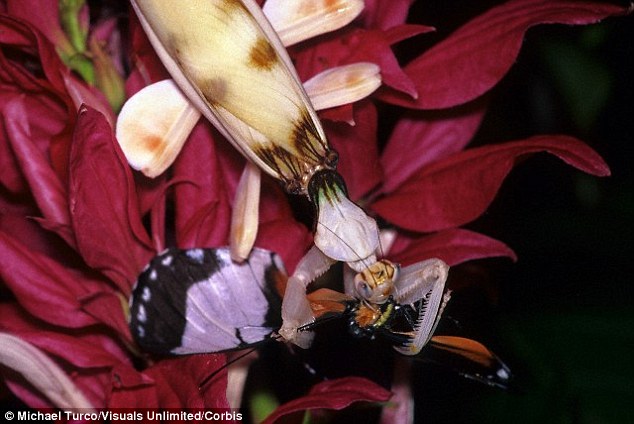
The Malaysian orchid mantis (Hymenopus coronatus) is a unique species of mantis that lives in the South Asian rainforests of Malaysia, Sumatra, and Indonesia. It is quite small, only about two and a half inches long at most for the female, and displays the greatest sexual dimorphism of all the mantids. Males are half the size of the female and there is even a slight difference in the coloring of a band-like marking around the neck. This marking is green in sub-adult females and a brownish purple on sub-adult males. Either color goes nicely with the subtle, creamy pastel shades of the mantis’ body. The species itself can come in a range of colors depending on what environment it matures in. Most often it is white or pink, but there can be purple, yellow, green and a variety of other colors.

Adult male and female.

Although the Malaysian orchid mantis is a beautiful creature, it is also a vicious predator. As the name suggests, this mantis often chooses orchid flowers as its hunting grounds. Its body is camouflaged perfectly to match the botanical backdrop on which it hides. The four walking legs are even equipped with petal mimicking projections so as to camouflage better. All the mantis needs to do is lie in wait, perfectly still, for some poor unsuspecting insect to visit the flower. Once this occurs, the mantis grabs it up in its sharp, spiny forelegs with lightning speed and proceeds to rip it apart with its powerful jaws. It uses this same weaponry to defend itself from harm when threatened and can become quite aggressive if disturbed. First it will rise up into a threat display with its arms outstretched and wings spread wide. If it still feels bothered then it will attack. Those arms can actually inflict a good amount of damage to a human hand and the mantis will not hesitate to bite any place it can reach.

Another very interesting defense is used only by orchid mantises when they are very young nymphs. The little baby mantises walk around disguised as a dangerous species of ant. They hold their abdomens curled over their bodies and move with an ant-like motion. They walk on all six legs, which are tipped in black, contrasting with their bright red bodies. This allows them to avoid predators that aren’t looking to mess around with getting stung or bitten by ants and also as a cover-up to go hunting real ants. It is evident that these clever insects are masters of camouflage at every stage of life.

Ant mimicking nymph.

Although the ant disguise is a striking technique, it doesn’t last long. A nymph loses this costume after the first molt and begins to look like a tiny adult instead. Orchid mantis females go through seven molts to reach adulthood and males go through five, maturing much quicker but living shorter lives. The average female lives about eight months while a male will only live to be five or six months old. Once a nymph becomes an adult, it develops large wings and becomes a very good flier and can travel more effectively. Orchid mantises don’t just frequent orchids. They will hang around in many other flowering plants and trees such as papayas and the wonderfully scented plumeria. So if you live in Southern Asia, definitely go check out some flowers to see if you can find one of these stunning insect beauties.

12089400405_b46f654ba2_z

Sub-adult female by “Frupus” on Flickr (see link below).

References:
1.”Orchid Mantis – Hymenopus Coronatus.” Keeping Insects. Keepinginsects.com, n.d. Web. 23 June 2015. <http%3A%2F%2Fwww.keepinginsects.com%2Fpraying-mantis%2Fspecies%2Forchid-mantis%2F>.

2. O’hanlon, J. C., D. Li, and Y. Norma-Rashid. “Coloration and morphology of the orchid mantis Hymenopus coronatus (Mantodea: Hymenopodidae).” Journal of Orthoptera Research 22.1 (2013): 35-44.

3. “Malaysian Orchid Mantis.” WAZA. World Association of Zoos and Aquariums, n.d. Web. 23 June 2015. <http%3A%2F%2Fwww.waza.org%2Fen%2Fzoo%2Fchoose-a-species%2Finvertebrates%2Finsects-and-millipedes%2Fhymenopus-coronatus>.

Photo Links:
1. http://lemondedesphasmes.free.fr/IMG/jpg/Hymenopuscoronatuscoupleadulte2.jpg

2.http://i.dailymail.co.uk/i/pix/2015/01/27/251D8E8800000578-0-image-a-43_1422365247535.jpg

3. https://s-media-cache-ak0.pinimg.com/736x/c1/d7/77/c1d777466221bdcf3f8634826ec41996.jpg

4. https://flic.kr/p/jqiky2

Foxy Faced – Mariana Fruit Bat

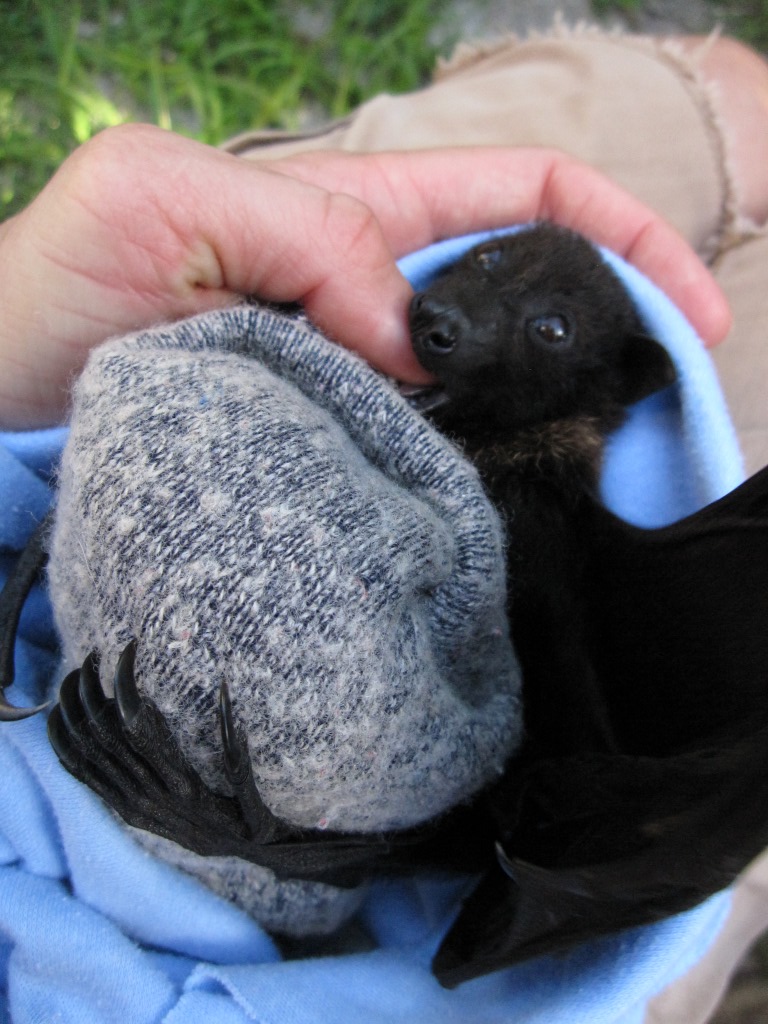
This leathery winged, furry bodied creature is not nearly as creepy as a good number of its relatives. In fact, depending on who you talk to (are they afraid of bats?), it’s downright adorable. The Mariana fruit bat (Pteropus mariannus), or Mariana flying fox, is a large, fuzzy, and endangered bat living primarily on Guam in the Pacific Islands. Although mostly nocturnal like the majority of bat species, these fruit bats will also use the day to breed, mark their territories with scent, or groom each other to form and strengthen social bonds. They live in large colonies together in tropical and subtropical forests with sparse undergrowth and relatively taller trees scattered throughout that reach above the main canopy. Roosting mainly takes place in different species of fig, pandanus, coconut, and hibiscus trees.

Mariana fruit bats are quite strikingly colored for a bat, and possess coats of blackish brown fur with silvery streaks and golden-brown or yellow necks and shoulders. Their faces have very canine features, hence the name “flying fox”, with their pointed snouts, slightly rounded ears, and large eyes. Their powerful wings are black and account for the majority of their total size. Wingspans can range from a little over 33 inches to almost 42 inches while the body is less than a foot long at just a bit over eight inches. It is not known for sure how long this particular species of bat lives, but similar species have been recorded to live for about 30 years in captivity.
When a bunch of Mariana fruit bats form colonies together, these colonies are usually made up of many breeding harems consisting of several females (2-15) and a male. Some other groups contain non-breeding bachelor males and there are also often a few lone, non-breeding males near the edges of the colony. There is no specific mating season for these bats and breeding takes place throughout the year. However, female bats will only produce one pup per year and take care of that pup until it can fend for itself. Babies cling their mothers and are carried around until they are too big. When roosting, a mother bat will envelop her baby in her wings to protect it.

Though they lead a relatively sedentary lifestyle and only stay in one specific spot, Mariana fruit bats are strong fliers and can travel long distances to find food. This food is (obviously) fruit, but flowers and leaves will occasionally be chosen as well. Many different fruits are eaten by these bats and preferred fruits include coconut, figs, papayas, cycad seeds, breadfruit, pandanus fruit, and umbrella tree fruit. Bats will normally fly six to seven miles to feeding sites, but will sometimes even go as far as 60 across to other islands. The phrase “blind as a bat” does not apply to these fruit bats, as they navigate and seek out fruit using their excellent vision and keen sense of smell.

9187712502_bbecd929e1_c

Traditionally, and even still today, native Pacific Islanders would kill and eat these bats, considering their meat a delicacy. Thankfully, they are protected as an endangered species now and there are fines and the threat of imprisonment to discourage hunting or poaching of Mariana fruit bats. In addition to legal protection, it has also been found that these fruit bats are major bioaccumulators. They build up toxins in their bodies from the poisonous cycad seeds they eat and from pesticides such as DDT and other toxic chemicals. Eating the meat of the bats can lead to a neuropathological degenerative disease identified as amyotrophic lateral sclerosis-Parkinsonian dementia complex. The long and obnoxious-to-say name reflects the seriousness of a disease such as this. It keeps progressing until it eventually leads to death. This disease comes from the toxins accumulated from the cycad seeds that bats feed on. You’d think this would be enough of a deterrent to keep people from trying to eat the poor creatures, but humans seem to prove themselves over and over again as being notoriously stubborn and nonsensical. Maybe if this continues and more and more people get sick, they will finally stop and the Mariana fruit bats will be safer. You never know.

9157728697_fe9be8019f_c

References:
1. Wilson, Don E., and DeeAnn M. Reeder. “Order Chiroptera.” Mammal Species of the World: A Taxonomic and Geographic Reference. Baltimore: Johns Hopkins UP, 2005. 340. Print.

2. Crichton, Elizabeth G., and Philip H. Krutzsch. “Year-round Harems with Less Stable Female Composition.” Reproductive Biology of Bats. San Diego, CA: Academic, 2000. 334. Print.

3. Pickrell13, John. “Bat-Eating Linked to Neurological Illness.” National Geographic News. National Geographic Society, 13 June 2003. Web. 23 June 2015. <http://news.nationalgeographic.com/news/2003/06/0613_030613_bateaters.html&gt;.

4. “Endangered Species in the Pacific Islands.” Pacific Islands Fish and Wildlife Office. US Fish and Wildlife Service, 20 Sept. 2012. Web. 23 June 2015. <http://www.fws.gov/pacificislands/fauna/marianabat.html&gt;.

Photo Links:
1. http://animal.memozee.com/ArchOLD-4/1128059751.jpg

2. https://c2.staticflickr.com/6/5511/9159953896_b358c98425_b.jpg

3. https://flic.kr/p/eZTqQf

4. https://flic.kr/p/eXeKG6

The Monarch of Venom – King Cobra

As I’m sure all of you know, the king cobra (Ophiophagus hannah) is a very dangerous and venomous snake. It is a member of Elapidae so its fangs are fixed instead of hinged like a viper’s. This means they do not fold down when the snake’s mouth is closed. Also unlike viper fangs, an elapid’s fangs are relatively short. This does not mean that any less venom can be injected, however, and has no impact on the snake’s ability to do serious damage. The venom of a king cobra is some of the most powerful in the snake world. One bite can deliver as much as two tenths of an ounce of venom and is enough to kill twenty adult humans or one adult elephant. The venom contains a mixture of neurotoxins and cardiotoxins. Once bitten, a person may feel extreme pain, become dizzy with blurred vision, experience paralysis, cardiovascular collapse, coma, and then respiratory failure. Death can come within half an hour for an untreated bite victim. Fortunately, there are two kinds of antivenom that have been created solely for king cobra bites.

King Cobra

But venom isn’t everything about the king. This snake also happens to hold the record for being the longest venomous snake in the world at up to eighteen feet. Another interesting thing is the fact that, despite being the most famous cobra and often the first snake that comes to mind when that word is said, it is not actually a “true cobra”. True cobras belong to the genus, Naja, while the king cobra is in its own separate genus, Ophiophagus, which is Greek for “snake eater”. That part of the name doesn’t lie. King cobras do in fact eat other snakes almost exclusively, the favorite being ratsnakes. It will also eat pythons, and other venomous snakes such as true cobras and kraits. When snake prey is scarce, it will hunt birds, lizards, rodents, and other mammals instead. The king cobra is found throughout South and South-East Asia in higher elevation forests. It has no problems pursuing prey into the trees or water, as it is an excellent swimmer and climber. It even prefers to live in areas that have access to several bodies of water.

48297923106_45dbd5b057_c
As fearsome as they appear, king cobras are actually quite shy and reclusive, much preferring to flee if they have a choice. If this is not possible, however, they will first try to ward off a threat by raising up and displaying their hood. They may even feign striking while keeping their mouth closed. A king cobra’s hiss is also another effective defense tactic. Unlike the higher frequency hisses of most snakes, the king’s hiss is low and almost like a growl. If all this fails then the snake will strike to harm. It can do this even while raised high off the ground and moving forward. King cobras have a very large striking range and it is easy to misjudge the distance they can reach and accidentally get caught in the danger zone. While adult cobras would rather not waste their venom on defense, it’s a different story for the babies. Their bites are every bit as toxic as adult bites and they are much more nervous and aggressive since they are so small and vulnerable.

6411226005_6ee68374b1_c

Eating another snake

King cobras are very good parents, which is fairly unusual for most snakes. The female will make a nest for her eggs on the ground and vigilantly guard them and incubate them until they are ready to hatch. She usually lays between twenty and forty eggs and stays with them for up to ninety days. When the babies finally hatch, the mother leaves by instinct to go hunt so she doesn’t eat the hatchlings. Baby king cobras are a little less than two feet long and are more vibrantly patterned and colored than adult cobras.

Babies!

Hopefully you now know a little bit more about the king cobra than the average person, and hopefully you enjoyed learning about it. It’s definitely an animal to be understood and respected deeper than just its widely feared surface.

References:
“King Cobras.” National Geographic. National Geographic Society, n.d. Web. 23 June 2015. http://animals.nationalgeographic.com/animals/reptiles/king-cobra/

2. Reid, H. Alistair. “Snakebite in the tropics.” BMJ 3.5614 (1968): 359-362.

3. “King Cobra (Ophiophagus Hannah).” Toxicology. University of California, San Diego, n.d. Web. 23 June 2015. <http://toxicology.ucsd.edu/Snakebite%20Protocols/Ophiopha.htm&gt;.

4. Young, Diana. “Ophiophagus Hannah (Hamadryad, King Cobra).” Animal Diversity Web. University of Michigan Museum of Zoology, 7 June 1999. Web. 23 June 2015. <http://animaldiversity.org/accounts/Ophiophagus_hannah/&gt;.

5. O’Shea, Mark. Venomous Snakes of the World. Princeton: Princeton UP, 2011. 97. Print.

6. Smith, Grant. “The Ultimate Cobra Snake Facts Guide.” Cape Snake Conservation. Cape Snake Conservation, 08 Apr. 2013. Web. 23 June 2015. <http://www.capesnakeconservation.com/the-ultimate-cobra-snake-facts-guide/&gt;.

Photo Links:
1. https://flic.kr/p/aWPEic

2. https://flic.kr/p/2gzVtSb

3. https://flic.kr/p/aLxd8p

4. https://i.pinimg.com/originals/20/a7/6d/20a76dc85f0b018ecb1f993cd8e42d3f.jpg

Gifts of Love – The Dance Fly

When a person says dance fly, most people would likely think of a dancing housefly. However, there is actually such an insect that goes by this name, though it is very different from the common housefly. Dance flies, also called balloon flies or dagger flies, are predatory Dipterans that are members of the family Empididae. Empids are characterized by their long, pointy mouth parts and their extravagant mating rituals. If a fly can be charming, the dance fly is certainly the one that is most likely to be. During the breeding season, swarms of male dance flies will gather together and perform for nearby females while carrying delicate, specially crafted silk balloons. These balloons are called nuptial gifts and a successful male will pass his balloon to his partner during mating and they will often tumble to the ground together.

Credit: Mark Shields

Nuptial gifts in the form of silk balloons are unique to this family. Often, these balloons will contain a protein rich meal for the female to consume whilst mating. Typically, the larger the prey item, the more time the male gets to mate and the more sperm he can deliver. Other insects such as scorpionflies show this behavior as well, but they do not construct balloons to carry the prey items as dance flies do.

Jennifer Sadowski and her team (1998) have shown that an interesting phenomenon has evolved in certain species of dance flies, more specifically, Empis snoddyi. What they’ve learned is that males of this species no longer offer prey to their female mates, but just the silken balloon, which has no nutritional value and serves no purpose for the female other than to hold during copulation. This is called an “empty” nuptial gift. Although females will accept gifts of no direct or indirect benefit to themselves, they can still be choosy about who they take as their partners. This study found that there is an inverse correlation between balloon size and body size within successful males. It appears that female choice over generations has selected for a smaller balloon size and bigger male body size. Sadowski et al. noticed that the most successful males weren’t necessarily the ones with the smallest balloons, though. They observed that males with large body sizes and intermediate sized balloons took the most mates. There are a number of reasons why this may be. When sexual selection favors female choice, there are often signs that females look for in a mate that are indicative of their health and good genetics. In dance flies, females will chase their chosen male out of the swarm before deciding to mate with him. This could possibly be an assessment of his flying ability and fitness. It makes sense, then, that males with larger balloons would have a more difficult time performing at the top of their game. The bigger a balloon is, the more cumbersome it might be and could hinder a male’s flight displays. On the other end of the spectrum, a female requires a gift to mate and if a balloon is so small that it is not readily visible to her, she may ignore the male carrying it. As we can see from these animals, the courtship and mating process of insects can be complex, elaborate, and elegant. It isn’t just the more charismatic animals like mammals and birds that can show fascinating sexual behavior. Next time you go outside and notice the insects around you, consider the intricacies of their intimate behaviors and marvel at the great variation of life on this planet.

This photo was taken in my very own garden and is what inspired the article. I suspected they were scorpionflies just based on the behavior, but they didn’t look right. I did some research and found out how awesome dance flies are.

References:
1. Sadowski, Jennifer A., Allen J. Moore, and Edmund D. Brodie III. “The evolution of empty nuptial gifts in a dance fly, Empis snoddyi (Diptera: Empididae): bigger isn’t always better.” Behavioral ecology and sociobiology 45.3-4 (1999): 161-166.

2. Cumming, Jeffery M. “Sexual selection and the evolution of dance fly mating systems (Diptera: Empididae; Empidinae).” The Canadian Entomologist 126.03 (1994): 907-920.

Photo Links:
1.http://bugguide.net/images/cache/PZK/LGZ/PZKLGZSL9ZGHJHPHYH9HYH2HBHZLNZILWZ7L3HMLAZMLFHWHJH9HYH5LAZ2HNZMLRREHFHIL3H6HJHNHBZ8L9Z4LFH.jpg

2.https://i1.wp.com/bugguide.net/images/cache/IZT/L0Z/IZTL0ZDL3L0HQRDZKRLH4RQHERKHERYZZZ3ZYLULLZTLKZBL5RZHSZLH6R0HGRLH2RZHKZQHIRELYL3Z7R9LMRQHPRZH.jpg

UPDATE: NEW CLOUDED LEOPARD CUBS!

UPDATE!!! 6/5/15
Four new clouded leopard cubs that were born in May at the Point Defiance Zoo & Aquarium in Tacoma, Washington are now officially on display! Go see them if you’re in the area! 🙂


http://www.king5.com/story/news/2015/05/19/1-week-old-clouded-leopard-cubs-at-point-defiance-healthy-and-adorable/27613921/

Saving A Serpent – Mangshan Pit Viper

The only places in the world you can find the Mangshan pit viper (Protobothrops mangshanensis) are Mt. Mang and the Hunan and Guangdong Provinces of China. It is currently listed as an endangered species by the International Union for Conservation of Nature and Natural Resources (IUCN) because of its restricted range in combination with deforestation and human encroachment into its habitat. There is also a demand for it in the illegal pet trade business because of the stunningly gorgeous colors and patterns on its scales and its lovely green eyes. Fortunately, there are populations present in the Mangshan Natural Nature Reserve and captive breeding has been going on in several countries with fair success since 1994. 100 snakes have been bred as of 2010.

Closeup of the beautiful scales

The Mangshan pit viper lives in mountainous, mixed pine and broad leaf forests in leaf litter, rotting wood, and caves. It typically reaches lengths of 5-7 feet and is a particularly heavy snake, getting up to about 11 pounds or so. This pit viper preys on frogs, rodents, birds, and insects. The tip of its tale is a pale, greenish white and is used to lure in the animals it hunts by mimicking a caterpillar or worm. The snake hides the rest of its body from sight and sticks up its tail, which is wriggled back and forth. When prey comes close enough, it strikes and injects a mix of hemotoxic and myotoxic venom with its 0.8 inch long fangs. Hemotoxin prevents blood coagulation and leads to hemorrhaging while myotoxin causes muscle paralysis and necrosis. Most vipers deliver large amounts of venom in a bite and this snake is no exception. Up to 960 milligrams can be injected by a single fang. As with all pit vipers, the Mangshan pit viper possesses small, temperature sensitive pits beneath its eyes that help it locate prey.
800px-Chřestýšovec_mangšanský_zoo_praha_2

One man, Dr. Chen Yuanhui, has dedicated his life to protecting these snakes since 1990 when the species was officially recorded. Nicknamed “Dr. Snake”, Yuanhui first heard about the pit viper in 1984 when he was given a description of it by a snakebite victim in the hospital where he worked. Several years later, in 1989, he was notified about a nest of 23 snakes that had been captured nearby. He went to investigate and the snakes that were caught fit the exact description his patient had given him years ago – green and yellow markings with a white tail tip. Ever since then, Dr. Yuanhui has kept several Mangshan pit vipers in his home and has conducted research and raised awareness about the need to conserve this species. He is also curator for the Mangshan Museum of Natural History.

Dr. Chen Yuanhui with a wild Mangshan pit viper, 2010.

It takes a lot of love and dedication to continue to care for and research these gorgeous pit vipers after having survived 9 bites over the past 30 years. It’s a great thing there are people like Dr. Yuanhui in the world to set an example for the rest of us about what can be done for endangered animals like the Mangshan pit viper.

References:
1. Gong, Shi-ping, et al. “Population status, distribution and conservation needs of the Endangered Mangshan pit viper Protobothrops mangshanensis of China.” Oryx 47.01 (2013): 122-127.

2. O’Shea, Mark. Venomous Snakes of the World. Princeton: Princeton UP, 2011. 160. Print.

3. “Mangshan Pit Viper Fact Sheet.” San Diego Zoo. San Diego Zoo Global, 4 Apr. 2011. Web. 21 May 2015. <http://library.sandiegozoo.org/factsheets/mangshan_pit_viper/pit_viper.html&gt;.

4. “Mangshan Pit Viper.” Arkive.org. Wildscreen, n.d. Web. 20 May 2015. <http%3A%2F%2Fwww.arkive.org%2Fmangshan-pit-viper%2Fprotobothrops-mangshanensis%2F>.

5. China Daily. “‘Dr. Snake’ Bears Fangs for Conservation.” China.org.cn. China Daily, 17 Feb. 2011. Web. 21 May 2015. <http://www.china.org.cn/environment/2011-02/17/content_21940781.htm&gt;.

Photo Links:
1.https://www.wallpaperflare.com/snake-reptile-animal-memphis-zoo-memphis-tn-usa-camouflage-wallpaper-efpip

2.https://commons.wikimedia.org/wiki/File:Ch%C5%99est%C3%BD%C5%A1ovec_mang%C5%A1ansk%C3%BD_zoo_praha_2.jpg

3.http://www.chinadaily.com.cn/china/images/attachement/jpg/site1/20110217/0023ae6962090ec6a81847.jpg