Master of Pain – Irukandji Jellyfish

Are you afraid of sharks? If you are, here’s an animal no larger than your thumbnail that you should fear far more. At least, if you plan on ever going swimming in Northern Australia’s waters.

The Irukandji jelly (Carukia barnesi) is named after the Irukandji people on the coast North of Cairns who have long been familiar with and feared it. It is a type of box jelly and possibly the most venomous creature on the planet. It has four small tentacles that can be extended up to a little over three feet if necessary. Each of these is coated in nematocysts, or stinging cells, that fire microscopic harpoons loaded with venom into anything they brush against. There are also stinging cells covering its bell, which is unusual for most jellyfish species. This is thought to be an adaptation to protect itself from prey that could rip it apart while trying to escape. One touch anywhere and the prey is instantly killed.
This venom isn’t as deadly to humans, but getting stung is still no laughing matter. The symptoms of a sting from Carukia barnesi have come to be known collectively as Irukandji Syndrome. The story of how this jelly was proven to cause the syndrome is slightly amusing, yet still horrible. A medical doctor in Australia by the name of Jack Barnes noticed one of these jellies swimming by so, in order to prove it was the culprit, deliberately caught it and proceeded to sting himself, his young son, and a nearby lifeguard. All of them were then afflicted with the syndrome, but they all survived. That brings us to the heart of Irukandji Syndrome. It is not often fatal, but it is described as causing possibly the most excruciating pain a person could ever experience.
When stung, there is little to no mark where the tentacles or bell made contact. It doesn’t even feel any more irritating than a mosquito bite at that point. Within half an hour, though, the venom starts taking its full effect and the symptoms grow more and more intense. These usually include muscle aches, severe headaches, chest and stomach pain, nausea, vomiting, tachycardia (rapid heart rate), profuse sweating, anxiety, and the unique symptom of “impending doom”. There have been records of victims being so sure they were going to die that they begged the doctors to just kill them to get it over with. The pain alone is also a reason to beg for death. Patients have described it as being so intense that they want to rip their skin off, and as coming in waves like labor pains (only about 100 times worse) but never completely receding. Even the highest doses of painkillers possible to safely administer have almost no effect in taking the edge off and the pain can last for a little over a day, sometimes taking up to two weeks to completely go away.
This is definitely not an animal to cross paths with. Even worse, there is currently no antivenom.


Amazing how something so small and fragile, even beautiful, can cause so much suffering isn’t it?

References:
1. Ramasamy, Sharmaine, et al. “The in vivo cardiovascular effects of the Irukandji jellyfish (Carukia barnesi) nematocyst venom and a tentacle extract in rats.” Toxicology letters 155.1 (2005): 135-141.

2. Carrette, Teresa J., Avril H. Underwood, and Jamie E. Seymour. “Irukandji syndrome: a widely misunderstood and poorly researched tropical marine envenoming.” Diving and Hyperbaric Medicine 42 (2012): 214-223.

3. Lyons, Kelsey. “Carukia Barnesi.” Irukandji Syndrome: : Irukandji Jellyfish. University of Wisconsin La Crosse, 26 Apr. 2013. Web. 19 Apr. 2015.

Photo Links:
1. https://commons.wikimedia.org/wiki/File:Carukia_barnesi_001A.jpg

2. https://www.echo.net.au/2018/01/southbound-irukandji-no-issue-tourism/

The World’s Longest Leaves – Welwitschia

Welwitschia is a genus containing only one single plant – Welwitschia mirabilis. This is a most unusual plant that is endemic to the Namib desert in Namibia and Angola. It was discovered in 1859 by Australian botanist Friedrich Welwitsch who is quoted as having said “[I] could do nothing but kneel down and gaze at it, half in fear lest a touch should prove it a figment of the imagination.” It has only two leaves, one on each side of its base. These leaves continue to grow throughout the plant’s lifetime and become more frayed the older it gets, which can be anywhere from 400 to 1,500 years old! They can reach from six to twelve feet in length, sometimes longer, and the central portion can grow up to six and a half feet tall. This gives it an appearance that is slightly reminiscent of a Tangela or Tangrowth, if you’re a Pokémon fan or, as one site puts it, a “dehydrated monster octopus.” The leaves are very thick, rigid, and leathery to lock in the little moisture the plant is able to get in its arid habitat.

Yes, that’s just two leaves!

Female cones

Welwitschia plants are dioecious, meaning that there are separate male and female plants. Both sexes of plant produce cone like structures that make sugary nectar to attract pollinators such as desert beetles and possibly hornets. After the female plant’s cones are fertilized, it takes nine months for them to reach maturity. The actual germination of a new plant depends upon the amount of water available to it. The seeds require several days of heavy rain in order for this to work. Once established, the only moisture the plant lives off of is coastal fog that drifts in, the very, very occasional rainfall, and what it can reach with its deep taproot.

Male cones

Perhaps the funniest thing about welwitschia plants is that they are actually a type of dwarf conifer tree related to pines. They couldn’t look less like trees if they tried, but there you are. The weirdest looking tree species ever discovered.

References:
1. Zimmerman, J. “Ancient Tree of Africa: Welwitschia (Welwitschia Mirabilis).” Ancient Tree of Africa: Welwitschia (Welwitschia Mirabilis). J. Zimmerman, 2001. Web. 19 Apr. 2015.

2. Mateos, Cristina E. “Welwitschia (Welwitschia Mirabilis) – Encyclopedia of Life.” Encyclopedia of Life. Natural History Museum, London, 21 July 2011. Web. 19 Apr. 2015. .

3. Albuquerque, Sara. “Welwitschia Mirabilis (tree Tumbo).” Welwitschia Mirabilis (tree Tumbo). Ed. Steven Bachman, Emma Tredwell, and Owlen Grace. Board of Trustees of the Royal Botanic Gardens, Kew, n.d. Web. 19 Apr. 2015. <http://www.kew.org

Photo Links:
1. http://40.media.tumblr.com/tumblr_m1i2v7cUVf1r68th6o1_1280.jpg

2. https://upload.wikimedia.org/wikipedia/commons/thumb/0/00/Welwitschia_mirabilis_1_MHNT.jpg/800px-Welwitschia_mirabilis_1_MHNT.jpg

3. http://upload.wikimedia.org/wikipedia/commons/f/fc/Welwitschia_mirabilis_S%26J6.jpg/science-conservation/plants-fungi/welwitschia-mirabilis-tree-tumbo&gt;.

Are You Afraid of the Dark? – Horrors of the Deep Ocean

The deep sea has been less explored by humans than the surface of the moon! Down there in the depths, under bone crushing pressures, live some of the most alien things you could possibly imagine. Here are a few of the many fascinating residents of this barely touched world:

Marine Hatchetfish
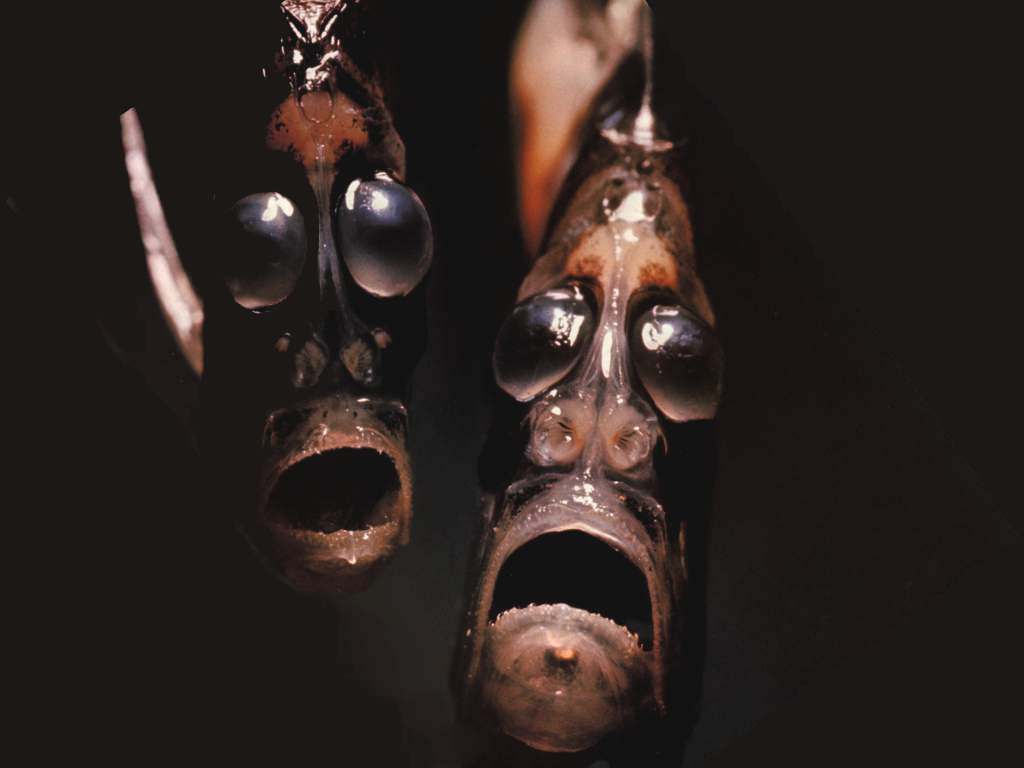
This silvery little fish belonging to the family of Sternoptychidae, whose face looks like it’s seemingly frozen in a silent scream, resides in most of the world’s oceans at depths of up to 4,950 feet. Their huge, tube shaped eyes allow them to catch the very little light that manages to reach even the deepest waters of their range. That way, they can see prey and watch out for predators. They also have a special defense mechanism that allows them to hide when nearer the surface. Special bioluminescent photophores, or light producing organs, will mimic the light of the surface waters to create the illusion of the fish’s disappearance. This is called counter-illumination. As one of the main food sources for other creatures in the deep, it’s a handy trick to avoid being eaten.

Stoplight Loosejaw
The stoplight loosejaws are a small group of dragonfishes in the genus Malacosteus found below the depth of 1,640 feet. They too have light producing photophores, which is where they get their name. The largest one emits red light while the smaller one emits green. Red wavelengths from sunlight don’t reach that far down, so the color red is essentially invisible to most creatures, which is a reason why many of them have red bodies. The stoplight loosejaws, however, are a few of the only ones that can actually emit their own red light and detect those wavelengths. This enables them to use those photophores as floodlights to spot prey. The “loosejaw” part of their name refers to the minimal attachment of the lower jaw to the upper portion of the skull. They have no floor to the lower jaw at all and it is only connected by small hinges. This reduces water resistance so they can snap their jaws shut more quickly when they find something edible.

Deep Sea Anglerfish
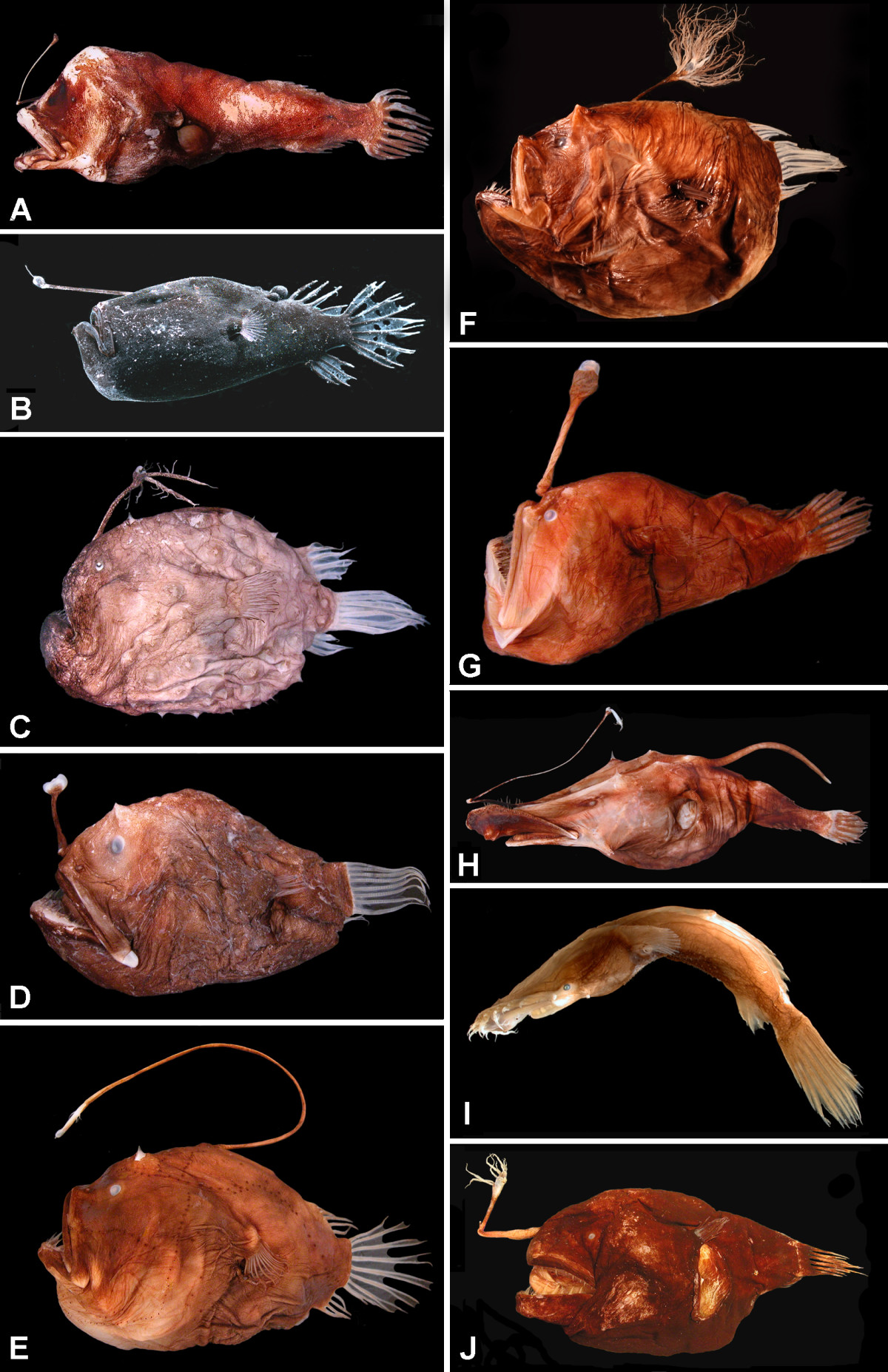
Deep sea anglerfish is a term for many fish in the family Ceratiidae. This is possibly one of the better known deep water fish because of its fearsome appearance. They all share the trait of using a lure to attract prey to them since they aren’t the fastest swimmers in the ocean. This tactic also conserves the precious energy that is hard to come by, as there is little food down where they live. All they have to do is wait and then pounce. Some have light producing bacteria in their lures that makes them even more attractive to potential meals. That’s cool and all, but the weirdest thing about these species is their sexual dimorphism (morphological differences between sexes). The fish we are all familiar with are only the females. The male is actually only a few millimeters long and permanently fuses to the female’s body as a parasite when the two meet. His only purpose is to provide genetic material to the female. As breeding opportunities are so rare down there, this is a clever, albeit creepy, evolutionary adaptation. Once the female finds a mate, she’ll never be lonely again.

(A) Centrophryne spinulosa, (B) Cryptopsaras couesii, (C) Himantolophus appelii, (D) Diceratias trilobus, (E) Bufoceratias wedli, (F) Bufoceratias shaoi, (G) Melanocetus eustales, (H) Lasiognathus amphirhamphus, (I) Thaumatichthys binghami, and (J) Chaenophryne quasiramifera.

Sleep tight!

References:
1. Cronin, Thomas W. “Camouflage via Emitted Light – Counterillumination.” Visual Ecology. N.p.: Princeton UP, 2014. 315-19. Print.

2. Kenaley, Christopher P. “Revision of the stoplight loosejaw genus Malacosteus (Teleostei: Stomiidae: Malacosteinae), with description of a new species from the temperate southern hemisphere and Indian Ocean.” Copeia 2007.4 (2007): 886-900.

3. Pietsch, Theodore W. “Dimorphism, parasitism, and sex revisited: modes of reproduction among deep-sea ceratioid anglerfishes (Teleostei: Lophiiformes).” Ichthyological Research 52.3 (2005): 207-236.

Photo Links:
1. https://creaturefacts.org/wp-content/uploads/2015/04/ed76a-hatchetfish_face_killah.jpg

2. https://commons.wikimedia.org/wiki/File:Malacosteus_niger_(black).jpg

3. https://commons.wikimedia.org/wiki/File:Representatives_of_ceratioid_families.jpg

Lammergeier – The Pretty Vulture

The Lammergeier (Gypaetus barbatus), also known as the bearded vulture, is an old world vulture living at very high altitudes across Europe, Africa, and Asia. They mostly live at or above the tree line of their given area, for instance, this would be about 16,000 feet above sea level in central Asia. They have even been recorded at altitudes up to 24,000 feet up in the great heights of Mount Everest! Those are some cold birds!

Credit: Richard Bartz

What is interesting about these vultures in particular is that 85-90 percent of their diet is bones, which they break by flying up high and dropping on the rocks below to get at the marrow inside. Because of this, they used to have the name Ossifrage, which means “bone breaker”. They will also occasionally take small live prey that is killed with the same technique used to break bones, or by beating it to death with their wings.

Lammergeiers are very large birds with wingspans up to a little over 9 feet and weighing an average of almost 14 pounds!

Here is a good comparison from an image of a boy in Kabul to show just how big these guys are.

As you can see from the pictures, these are exquisitely beautiful birds and it’s a shame that they are not often thought of when someone says “vulture”. The very word is associated with anything from death, uncleanliness, disgusting habits, to pure ugliness. So it’s nice we have the lammergeier around to disprove some of those assumptions.

References:
1. Tenenzapf, J. 2011. “Gypaetus barbatus” (On-line), Animal Diversity Web. Accessed April 18, 2015 at http://animaldiversity.org/accounts/Gypaetus_barbatus/

2. “Lammergeier (Gypaetus barbatus)” (On-line), Arkive. Accessed April 18, 2015 at http://www.arkive.org/lammergeier/gypaetus-barbatus/

Photo Links:
1.https://upload.wikimedia.org/wikipedia/commons/2/23/Bartgeier_Gypaetus_barbatus_front_Richard_Bartz.jpg

2. https://commons.wikimedia.org/wiki/File:Lammergeier_with_boy,_Kabul,_1973.JPG